
A significant shift in the cyber threat landscape has been identified in a new research report, distinguishing modern “Hacktivist Proxy Operations” from traditional digital protests or criminal schemes.
The findings suggest that hacktivism has evolved into a repeatable, model-driven instrument of statecraft, allowing nations to exert geopolitical pressure while maintaining plausible deniability.
The report details how these operations occupy a strategic “grey zone.” Unlike state-sponsored Advanced Persistent Threats (APTs) that seek intelligence or destruction, or financially motivated cybercrime gangs, Hacktivist Proxies function as ideologically aligned intermediaries.
They do not require formal command-and-control or direct funding. Instead, they act on shared narratives that align with state interests, offering a low-cost, high-deniability mechanism for coercion.
The Activation Chain: A Predictable Cycle
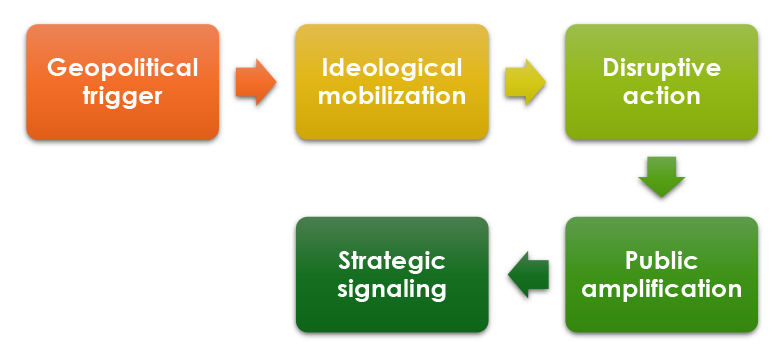
Research indicates that these operations are rarely random. Instead, they follow a consistent “activation chain” triggered by specific geopolitical events such as the announcement of economic sanctions, military aid packages, or diplomatic escalations.
Once a trigger event occurs, the model observes a rapid sequence:
- Narrative Mobilization: Online channels shift from routine chatter to calls for retaliation.
- Volunteer Coordination: Target lists are distributed, prioritizing high-visibility sectors like government portals, finance, and transportation.
- Disruptive Execution: Groups launch DDoS attacks, website defacements, and symbolic intrusions.
- Amplification: The psychological impact is maximized through social media claims of “infrastructure collapse,” often exaggerated beyond the actual technical damage.
- De-escalation: Operations taper off once the political point is scored, distinguishing them from persistent criminal campaigns.
While the technical methods primarily DDoS and defacement are often unsophisticated, their cumulative strategic impact is substantial.
Unlike traditional cyber operations, which seek technical dominance or long-term access, hacktivist proxy activity seeks visibility, disruption, and signalling.
The objective is not necessarily to cause lasting damage, but to demonstrate capability, impose friction, and influence perception at critical moments.
The report argues that security frameworks often misclassify these attacks as mere “nuisances.” This underestimation is dangerous.
For critical infrastructure operators and government bodies, repeated low-intensity disruptions exhaust defensive resources, erode public trust, and manipulate media perception during sensitive political moments.
The core advantage for beneficiary states is ambiguity. By relying on volunteers and standard tools, these operations complicate attribution.
States can frame the activity as independent “patriotic” resistance, delaying diplomatic response and reducing the risk of direct escalation.
Implications for Defense
The report concludes that existing cyber defense models are insufficient for countering proxy pressure.
As geopolitical competition intensifies, Hacktivist Proxy Operations are expected to become a normalized feature of modern statecraft, demanding that defenders prepare for waves of ideologically driven disruption that mirror the pulse of global politics.
Organizations are advised to move beyond purely technical attribution and integrate geopolitical intelligence into their threat modelling.
“Effective mitigation does not require attribution certainty, but rather improved resilience… and operational preparedness for episodic, narrative-driven disruption,” the report states.
Follow us on Google News, LinkedIn, and X to Get Instant Updates and Set GBH as a Preferred Source in Google.