
The cybercriminal underground has entered a new phase of industrialization. Hudson Rock researchers have uncovered ErrTraffic v2, a sophisticated ClickFix-as-a-Service platform that commoditizes deceptive social engineering at an unprecedented scale.
Priced at just $800 and advertised on top-tier Russian cybercrime forums, the tool represents a watershed moment in the democratization of cybercrime infrastructure.
ClickFix attacks exploit a critical gap in modern security architecture: the disconnect between browser defenses and operating system execution.
Rather than attempting silent downloads now effectively blocked by Chrome and Edge attackers present fake system errors that instruct users to open PowerShell or the Windows Run dialog and paste a “verification code.”
When executed, this code runs with full user privileges, often circumventing EDR solutions entirely. The genius lies in its simplicity: every action appears legitimate to security systems monitoring individual components.
ErrTraffic transforms this tactic into a turnkey operation. The tool’s dashboard reveals stunning efficacy metrics from active campaigns, with conversion rates approaching 60%.
Large-Scale ClickFix Exploitation
This extraordinary figure underscores the psychological manipulation at work. The platform achieves this through “fake glitch” rendering, injecting corrupted text and visual artifacts into compromised websites to simulate system failures.
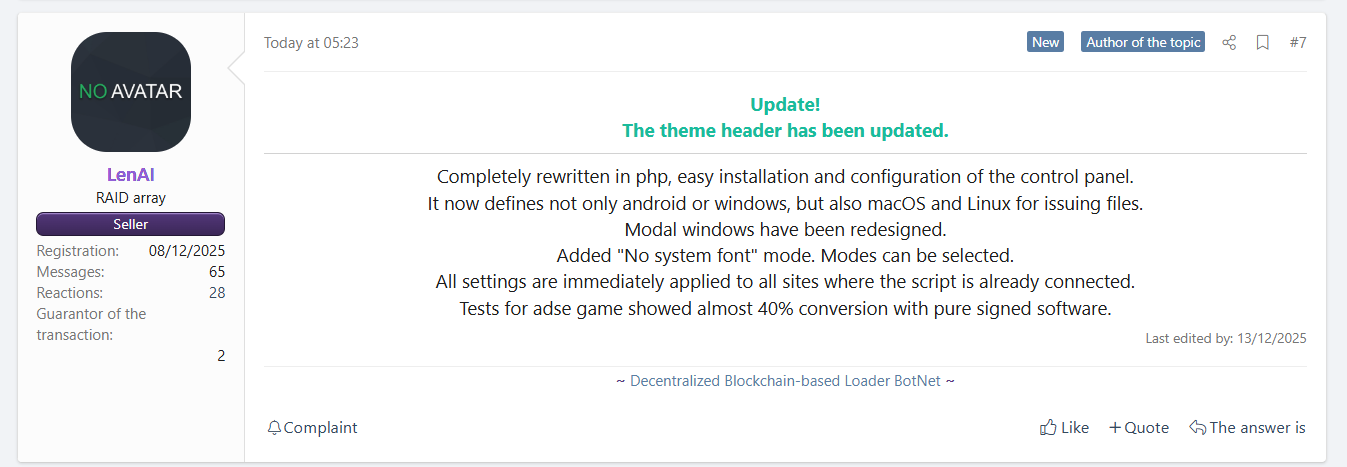
In early December 2025, Hudson Rock analysts observed a new promotional thread by a threat actor operating under the handle “LenAI” advertising “ErrTraffic v2.Panel”.
By destroying the visual appearance of a legitimate site, attackers create immediate panic, making the “Install Update” or “Download Font” button appear as the only solution.
The technical implementation is deceptively simple. Attackers inject a single line of HTML into compromised websites to load malicious JavaScript while executing server-side PHP logic that enables sophisticated filtering and OS fingerprinting.
The stealth is remarkable: legitimate users see no anomalies, while victims receive tailored payloads. Geofencing configurations hardcode exclusions for CIS countries a hallmark of Russian threat actors avoiding domestic law enforcement.
The platform’s actual danger emerges in its role as a traffic distribution system. ErrTraffic detects the victim’s operating system and delivers corresponding payloads: Windows systems receive infostealers like Lumma or Vidar; Android devices get banking trojans disguised as browser updates; macOS targets receive Atomic Stealer variants.
Psychologically, by visually “destroying” the website, the attacker creates an immediate problem. The “Install Update” or “Download Font” button presents the only lifeline.
But ErrTraffic’s impact extends beyond individual infections. The tool accelerates a vicious self-perpetuating cycle. Infostealers don’t just compromise user credentials they capture CMS administrative logins for websites that victims manage.
Speed and Consistency
These stolen credentials are weaponized to inject ErrTraffic scripts into newly compromised sites, which then distribute the lure to their visitors, restarting the cycle.
ErrTraffic is a “Traffic Distribution System” (TDS). It delivers whatever file the attacker uploads, tailored to the victim’s OS.
Stolen credentials eventually reach Initial Access Brokers, who sell them to ransomware groups and nation-state actors.
With conversion rates near 60%, ErrTraffic dramatically compresses this timeline from weeks to days. The tool’s affordability and ease of deployment mean novice cybercriminals can now operate at scales previously reserved for sophisticated threat actors.
For defenders, the implications are sobering. Traditional perimeter security proves insufficient against attacks that exploit human decision-making.
Organizations must shift focus toward credential intelligence and rapid compromise detection. Real-time monitoring of compromised identity feeds, coupled with behavioral analytics, represents the emerging defensive frontier.
The threat is no longer a technical vulnerability in code it’s a vulnerability in human judgment, systematically exploited at scale.
Follow us on Google News, LinkedIn, and X to Get Instant Updates and Set GBH as a Preferred Source in Google.