
The ShinyHunters hacking group claims it breached the systems of cybersecurity firm Resecurity and stole internal data, while Resecurity says the attackers only accessed a deliberately deployed honeypot containing fake information used to monitor their activity.
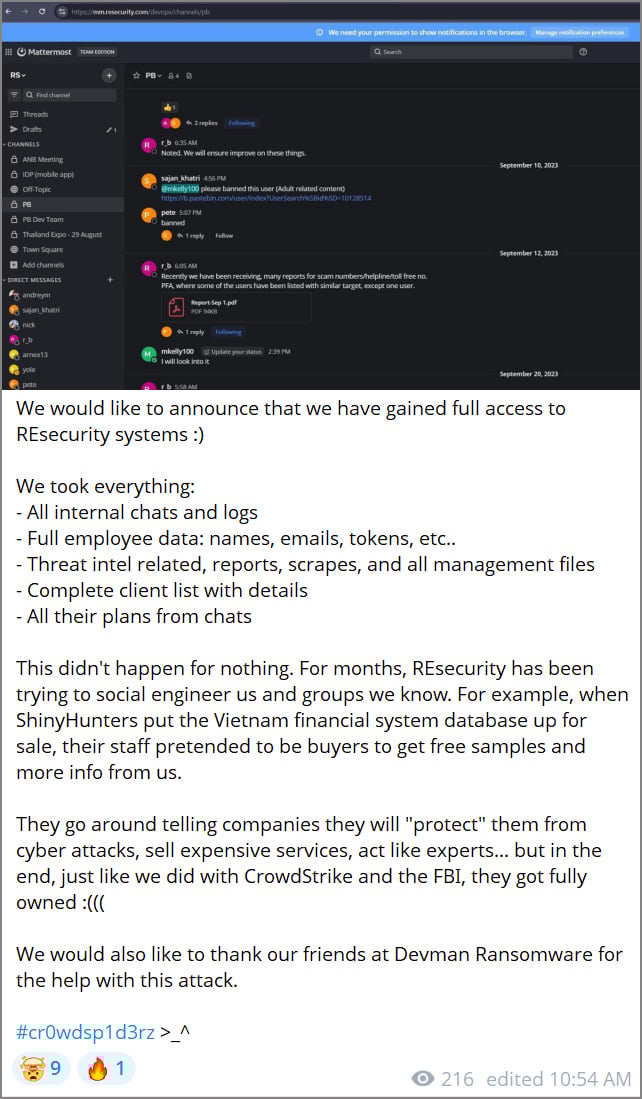
Today, the threat actors published screenshots on Telegram of the alleged breach, claiming to have stolen employee data, internal communications, threat intelligence reports, and client information.
“We would like to announce that we have gained full access to REsecurity systems,” the group wrote on Telegram, claiming to have stolen “all internal chats and logs”, “full employee data”, “threat intel related reports”, and a “complete client list with details.”

Source: BleepingComputer
As proof of their claims, the threat actors published screenshots they allege were stolen from Resecurity, including what appears to be a Mattermost collaboration instance showing communications between Resecurity employees and Pastebin personnel regarding malicious content hosted on the text-sharing platform.
The threat actors, who refer to themselves as “Scattered Lapsus$ Hunters” due to the alleged overlap between ShinyHunters, Lapsus$, and Scattered Spider threat actors, said the attack was retaliation for what they claim are ongoing attempts by Resecurity to socially engineer the group and learn more about its operations.
ShinyHunters says Resecurity employees pretended to be buyers during the sale of an alleged Vietnam financial system database, seeking free samples and additional information.
If you have any information regarding this incident or other undisclosed attacks, you can contact us confidentially via Signal at 646-961-3731 or at [email protected].
Resecurity says it was a honeypot
Resecurity disputes ShinyHunters’ claims, stating that the allegedly breached systems are not part of its legitimate production infrastructure but were instead a honeypot designed to attract and monitor the threat actors.
After BleepingComputer contacted Resecurity about the claim, they shared a report published on December 24, where the company says it first detected a threat actor probing their publicly exposed systems on November 21, 2025.
The company says its DFIR team identified reconnaissance indicators early and logged multiple IP addresses linked to the actor, including those originating from Egypt and Mullvad VPN services.
Resecurity said it responded by deploying a “honeypot” account within an isolated environment that allowed the threat actor to log in and interact with systems containing fake employee, customer, and payment data while it was being monitored by the researchers.
A honeypot is a deliberately exposed, monitored system or account designed to lure attackers, allowing them to be observed and analyzed and to gather intelligence on their activity without risking real data or infrastructure.
The company says it populated the honeypot with synthetic datasets designed to closely resemble real-world business data. These included more than 28,000 synthetic consumer records and over 190,000 synthetic payment transaction records, both generated from Stripe’s official API format.
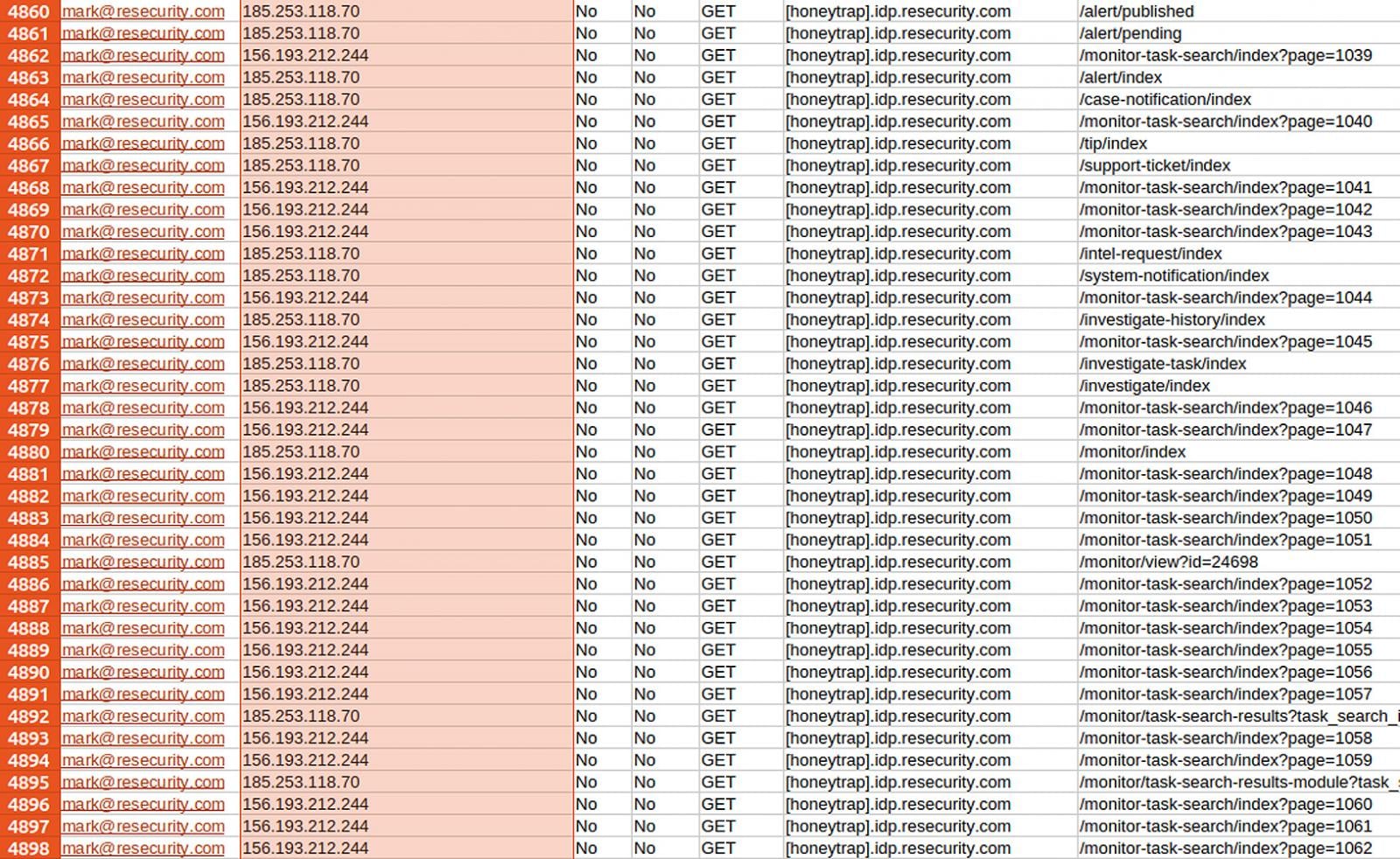
According to Resecurity, the threat actor began attempting to automate data exfiltration in December, generating more than 188,000 requests between December 12 and December 24 while using large numbers of residential proxy IP addresses.
During this activity, the company says it collected telemetry on the attacker’s tactics, techniques, and infrastructure.
Source: Resecurity
Resecurity claims that the attacker briefly exposed confirmed IP addresses on multiple occasions due to proxy connection failures, and that the intel was reported to law enforcement.
After observing additional activity, Resecurity says it added further fake datasets to study the attacker’s behavior, which led to additional OPSEC failures and helped narrow down the threat actor’s infrastructure.
The firm says it later identified servers used to automate the attack via residential proxies and shared the intelligence with law enforcement as well.
“Once the actor was located using available network intelligence and timestamps, a foreign law enforcement organization, a partner of Resecurity, issued a subpoena request regarding the threat actor,” says Resecurity.
At the time of writing, ShinyHunters has not provided any further evidence, only issuing a new Telegram post stating that more information will be coming soon.
“Nice damage control Resecurity. More information coming soon!,” posted the threat actors.

Whether you’re cleaning up old keys or setting guardrails for AI-generated code, this guide helps your team build securely from the start.
Get the cheat sheet and take the guesswork out of secrets management.