
Cybercriminals are exploiting complex routing scenarios and misconfigured email authentication protections to successfully spoof organizational domains, enabling them to deliver phishing emails that appear to originate from within targeted companies.
The attack vector, which has seen increased activity since May 2025, leverages weaknesses in Domain-based Message Authentication, Reporting, and Conformance (DMARC) configurations and third-party email connectors to bypass security controls.
According to Microsoft Threat Intelligence, threat actors have weaponized this technique to deliver a wide variety of phishing campaigns, predominantly utilizing the Tycoon2FA phishing-as-a-service (PhaaS) platform.
These attacks employ convincing lures themed around voicemail notifications, shared documents, human resources communications, and password reset requests, all designed to steal user credentials through adversary-in-the-middle (AiTM) capabilities that can circumvent multifactor authentication protections.
Attack Vector Mechanics
The spoofing attacks succeed when organizations configure complex routing scenarios where mail exchanger (MX) records do not point directly to Office 365, combined with inadequate enforcement of spoof protection mechanisms.
When DMARC policies are set to “none” rather than “reject,” and Sender Policy Framework (SPF) is configured for soft fail instead of hard fail, threat actors can send emails where the recipient’s address appears in both the “To” and “From” fields, creating the illusion of internal correspondence.
Microsoft clarified that this vulnerability does not stem from Direct Send functionality itself, but rather from improper configuration of authentication protocols and third-party connectors.
Organizations with MX records pointed directly to Office 365 are protected by native spoofing detection capabilities.
The phishing campaigns observed by Microsoft are opportunistic rather than targeted, affecting organizations across multiple industries and verticals.
In October 2025 alone, Microsoft Defender for Office 365 blocked more than 13 million malicious emails linked to Tycoon2FA. The platform provides threat actors with ready-made infrastructure, lures, and AiTM capabilities to circumvent authentication safeguards.
Beyond credential theft, Microsoft has identified financial scam campaigns exploiting this vector. These attacks craft elaborate email threads impersonating company executives, particularly CEOs, requesting urgent invoice payments.
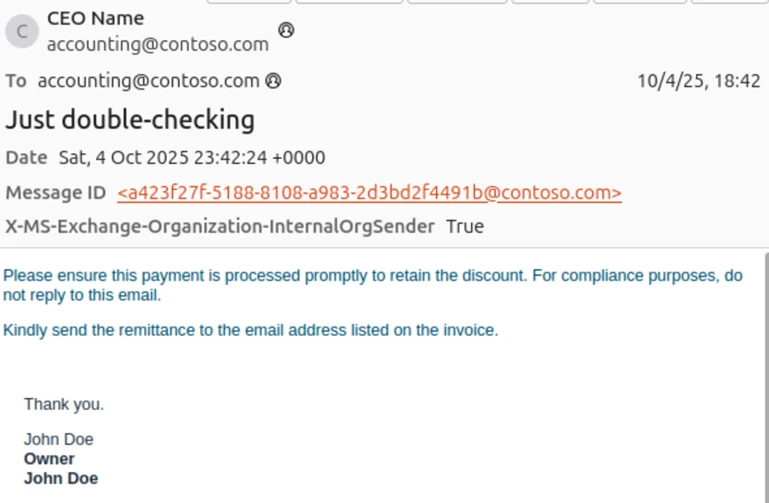
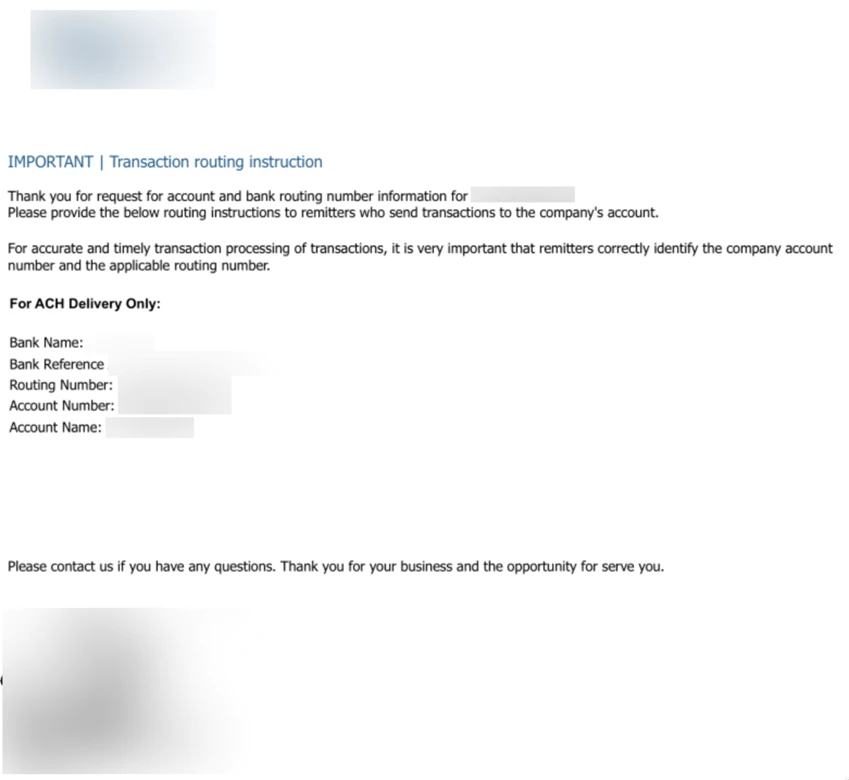
The scam messages include fake invoices, fraudulent W-9 forms, and counterfeit bank letters directing funds to accounts created using stolen personally identifiable information.
Email header analysis reveals critical indicators of these spoofed messages. Despite appearing internal, headers show external IP addresses as message origins, SPF failures, DMARC failures, and DKIM values set to “none.”
The X-MS-Exchange-Organization-InternalOrgSender flag may be set to “True” while X-MS-Exchange-Organization-MessageDirectionality indicates “Incoming” a combination signaling spoofed messages attempting to masquerade as internal communications.
Mitigations
Microsoft recommends organizations implement strict DMARC reject policies, configure SPF complex fail settings, and properly configure third-party connectors to prevent authentication calculation errors.
The third attachment is a fake “bank letter” ostensibly provided by an employee at the online bank used to set up the fraudulent account.
Additional protective measures include enabling Zero-hour auto purge (ZAP) in Defender for Office 365, implementing Safe Links for URL scanning, and adopting phishing-resistant authentication methods such as FIDO2 security keys and Windows Hello for Business.
Organizations should immediately reset credentials, revoke active sessions, review MFA devices, remove suspicious inbox rules, and verify MFA reconfiguration when compromise is detected.
The transition to passwordless authentication using phishing-resistant MFA methods for privileged roles significantly reduces account compromise risks.
As threat actors continue evolving their techniques, proper email authentication configuration remains essential for defending against domain spoofing attacks that exploit the trusted appearance of internal communications.
Follow us on Google News, LinkedIn, and X to Get Instant Updates and Set GBH as a Preferred Source in Google.