Meta has rolled out a new wave of anti‑scam protections across WhatsApp, Facebook, and Messenger, combining AI‑driven detection, stricter advertiser controls, and public awareness campaigns to tackle fast‑evolving online fraud at scale.
The new tools are designed to warn users at the moment they are about to interact with potentially malicious accounts, links or messages, rather than only reacting after scams are reported.
On WhatsApp, a new device‑linking warning will trigger when Meta’s systems detect suspicious patterns around attempts to connect your account to another device, such as unexpected QR codes scams or sharing of linking codes under false pretenses.
The alert highlights where the linking request is coming from and flags it as a possible scam, giving users a chance to stop before the attacker gains persistent access to their chats.
These warnings are meant to help users quickly decide whether to block, ignore or accept a request that could be the starting point for phishing, romance scams or investment fraud.
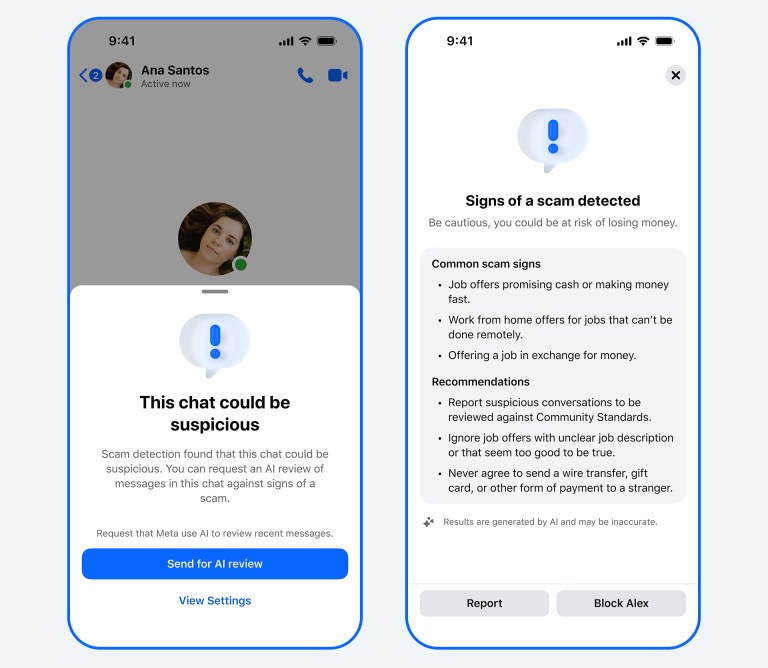
Messenger is also expanding its advanced scam detection feature to more countries, using AI to spot patterns associated with common scams such as fake job offers and “get rich quick” schemes.
According to the report, on facebook Meta is testing alerts for suspicious friend requests, especially from accounts with very few mutual connections, recent creation dates or apparent locations that do not match their profile details.
When a risky pattern is detected in a chat with a new contact, Messenger can prompt the user to share recent messages for an AI‑based scam review and then present tailored guidance if a scam is likely.
Recommended actions range from blocking and reporting the suspicious account to learning about how that particular scam operates, with the goal of stopping the conversation before money or data are lost.
AI against impersonation and deceptive
Beyond user‑visible alerts, Meta has deployed new AI models to tackle celebrity and brand impersonation, as well as deceptive domains that mimic legitimate services.
These systems look across text, images and context such as fake “fan” posts, misleading biographies or logo misuse to catch impostor pages and profiles that piggyback on public trust to push scams.
The same AI is used to detect links that route users to phishing pages and clone sites, allowing Meta to remove or down‑rank this content before it reaches a wide audience.
Meta says scammers’ techniques have grown more industrialized, with coordinated networks running large‑scale fraud operations across social media, messaging, crypto platforms and dating apps.
In response, the company is coupling AI detection with offline enforcement, working with law‑enforcement agencies and industry peers to identify and disrupt organized scam centers.
The latest disclosure underlines the size of the problem and Meta’s enforcement footprint. In 2025, the company removed more than 159 million scam ads globally, with 92 percent taken down before users reported them.
When a chat with a new contact may contain patterns of common scams like suspicious job offers, we warn you and ask if you’d like to share recent chat messages for an AI scam review.
In India alone, over 12.1 million ad creatives were banned in 2025 for violating policies on fraud, scams and deceptive practices, and more than 93 percent of those were removed proactively.
Meta also deactivated around 10.9 million accounts on Facebook and Instagram linked to criminal scam centers during the same period, reflecting a focus on infrastructure rather than just individual posts.
To reduce abuse in its ad ecosystem, Meta is expanding its advertiser verification program, with a target for verified advertisers to account for about 90 percent of its ad revenue by the end of 2026, up from roughly 70 percent today.
Verification will be prioritized for higher‑risk categories, while a small slice of revenue will continue to come from low‑risk small businesses that pose minimal fraud risk.
Meta says this process is intended to make it harder for bad actors to misrepresent who they are, adding another layer of friction for scam operations that rely heavily on paid ads.
Disrupting scam centers
Meta reports taking action not just online but also against organized scam centers, including a recent disruption campaign in Southeast Asia.
Working with global law‑enforcement partners, Meta investigators disabled more than 150,000 accounts tied to criminal networks behind schemes such as “digital arrest” scams where criminals impersonate officials over video calls to coerce payments and fraudulent cryptocurrency investments.
These actions are detailed in the company’s latest Adversarial Threat Report, which outlines how threat actors weaponize Meta platforms and how their infrastructure is taken down.
In India, Meta is complementing technical controls with large‑scale education efforts through its “Scam Se Bacho” campaign, now in its third edition.
Run in partnership with the Indian Cyber Crime Coordination Centre (I4C) and the Securities and Exchange Board of India (SEBI), the initiative features actor Neena Gupta and digital creators explaining common fraud types and how to report them.
The campaign focuses on helping users recognize fake job offers, high‑pressure investment pitches and other red flags, an approach Meta says is essential because technology alone cannot fully stop social engineering attacks.
Meta stresses that its fight against scammers is ongoing, with continued investment planned in AI, verification and cross‑border cooperation as attackers adapt.
For everyday users, the company’s message is clear: slow down when you see a warning, be skeptical of unsolicited requests and use built‑in reporting tools whenever something feels off.
Follow us on Google News, LinkedIn, and X to Get Instant Updates and Set GBH as a Preferred Source in Google.