A rising wave of cryptocurrency scams sweeping across Asia is blending two major fraud techniques malvertising and pig butchering to create a more deceptive and scalable attack model.
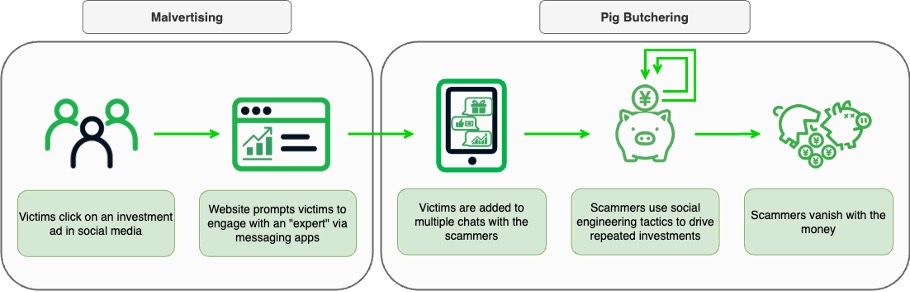
The scams begin with malvertising, where attackers run ads impersonating well‑known financial experts or promoting AI‑powered trading platforms.
These ads often seen on Facebook, Instagram, and other social media sites direct users to lure websites that mimic legitimate investment portals.
According to recent findings and media reports, this hybrid approach has led some individual victims in Japan to lose as much as ¥10 million (around US$63,000) in fake investment schemes.
Instead of asking users to invest directly, the sites invite them to join group chats on messaging apps such as LINE, KakaoTalk, or WhatsApp.
Cryptocurrency Scams
Once users engage, they are drawn into an active trading community. However, most of the “experts,” “assistants,” and fellow “students” within these chats are AI‑driven chatbots designed to build trust through constant interaction and fabricated success stories.
Victims are gradually encouraged to invest increasing amounts of money, culminating in demands for additional “fees” to withdraw imaginary profits.
Researchers discovered that many of these fraudulent operations are supported by industrial‑scale infrastructure.
Over 23,000 domains have been linked to related campaigns, many of which were created using registered domain generation algorithms (RDGAs).
These domains often imitate legitimate brands such as googlenames[.]top or youtubefind[.]top to appear trustworthy, while their short lifespan indicates they are rapidly cycled to evade detection.
The investigation revealed that the campaigns share common frameworks and backend structures, pointing to a shared enablement layer possibly a commercialized “fraud‑as‑a‑service” model.
Victims Face Losses of Up to ¥10 Million
This allows different operators to reuse the same infrastructure, templates, and chatbot systems across multiple languages and target regions.
A major shift in the future of online financial fraud one where technology amplifies the emotional manipulation at the heart of social engineering.
While Japan appears to be the main focus, similar scams have also been detected in South Korea, Singapore, and the United States, with localized content tailored for different audiences.
The fraudulent ads often exploit the likenesses of public figures such as Japanese investment YouTuber Takaaki Mitsuhashi, commentator Mori Fuyuko, and businessman Hiroto Kiritani, many of whom have publicly condemned the misuse of their identities.
![Ad on Meta targeting Japanese speakers, misusing the likeness of Hiroto Kiratani, and directing to ‘youtubefind[.]top’(Source : infoblox).](https://www.infoblox.com/blog/wp-content/uploads/banners-bots-and-butchers-figure5.jpeg)
What makes these hybrid scams particularly dangerous is their mix of scale and personalization. Malvertising casts a wide net, drawing in thousands of potential victims, while the AI‑powered pig‑butchering chats provide a convincing illusion of real human interaction.
Together, this combination allows fraudsters to operate large‑scale campaigns without relying heavily on human operators.
Experts warn that this evolution demonstrates how cybercriminals are leveraging automation and AI to modernize old scams, making them faster, cheaper, and easier to scale globally.
As this hybrid model continues to mature, it could signal a major shift in the future of online financial fraud one where technology amplifies the emotional manipulation at the heart of social engineering.
Follow us on Google News, LinkedIn, and X to Get Instant Updates and Set GBH as a Preferred Source in Google.