Mandiant has publicly released comprehensive rainbow tables designed to crack Net-NTLMv1 authentication hashes, addressing a critical security gap that has persisted for over two decades, despite the protocol being deprecated and widely recognized as fundamentally insecure.
The decision to release these tables underscores the urgency of migrating away from this outdated authentication mechanism, which remains prevalent in active environments due to organizational inertia rather than technical necessity.
The release represents a significant shift in how the security community addresses legacy protocol vulnerabilities.
Previously, cracking Net-NTLMv1 hashes required either uploading sensitive credentials to third-party services or investing in expensive specialized hardware to brute-force DES keys.
Mandiant’s dataset eliminates these barriers by enabling security professionals to recover passwords in under 12 hours using consumer-grade hardware costing less than $600 USD.
This democratization of vulnerability testing transforms Net-NTLMv1 from a theoretical risk into a demonstrable threat that organizations can no longer ignore.
The Attack Chain and Technical Vulnerability
Net-NTLMv1’s core weakness stems from its reliance on a known plaintext attack mechanism.
When an attacker obtains a Net-NTLMv1 hash without Extended Session Security enabled, typically through credential coercion tools such as Responder, PetitPotam, or DFSCoerce, they can mount cryptographic attacks that guarantee recovery of the underlying key material.
This key material directly corresponds to the password hash of the authenticating Active Directory object, whether a user account or computer machine account.

The attack’s severity escalates when perpetrators target highly privileged systems. A standard exploitation chain involves coercing a domain controller into authenticating, recovering its machine account hash, and leveraging that access to execute DCSync attacks that compromise every account in the Active Directory environment.
The attack represents a complete organizational compromise path that requires no sophisticated zero-day exploits or complex multi-stage payloads.
The vulnerability itself is not new. Cryptanalysis of the underlying protocol dates back to 1999, with widespread recognition of Net-NTLMv1’s insecurity occurring by 2012 following DEFCON presentations.
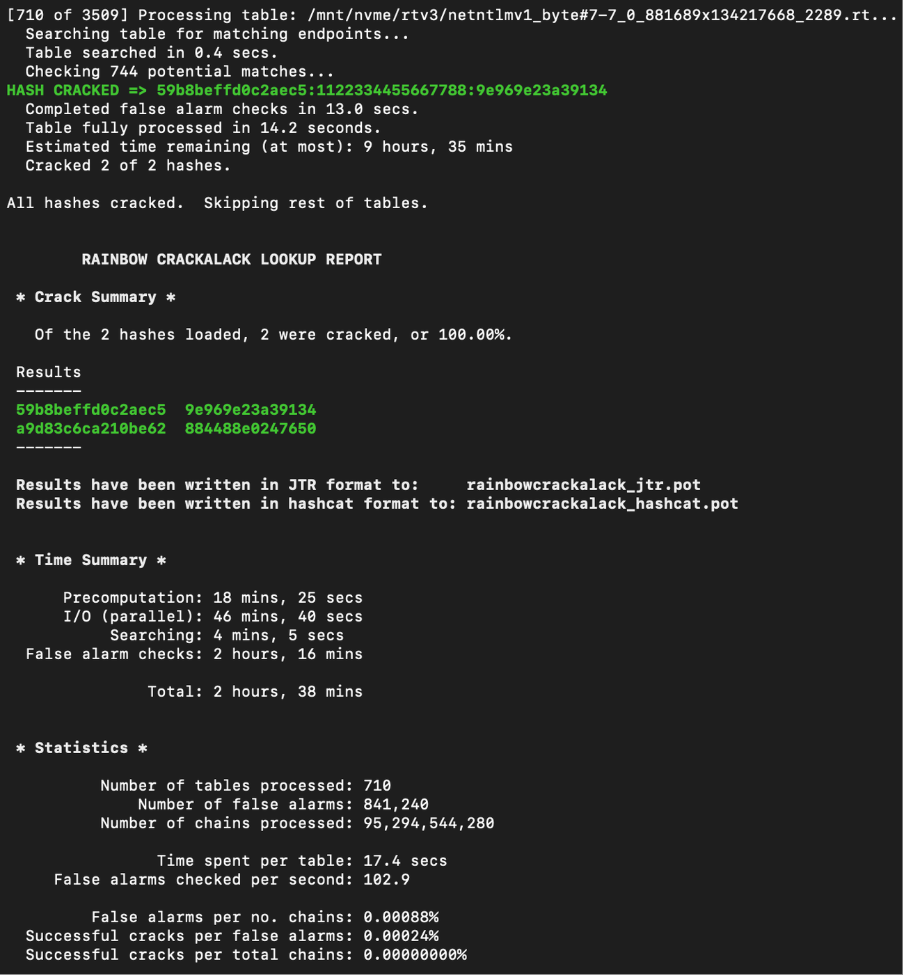
Rainbow table methodology was published in 2003 by Philippe Oechslin, building on time-memory trade-off concepts from 1980.
Hashcat added DES key-cracking support in August 2016, further lowering the barriers to exploitation, as reported by Google.
Mandiant’s contribution is not inventing new attacks but rather providing the computational infrastructure and pre-calculated tables that consume substantial storage and processing resources, making attacks trivial to execute.
The rainbow tables are available on Google Cloud’s Research Dataset portal. They can be downloaded using gsutil commands, with SHA-512 checksums for verification.
The password-cracking community has already created derivative-optimized versions and alternative hosting arrangements, ensuring widespread availability.
Security researchers can integrate these tables with multiple tools, including RainbowCrack-NG and GPU-accelerated implementations, making integration straightforward for most security operations teams.
Organizations must immediately turn off Net-NTLMv1 authentication by configuring both local computer policies and Group Policy to enforce NTLMv2 exclusively.
However, remediation requires additional layers of protection. Attackers with local administrative access can alter security policies after a successful compromise, necessitating continuous monitoring of Event ID 4624 authentication events that indicate Net-NTLMv1 usage.
This multi-layered approach policy enforcement, constant monitoring, and active alerting transforms Net-NTLMv1 from a direct attack vector into a detectable compromise indicator.
The release of these rainbow tables signals a decisive shift in how the security community handles deprecated protocols.
Follow us on Google News, LinkedIn, and X to Get Instant Updates ancd Set GBH as a Preferred Source in Google.