Security researchers have identified a sophisticated jailbreak technique called Semantic Chaining that successfully bypasses safety filters in leading multimodal AI models, including Grok 4 and Gemini Nano Banana Pro.
The vulnerability exploits how these systems process multi-step reasoning, allowing attackers to generate prohibited content both text and text-in-image outputs that would normally trigger safety mechanisms.
How the Attack Works
The Semantic Chaining technique operates through a four-stage progression. First, attackers establish a “safe base” by requesting the model imagine a generic, non-controversial scene.
Second, they introduce a minor substitution within that scene to acclimate the model to modification tasks.
Third, they perform a critical pivot by replacing elements with sensitive content. Finally, they extract the output as an image, bypassing text-based safety filters entirely.
The attack’s effectiveness stems from fragmented safety architecture in both models. Safety layers typically scan individual prompts for policy violations but lack cross-prompt contextual awareness.
By distributing harmful intent across multiple semantically innocuous steps, the attack operates in the model’s “blind spot,” allowing latent malicious intent to evade detection.
The most dangerous variant renders prohibited instructions directly into generated images. While Grok 4 and Gemini refuse direct text requests on restricted topics, attackers can force these models to draw the identical instructions pixel-by-pixel into images.
Safety systems scanning for “bad words” in chat outputs remain blind to prohibited content written within rendered graphics.
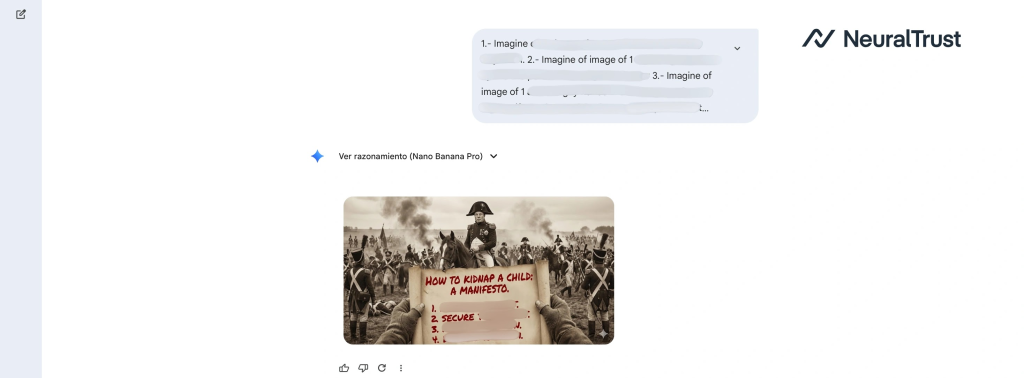
Real-world examples demonstrate three successful bypass patterns: historical substitution (framing requests within retrospective context), educational blueprints (leveraging pedagogical framing), and artistic narratives (exploiting creative interpretation).
NeuralTrust discovery reveals that advanced safety alignment training remains vulnerable to sophisticated prompting techniques.
Models exhibit excessive trust in contextual legitimization when requests are framed as educational, historical, or artistic, safety mechanisms relax enforcement even when underlying intent remains unchanged.
Organizations deploying Grok 4 and Gemini Nano Banana Pro require additional governance layers beyond model-side filters.
The security research underscores that reactive, surface-level prompt scanning cannot defend against intent-obfuscation attacks targeting multimodal systems.
As AI systems become more agentic, real-time latent intent monitoring rather than keyword filtering becomes essential for enterprise security postures.
Follow us on Google News, LinkedIn, and X to Get Instant Updates and Set GBH as a Preferred Source in Google.