Ukraine’s cyber defenders warn Russian hackers weaponized a Microsoft zero-day within 24 hours of public disclosure, targeting government agencies with malicious documents delivering Covenant framework backdoors.
Russian state-sponsored hacking group APT28 used a critical Microsoft Office zero-day vulnerability, tracked as CVE-2026-21509, in less than a day after the vendor publicly disclosed the flaw, launching targeted attacks against Ukrainian government agencies and European Union institutions.
Ukraine’s Computer Emergency Response Team detected exploitation attempts that began on January 27—just one day after Microsoft published details about CVE-2026-21509.
Microsoft had acknowledged active exploitation when it disclosed the flaw on January 26, but details pertaining to the threat actors were withheld and it is still unclear if it is the same or some other exploitation campaign that the vendor meant. However, the speed at which APT28 deployed customized attacks shows the narrow window defenders have to patch critical vulnerabilities.
Also read: APT28’s Recent Campaign Combined Steganography, Cloud C2 into a Modular Infection Chain
CERT-UA discovered a malicious DOC file titled “Consultation_Topics_Ukraine(Final).doc” containing the CVE-2026-21509 exploit on January 29. Metadata revealed attackers created the document on January 27 at 07:43 UTC. The file masqueraded as materials related to Committee of Permanent Representatives to the European Union consultations on Ukraine’s situation.
On the same day, attackers impersonated Ukraine’s Ukrhydrometeorological Center, distributing emails with an attached DOC file named “BULLETEN_H.doc” to more than 60 email addresses. Recipients primarily included Ukrainian central executive government agencies, representing a coordinated campaign against critical government infrastructure.

The attack chain begins when victims open malicious documents using Microsoft Office. The exploit establishes network connections to external resources using the WebDAV protocol—a file sharing protocol that extends HTTP to enable collaborative editing. The connection downloads a shortcut file containing program code designed to retrieve and execute additional malicious payloads.
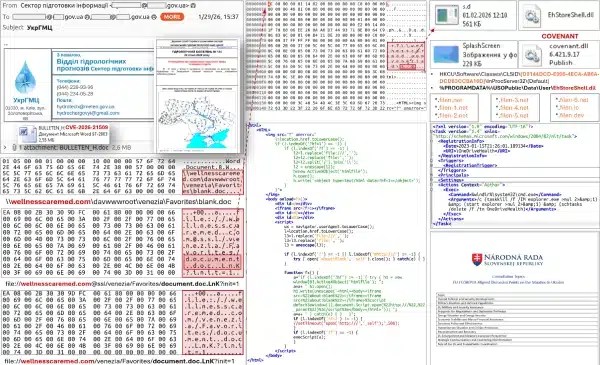
Successful execution creates a DLL file “EhStoreShell.dll” disguised as a legitimate “Enhanced Storage Shell Extension” library, along with an image file “SplashScreen.png” containing shellcode. Attackers implement COM hijacking by modifying Windows registry values for a specific CLSID identifier, a technique that allows malicious code to execute when legitimate Windows components load.
The malware creates a scheduled task named “OneDriveHealth” that executes periodically. When triggered, the task terminates and relaunches the Windows Explorer process. Because of the COM hijacking modification, Explorer automatically loads the malicious EhStoreShell.dll file, which then executes shellcode from the image file to deploy the Covenant framework on compromised systems.
Covenant is a post-exploitation framework similar to Cobalt Strike that provides attackers persistent command-and-control access. In this campaign, APT28 configured Covenant to use Filen.io, a legitimate cloud storage service, as command-and-control infrastructure. This technique, called living-off-the-land, makes malicious traffic appear legitimate and harder to detect.
CERT-UA discovered three additional malicious documents using similar exploits in late January 2026. Analysis of embedded URL structures and other technical indicators revealed these documents targeted organizations in EU countries. In one case, attackers registered a domain name on January 30, 2026—the same day they deployed it in attacks—demonstrating the operation’s speed and agility.
“It is obvious that in the near future, including due to the inertia of the process or impossibility of users updating the Microsoft Office suite and/or using recommended protection mechanisms, the number of cyberattacks using the described vulnerability will begin to increase,” CERT-UA warned in its advisory.
Microsoft released an emergency fix for CVE-2026-21509, but many organizations struggle to rapidly deploy patches across enterprise environments. The vulnerability affects multiple Microsoft Office products, creating a broad attack surface that threat actors will continue exploiting as long as unpatched systems remain accessible.
Read: Microsoft Releases Emergency Fix for Exploited Office Zero-Day
CERT-UA attributes the campaign to UAC-0001, the agency’s designation for APT28, also known as Fancy Bear or Forest Blizzard. The group operates on behalf of Russia’s GRU military intelligence agency and has conducted extensive operations targeting Ukraine since Russia’s 2022 invasion. APT28 previously exploited Microsoft vulnerabilities within hours of disclosure, demonstrating consistent capability to rapidly weaponize newly discovered flaws.
CERT-UA recommends organizations immediately implement mitigation measures outlined in Microsoft’s advisory, particularly Windows registry modifications that prevent exploitation. The agency specifically urges blocking or monitoring network connections to Filen cloud storage infrastructure, providing lists of domain names and IP addresses in its indicators of compromise section.