Here’s an overview of some of last week’s most interesting news, articles, interviews and videos:
Building cyber talent through competition, residency, and real-world immersion
In this Help Net Security interview, Chrisma Jackson, Director of Cybersecurity & Mission Computing Center and CISO at Sandia National Laboratories, reflects on where the cyber talent pipeline breaks down and what it takes to fix it. She discusses skill gaps, hiring and retention realities, and how cybersecurity careers are evolving beyond traditional paths.
WatchGuard Firebox firewalls under attack (CVE-2025-14733)
More than 115,000 internet-facing WatchGuard Firebox firewalls may be vulnerable to compromise via CVE-2025-14733, a remote code execution vulnerability actively targeted by attackers, Shadowserver’s latest scanning reveals.
Budding infosec pros and aspiring cyber crooks targeted with fake PoC exploits
Malware peddlers are targeting infosec enthusiasts, budding security professionals, and aspiring hackers with the Webrat malware, masquerading the threat as proof-of-concept (PoC) exploits for known vulnerabilities.
DIG AI: Uncensored darknet AI assistant at the service of criminals and terrorists
Resecurity has identified the emergence of uncensored darknet AI assistants, enabling threat actors to leverage advanced data processing capabilities for malicious purposes. One of these – DIG AI – was identified on September 29 of this year and has already gained popularity among cybercriminal and organized crime circles.
Five identity-driven shifts reshaping enterprise security in 2026
Delinea leaders predict that 2026 will force a new identity security playbook, one built for a world where AI systems, machine identities, and autonomous agents outnumber humans, operate at machine speed, and increasingly make decisions beyond direct human oversight.
Session tokens give attackers a shortcut around MFA
In this Help Net Security video, Simon Wijckmans, CEO at cside, discusses why session token theft is rising and why security teams miss it. He walks through how web applications rely on browsers to store session tokens after login often in cookies or browser storage. Any script running on the page can reach those tokens including ads analytics tools and marketing tags.
NIST issues guidance on securing smart speakers
Smart home devices, such as voice-activated digital assistants, are increasingly used in home health care, with risks involved. An attacker could change a prescription, steal medical data, or connect a patient to an impostor. To reduce cybersecurity risks tied to this use, NIST has released guidelines to help protect patients and providers.
Anubis: Open-source web AI firewall to protect from scraper bots
Anubis is an open-source tool designed to protect websites from automated scraping and abusive traffic by adding computational friction before a request is served. Maintained by TecharoHQ, the project targets a growing problem for site operators who want to keep content accessible to humans while limiting large scale automated collection.
Browser agents don’t always respect your privacy choices
Browser agents promise to handle online tasks without constant user input. They can shop, book reservations, and manage accounts by driving a web browser through an AI model. A new academic study warns that this convenience comes with privacy risks that security teams should not ignore.
Docker makes hardened images free open and transparent for everyone
Docker has made its open source Docker Hardened Images project available at no cost for every developer and organization. The catalog contains more than 1,000 container images built on open source distributions such as Debian and Alpine and is released under the Apache 2.0 license. The images are accessible through Docker Hub and related distribution points.
Formal proofs expose long standing cracks in DNSSEC
DNSSEC is meant to stop attackers from tampering with DNS answers. It signs records so resolvers can verify that data is authentic and unchanged. Many security teams assume that if DNSSEC validation passes, the answer can be trusted. New academic research suggests that assumption deserves closer scrutiny.
Weak enforcement keeps PCI DSS compliance low
Payment card breaches continue to surface across industries, even after years of investment in security standards. A new study links this pattern to enforcement, showing that PCI DSS compliance trails behind HIPAA, GDPR, and the EU’s NIS2 Directive.
Conjur: Open-source secrets management and application identity
Conjur is an open-source secrets management project designed for environments built around containers, automation, and dynamic infrastructure. It focuses on controlling access to credentials such as database passwords, API keys, and tokens that applications need at runtime. The project is maintained in the open and developed with input from a user and contributor base.
What if your face could say “don’t record me”? Researchers think it’s possible
Phones, smart glasses, and other camera-equipped devices capture scenes that include people who never agreed to be recorded. A newly published study examines what it would take for bystanders to signal their privacy choices directly to nearby cameras.
From AI to cyber risk, why IT leaders are anxious heading into 2026
Cybersecurity threats are shaping IT planning for 2026, with AI maturity and regulation emerging as another major source of disruption, according to a global survey from Veeam.
LLMs can assist with vulnerability scoring, but context still matters
Every new vulnerability disclosure adds another decision point for already stretched security teams. A recent study explores whether LLMs can take on part of that burden by scoring vulnerabilities at scale. While the results show promise in specific areas, consistent weaknesses continue to hold back fully automated scoring.
574 arrests, $3 million recovered in Africa-wide cybercrime crackdown
Law enforcement agencies across 19 countries arrested 574 suspects and recovered approximately $3 million during a major cybercrime operation spanning Africa.
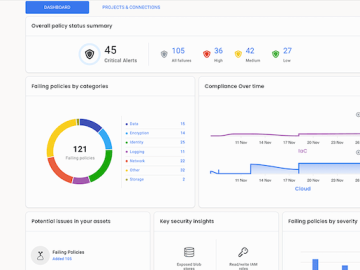
Cloud security is stuck in slow motion
Cloud environments are moving faster than the systems meant to protect them. A new Palo Alto Networks study shows security teams struggling to keep up with development cycles, growing cloud sprawl, and attacker tactics that now compress breaches into minutes instead of weeks.
AI code looks fine until the review starts
Software teams have spent the past year sorting through a rising volume of pull requests generated with help from AI coding tools. New research puts numbers behind what many reviewers have been seeing during work.
What happens to enterprise data when GenAI shows up everywhere
Generative AI is spreading across enterprise workflows, shaping how employees create, share, and move information between systems. Security teams are working to understand where data ends up, who can access it, and how its use reshapes security assumptions. This article explores how GenAI is increasing data exposure, creating new threats, and outpacing existing policies, controls, and testing.
Counterfeit defenses built on paper have blind spots
Counterfeit protection often leans on the idea that physical materials have quirks no attacker can copy. A new study challenges that comfort by showing how systems built on paper surface fingerprints can be disrupted or bypassed.
Elementary OS 8.1 rolls out with a stronger focus on system security
Elementary OS 8.1 is now available for download and shipping on select hardware from retailers such as Star Labs, Slimbook, and Laptop with Linux. The update arrives after more than a year of refinements based on community feedback and issue reports.
Governance maturity defines enterprise AI confidence
AI security has reached a point where enthusiasm alone no longer carries organizations forward. New Cloud Security Alliance research shows that governance has become the main factor separating teams that feel prepared from those that do not.
The next big IT security battle is all about privileged access
Leostream predicts changes in Identity and Access Management (IAM) and Privileged Access Management (PAM) in 2026 driven by new realities of cybersecurity, hybridization, AI, and more.
NASLOV
Cybersecurity jobs available right now: December 23, 2025
We’ve scoured the market to bring you a selection of roles that span various skill levels within the cybersecurity field. Check out this weekly selection of cybersecurity jobs available right now.