A hacker using the alias “Lovely” has leaked what they claim is the personal data of over 2.3 million Wired.com users, a prominent American magazine and website. The leak was posted on December 20, 2025, on a newly launched hacking forum called Breach Stars.
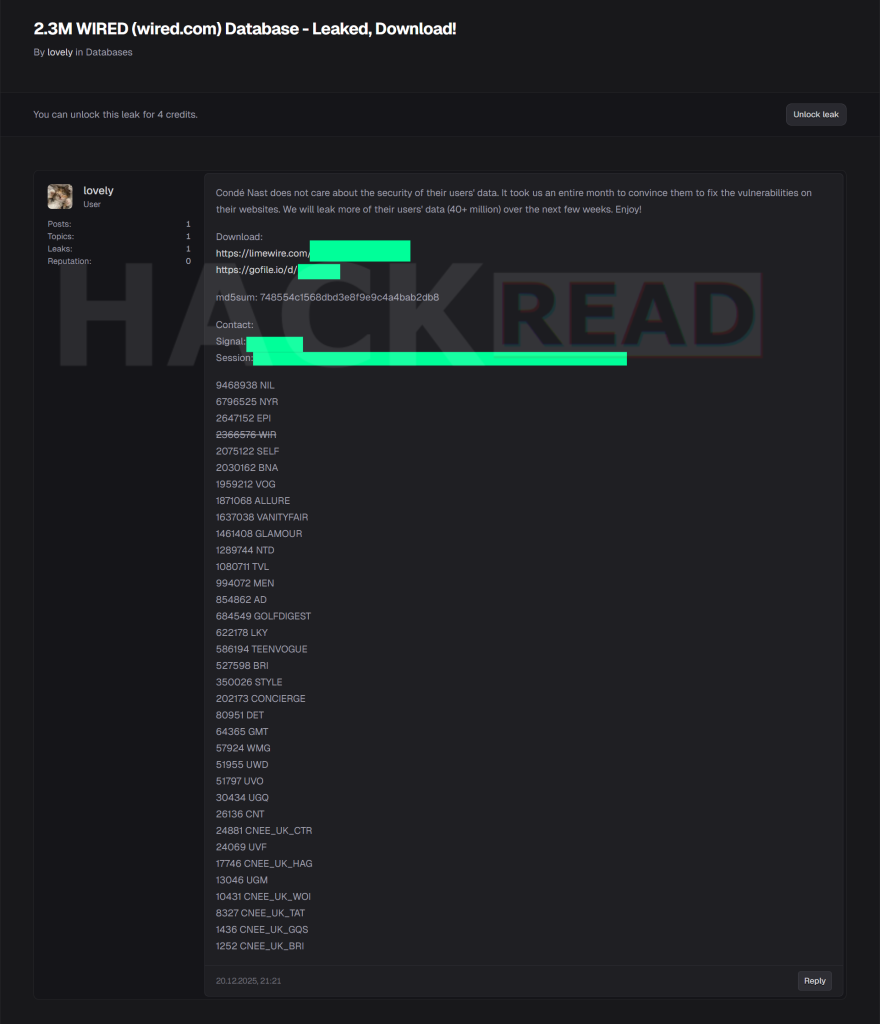
Along with a download link and file hash, the hacker issued a statement accusing Condé Nast, Wired’s parent company, of ignoring repeated warnings:
“Condé Nast does not care about the security of their users’ data. It took us an entire month to convince them to fix the vulnerabilities on their websites. We will leak more of their users’ data (40+ million) over the next few weeks. Enjoy!”
Wired Data
The leaked Wired.com data includes user records with fields such as full names, email addresses, user ID, display names, account creation and update timestamps, and in some cases, last session dates.
The good news is that there’s no password or payment information visible, but the presence of real email addresses and unique user IDs makes the leak sensitive and valid from a privacy standpoint.
Most records show empty values for personal fields like phone number, birthday, and address, indicating these weren’t required at sign-up. Some entries use system-generated Wired.com emails (e.g., (redacted)[email protected]), likely for automated or testing purposes, but others include personal emails such as Gmail, AOL, and regional ISP addresses, confirming the data includes real user accounts dating as far back as 2011.
Timestamps show a mix of older and more recent activity, with accounts created between 2011 and 2022, and some having last session data, while others do not. This suggests the data was pulled from a live or archived user database, not a static marketing list. Combined, this backs the hacker’s claim of direct access to Wired.com’s account system or a shared Condé Nast identity platform.
Sample of claimed record counts:
The post further includes a breakdown of records from other Condé Nast properties. Based on the list shared, the hacker claims to have accessed data covering more than 40 million accounts across dozens of brands, including:
- GQ (MEN) – 994,072
- Self (SELF) – 2,075,122
- Wired (WIR) – 2,366,576
- Vogue (VOG) – 1,959,212
- Allure (ALLURE) – 1,871,068
- Bon Appétit (BNA) – 2,030,162
- The New Yorker (NYR) – 6,796,525
- Glamour (GLAMOUR) – 1,461,408
- Architectural Digest (AD) -854,862
- Vanity Fair (VANITYFAIR) – 1,637,038
- Teen Vogue (TEENVOGUE) – 586,194
- Golf Digest (GOLFDIGEST) – 684,549
- Condé Nast Traveler (TVL) – 1,080,711
The list also includes an entry labelled “NIL,” which doesn’t match any known Condé Nast brand but contains 9,468,938 accounts. Additionally, smaller international or sub-brand segments like CNEE_UK_TAT (8327 accounts) and UVO (51,797 accounts) were also included, suggesting the breach may involve centralised account infrastructure.
As of publishing, Condé Nast has not issued any public statement confirming or denying the breach. Attempts to verify the validity of the data are ongoing, but some social media reports have confirmed that samples contain real user account details, including names, emails, and hashed credentials.
Hacker previously posed as a researcher
Separately, the hacker contacted other journalists, including Dissent Doe of DataBreaches.net, posing as a good-faith security researcher. The exchange fell apart after doubts emerged about their credibility, and they began threatening to leak the data publicly, casting further doubt on the rest of their claims.
The alleged vulnerability or method used to extract the data has not been publicly disclosed. Nevertheless, Hackread.com‘s analysis of the leaked 2.3 million records shows the data is legitimate.
However, Condé Nast remains the only authority that can confirm or deny the Wired.com leak and the broader breach. Until then, the data and all related claims from the hacker should be treated as unverified.
This is a developing story.