- Key Takeaways
- How These Tools Were Compared
- The 7 Best Vulnerability Scanning Tools for Lean Security Teams
- 1. Intruder
- 2. Aikido Security
- 3. Topscan.me
- 4. HostedScan
- 5. Pentest-Tools.com
- 6. Detectify
- 7. Tenable Nessus
- The Seven Side by Side
- Which One to Try First
- Who Didn’t Make the List
- How to Test a Shortlist
- Frequently Asked Questions
- What’s the Difference Between Vulnerability Scanning and Penetration Testing?
- Can a Vulnerability Scan Break Production?
- Is a Free Vulnerability Scanner Enough for a Small Team?
- Do Small Teams Need Internal Scanning as Well as External?

Verizon’s 2026 Data Breach Investigations Report (DBIR) puts vulnerability exploitation at the top of its initial access vectors, at 31%. Remediation went the other way. Only 26% of the flaws in CISA’s KEV (Known Exploited Vulnerabilities) catalog were fully remediated in 2025, down from 38% a year earlier, and the median time to full resolution grew from 32 days to 43.
Those figures cover organizations of every size. On a team where one or two people own security alongside infrastructure or product work, judge a scanner by how much it leaves you to do after it finishes.
Key Takeaways
- Intruder is the strongest all-round fit here: hosted and quick to start, with external, web app and cloud coverage in one account.
- Aikido Security and Topscan.me both put code and running systems in the same product. Aikido leans toward developers, Topscan toward the perimeter.
- HostedScan gives you established open-source engines without running them, and Pentest-Tools.com adds hands-on exploit validation.
- Detectify fits when most of the risk sits in web apps and subdomains, and Tenable Nessus when internal networks matter and someone can operate a scanner.
How These Tools Were Compared
“Lean” here means one to three people who own security alongside other work, often a DevOps lead, an IT manager or a CTO. Each tool was checked against four questions from that person’s point of view:
- Can one person start alone? Sign up, add a target and see results without an appliance or a sales call.
- Does it cover what faces the internet? External infrastructure and web applications, on a plan a small team would realistically buy.
- Does it help decide what to fix first? Some signal beyond a raw CVSS score, and enough detail to act on a finding without reproducing it from scratch.
- What happens after the fix? Rescans that confirm it, a status history, and a route into Jira, Slack or similar.
The facts below come from vendors’ public pricing pages and documentation as of early November 2026. None of this is a detection benchmark, so only a trial can show accuracy on your own stack. Prices depend on asset counts and change often, so they are left out.
The 7 Best Vulnerability Scanning Tools for Lean Security Teams
Where two tools came out level on those questions, the one that removes the need for another purchase (cloud, code or internal coverage) ranks higher.
1. Intruder
Intruder pitches its plans at “lean, time-strapped teams” and keeps setup short: you connect cloud accounts, add domains and IPs, and external scanning starts with no agents. The company says it runs more than 170,000 checks against internet-facing assets. Results are ordered by severity, exploitability and threat intelligence, and each one comes with remediation steps.
Paid plans add emerging threat scans, which check your estate when a new flaw goes public instead of waiting for the next scheduled run. They also add authenticated web app and API testing, daily cloud checks across AWS, Azure and Google Cloud, and integrations such as Jira and Slack.
Best for: Small teams that want external, web and cloud coverage with little setup and a clear fix order.
Trade-off: The free plan leaves out web apps and monitors only ports 80 and 443. Internal and agent-based scanning starts at the Pro plan, which goes through sales, and automated discovery of unknown assets sits in Enterprise.
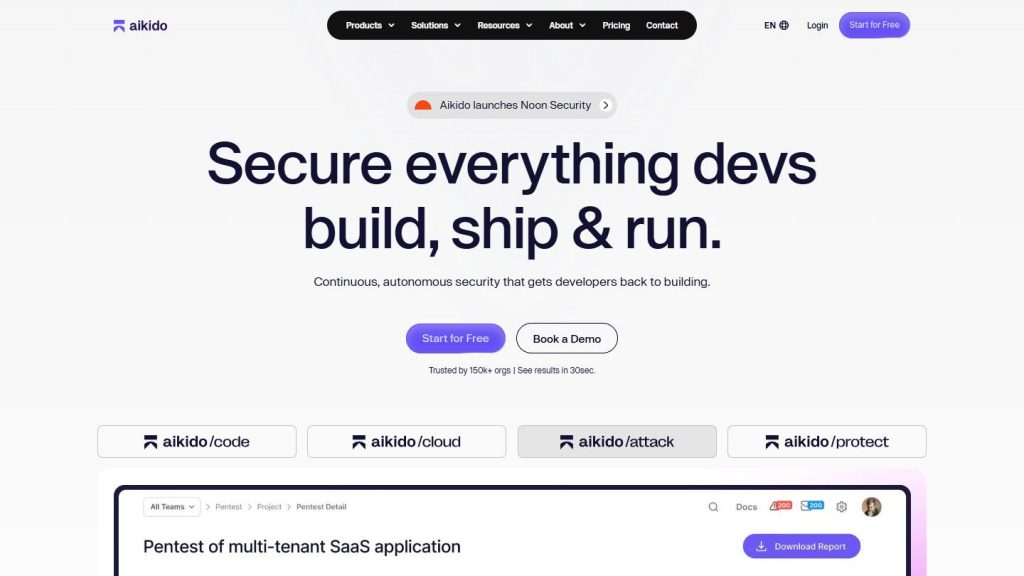
2. Aikido Security
Aikido starts from the repository. Dependency scanning, static analysis and secrets detection run alongside DAST, container scanning, infrastructure-as-code and cloud misconfiguration checks in one account. Triage is its main argument for a small team: reachability analysis filters out findings that can’t be reached, the triage learns custom context from your docs, and fixes can arrive as pull requests. The free Developer plan covers two users, ten repositories, one domain and one cloud account, with no card required.
Best for: Software teams where developers fix what the scanner finds and code is the first concern.
Trade-off: Attack surface monitoring starts at the Pro plan, and licensing counts the developers covered, which suits product teams better than IT groups with few coders. AutoTriage for code findings isn’t on the free plan.
3. Topscan.me
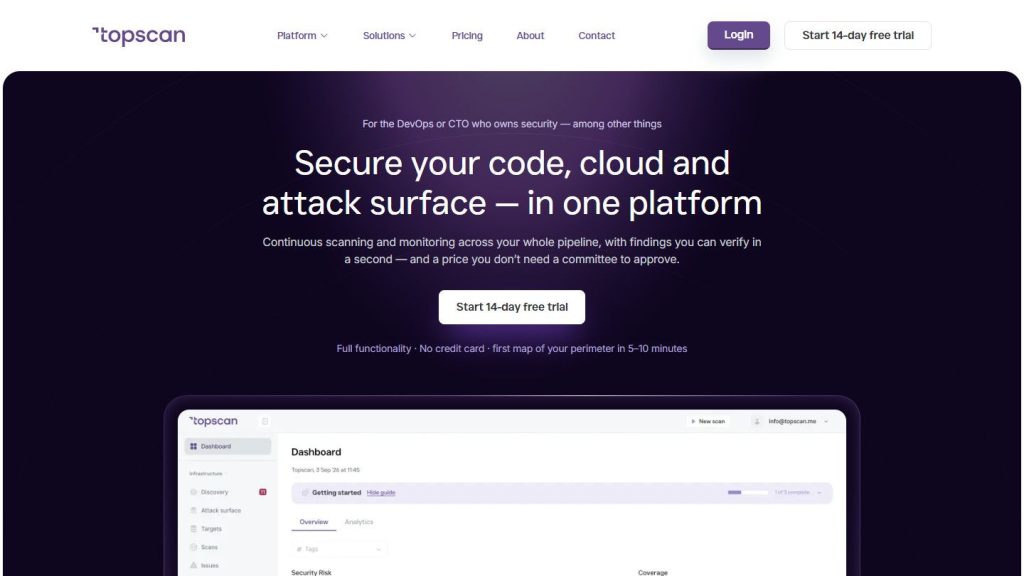
Topscan.me publishes what its engine runs at each stage and what it deliberately leaves alone, which helps when the person buying the scanner also answers for production. Its discovery stage works from public records (certificate transparency logs and DNS) plus a single normal HTTP request to each host, so it can map a domain before anything is approved. Port checks and active templates are limited to targets you have confirmed, at a capped request rate, and nothing destructive is sent.
A finding shows its evidence: the host, the status code, the response header or certificate date behind it, and when it was checked. The next scan closes a fixed issue with a date, and one that comes back is marked as reopened. Static code and dependency analysis for GitHub and GitLab repositories sits in the same workspace. Paid plans add web application scanning and, for perimeter findings, SLA timers that start at first detection. On the free plan, one host gets a weekly scan alongside one repository and one user, and a 14-day trial of a paid plan needs no card.
Best for: Teams where a DevOps lead or CTO owns security among other things and wants the perimeter and code under one subscription.
Trade-off: There is no internal network scanning, because hosts need a public address to be scanned. Cloud integration covers AWS only, and Slack, Microsoft Teams and Jira routing isn’t on the entry-level paid plan.
4. HostedScan
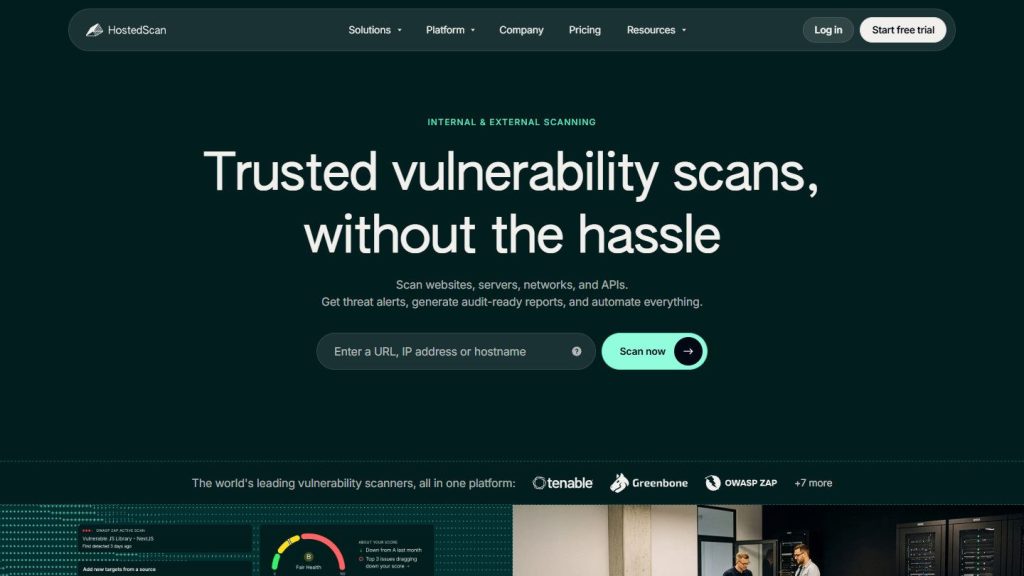
HostedScan runs established engines so you don’t have to: OpenVAS, OWASP ZAP, Nuclei, Nmap and SSLyze on every plan, with Nessus on the top tier. Triage rests on CVSS and EPSS scores and a report-card grade for each target, and you can accept, remediate and track each vulnerability through its lifecycle. Attack surface mapping and unlimited team members come with every plan, and the 14-day trial needs no card. The company counts more than 5,000 MSPs and IT teams as customers, and its reporting features lean that way.
Best for: IT teams and MSPs that trust open-source engines but lack the time to run them, and need reports for auditors or clients.
Trade-off: Authenticated scans, internal network scanning, APIs and webhooks start at the Premium plan. Source code isn’t covered.
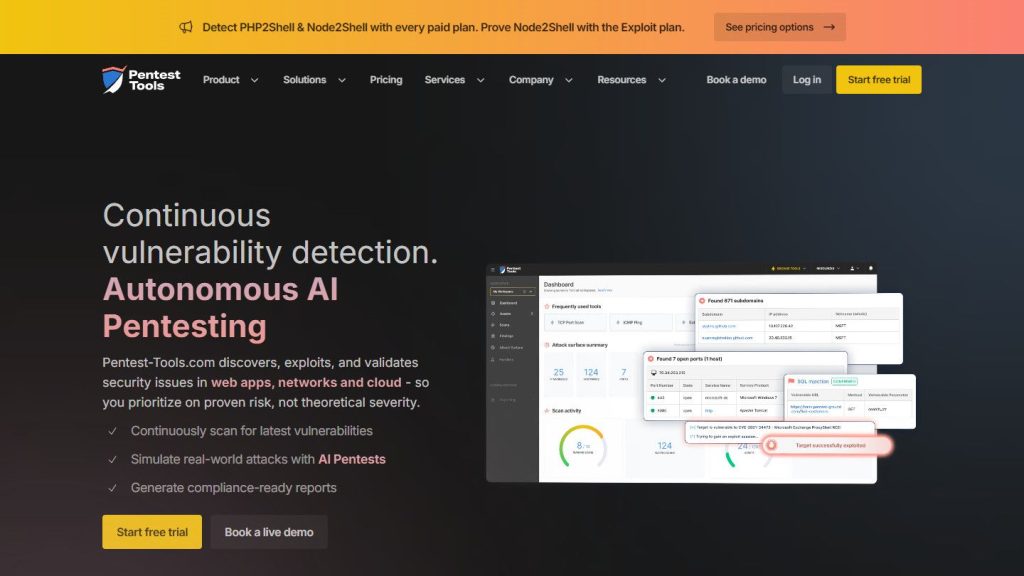
5. Pentest-Tools.com
Pentest-Tools.com comes from the pentesting side, and its catalog of 19 tools shows it: network, website, API and cloud scanners next to recon tools and exploiters. The findings view groups similar results and flags duplicates, and you can filter by target, severity, verification state or status.
Every paid plan includes unlimited rescans on network and web app assets, scan automation, unlimited team members, and integrations such as Jira and Microsoft Teams. The Exploit plan adds Sniper, an automatic CVE exploiter, which comes in handy when an engineer asks for proof that a finding is real.
Best for: A team with some offensive security experience that wants to validate findings itself.
Trade-off: The NetScan plan has only limited web and API scanning, so a team with its own web app needs AppScan or above. Internal network scanning is an optional add-on, and the range of tools takes some learning for anyone new to pentesting.
6. Detectify
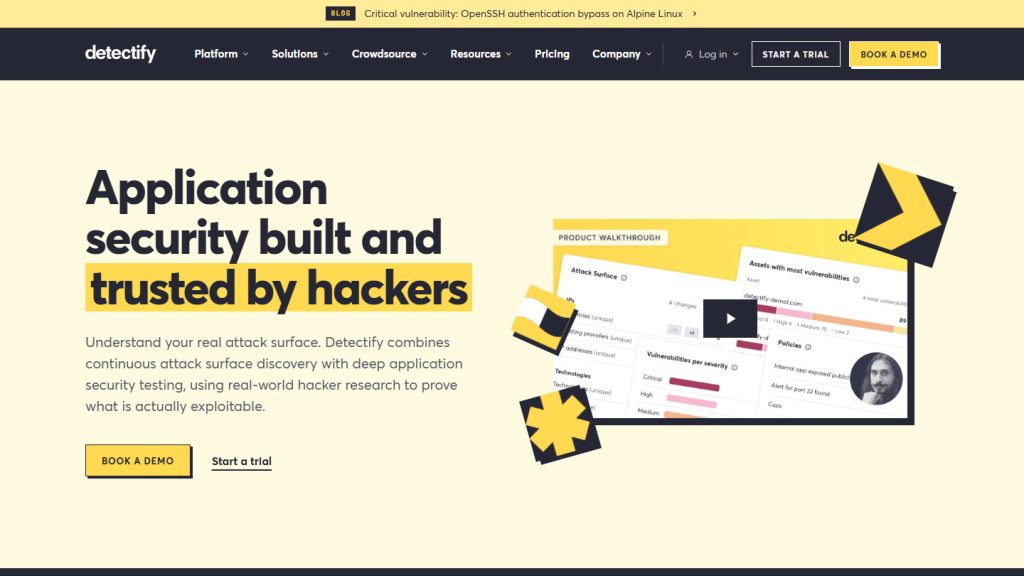
Detectify concentrates on what can be reached through domains and web apps. Surface Monitoring maps subdomains from certificate transparency logs, DNS enumeration and brute-forcing, finds open ports, and runs payload-based tests that the company says come from more than 1,765 modules built by ethical hackers in its Crowdsource community. Application Scanning goes deeper, crawling single-page apps and testing behind a recorded login.
For a small team, the payload is the useful part, because the finding shows what triggered it. Subdomain takeover checks run every eight hours, and those findings close automatically once the record is fixed. Those alerts can go to Slack, Jira or Microsoft Teams. The Starter tier has no platform fee and allows up to five users.
Best for: SaaS companies whose exposure is mainly web apps, APIs and a sprawl of subdomains.
Trade-off: Surface Monitoring and Application Scanning are billed per domain and per target, in addition to any platform fee. Internal scanning starts at the Professional tier, and tiers above Starter go through a demo or sales.
7. Tenable Nessus
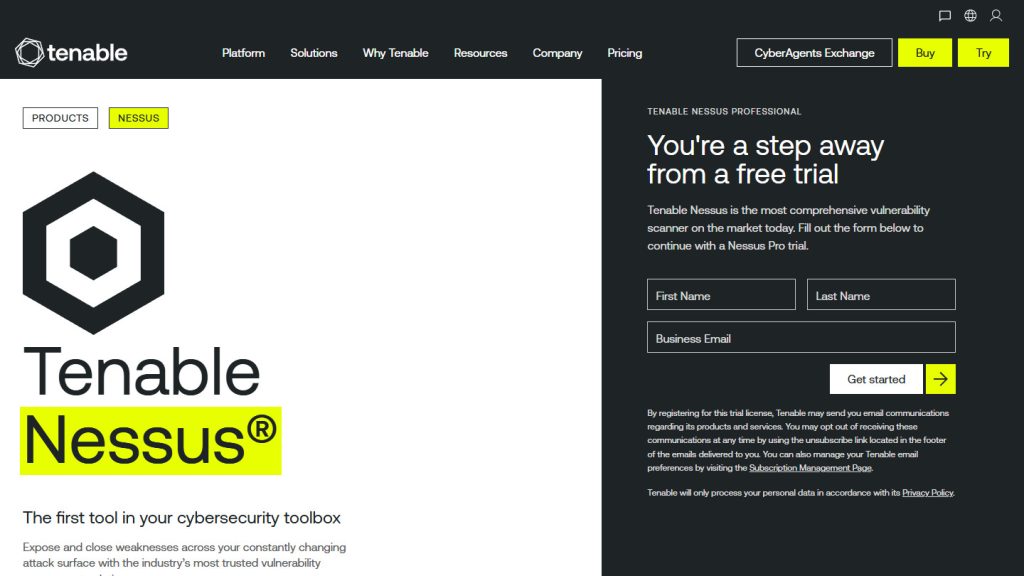
Nessus appears in almost every roundup of vulnerability scanning tools and is the only tool here you run yourself. It deploys on a wide range of platforms, including a Raspberry Pi, so getting it inside an internal network is straightforward. Prioritization draws on EPSS, CVSS and Tenable’s VPR, and more than 450 preconfigured templates include configuration audits against CIS benchmarks.
Nessus Professional doesn’t include web application or external attack surface scanning, which come with Nessus Expert. Check the license before planning around the free edition, too: Tenable now describes Nessus Essentials as a 30-day license limited to five IPs and strictly for non-commercial use.
Best for: Teams with internal networks to assess and someone comfortable operating a scanner.
Trade-off: You host it, schedule it and keep it updated. Results live in the scan and its reports, so assigning findings and tracking fixes usually moves to a ticket system. Tenable itself pitches Nessus Professional at consultants, pentesters and security professionals.
The Seven Side by Side
| Tool | Getting started | Internet-facing coverage | Triage signal | After the fix |
| Intruder | Free plan, 14-day trial | External on every plan, web apps and APIs on paid plans | Severity, exploitability, threat intelligence | Remediation scans; Jira and Slack on paid plans |
| Aikido Security | Free plan, no card | DAST on every plan, attack surface monitoring from Pro | Reachability, EPSS, AutoTriage | Automatic rescans; Jira sync from Basic |
| Topscan.me | Free plan and 14-day trial, no card | External on every plan, web apps on paid plans | Severity, exposure, evidence on each finding | Closed with a date, reopened if it returns; Jira and Slack above the entry plan |
| HostedScan | 14-day trial, no card | External and web apps on every plan | CVSS, EPSS, target grades | Accept and track each finding; Slack on every plan |
| Pentest-Tools.com | Free edition, free trial | Network on every paid plan, full web and API from AppScan | Grouped findings, verification state, exploit checks on the top plan | Unlimited rescans; Jira and Teams on every paid plan |
| Detectify | Starter tier, trial | Surface Monitoring and Application Scanning, billed per domain and target | Payload-based proof | Takeover findings close automatically; Slack, Jira, Teams |
| Tenable Nessus | Trial, self-hosted | Networks on every edition, web apps and external attack surface on Expert | EPSS, CVSS, Tenable VPR | Rescans you schedule; reports and exports |
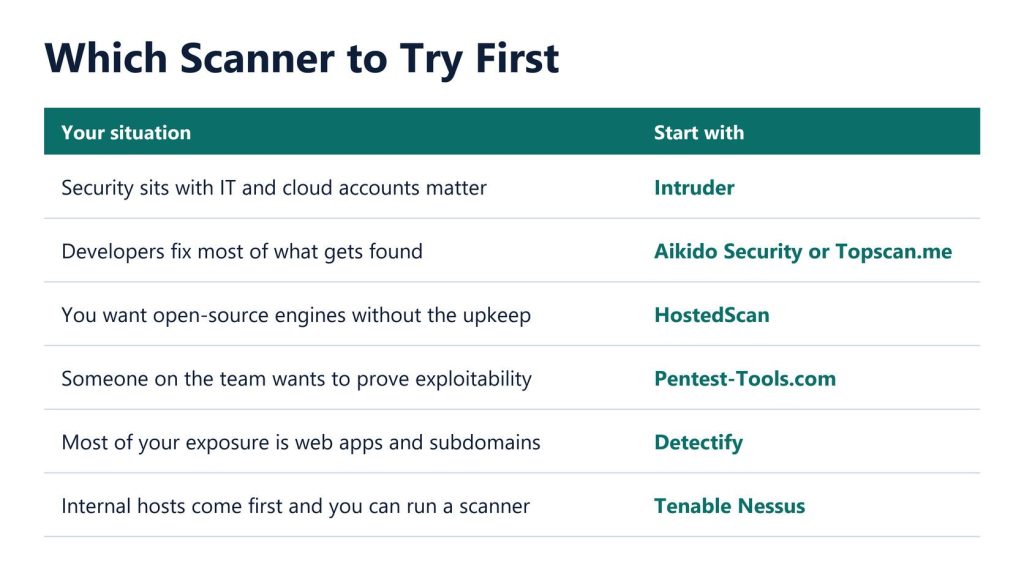
Which One to Try First
- Security sits with IT and cloud accounts matter: Intruder.
- Developers fix most of what gets found: Aikido Security or Topscan.me.
- You want open-source engines without the upkeep: HostedScan.
- Someone on the team wants to prove exploitability: Pentest-Tools.com.
- Most of your exposure is web apps and subdomains: Detectify.
- Internal hosts come first and you can run a scanner: Tenable Nessus
Who Didn’t Make the List
Qualys VMDR and Rapid7 head many roundups for good reason. Qualys spans virtual scanners, cloud agents, passive sensors and container sensors, and Rapid7 now sells InsightVM as part of Exposure Command. Both are built for programs with people dedicated to running them, which is usually more than one or two part-time owners need.
OpenVAS and Nuclei are free and capable, and HostedScan and Intruder both use them. On their own they are engines, so scheduling, hosting and triage are yours to build. They fit if someone has that time.
Web-only and cloud-only vulnerability scanning software misses the second question, though it can sit next to anything on this list.
How to Test a Shortlist
Run the trial on assets you are authorized to test, ideally a staging host with a few known problems such as an outdated package, a weak TLS setting or an admin panel left open. Then check:
- Does the tool find what you planted, and how much unrelated noise arrives with it?
- Can a non-specialist understand a finding and verify it from the details in the report?
- When you fix something and then break it again, does the tool close it with a date and reopen the same finding, or does it create a new one?
- What does the license count? Intruder and HostedScan count targets, Pentest-Tools.com counts assets, Detectify counts domains and app targets, Aikido counts developers, and Topscan counts hosts, web apps and repositories. Count your own estate in that unit before comparing plans.
Frequently Asked Questions
What’s the Difference Between Vulnerability Scanning and Penetration Testing?
A vulnerability scan is an automated, repeatable check for known weaknesses and misconfigurations. A penetration test goes after what automation misses, such as business logic flaws and chains of smaller issues. Scanning keeps watch between tests.
Can a Vulnerability Scan Break Production?
It can. Active checks send real traffic, and fragile services may react badly to it. Before you scan production, look at what the tool sends, whether it limits request rates, and whether you can point it at staging first.
Is a Free Vulnerability Scanner Enough for a Small Team?
It can be a start if you only have a few hosts. The free plans from Intruder, Aikido and Topscan.me all cap targets and hold back features, and web app testing is the one to check first if you run your own application.
Do Small Teams Need Internal Scanning as Well as External?
Start with what faces the internet, since anyone can reach it. Internal scanning matters more once a framework requires it, and PCI DSS is one that does, so check your own compliance scope before ruling it out.