Welcome to this week’s edition of the Threat Source newsletter.
To the surprise of absolutely no one who has seen my face, I’m one of the younger employees at Talos. As my industry veteran colleagues were buying the first iPods, navigating the switch from dial-up to broadband, saying goodbye to floppy disks, and making Myspace accounts, I was playing with my Password Journal and Friend Chips. It’s a funny contrast, but I still experienced the beginning of the “always-on” era.
Ah, those were the days. One of my most vivid tech memories is begging my dad to play games on his Handspring Visor — a classic personal digital assistant (PDA) launched in late 1999 by Handspring, a company formed by the original creators of the PalmPilot. Handspring stopped producing the Visor line in 2002 and it eventually became obsolete, mostly because its desktop sync feature couldn't keep up with modern OS updates. Despite the tech debt, I spent hours playing Asteroid, Centipede, and Hardball (aka Breakout) on that thing. My dad, meanwhile, mostly used the Memo function to store his passwords… which he still does today. (Yeah, I’m still working on getting him to see the wonders of 1Password.)

You might be wondering what made me reminisce on childhood toys. A few weeks back, my fiancée and I drove a few hours to visit my family. Even if we get in at 9:00 p.m., it’s tradition for us to stay up late eating pizza and talking about random stuff.
We got on the topic of phones because my parents still have a landline, and I mentioned that walkie talkies were my first introduction to having my own personal device. My dad dug some old ones out, set them on the table, and put them on scan while we chatted.
At some point, the conversation petered out just when the walkie talkie captured a channel. Radio static, and then a kid’s voice broke our silence: “Your butt crack is out.”
My dad got an impish grin and brought the talkie up to his mouth. My mom pleaded, “No. Honey, no. Don’t.” The rest of us were already wheezing and crying.
He pressed the talk button and, in his best crotchety old man voice, bellowed, “Hey, you kids. Get off my lawn!”
Imagine being those poor kids. It’s a funny story, but if you don’t want people like my dad intercepting your comms, maybe stick to encrypted channels.
The one big thing
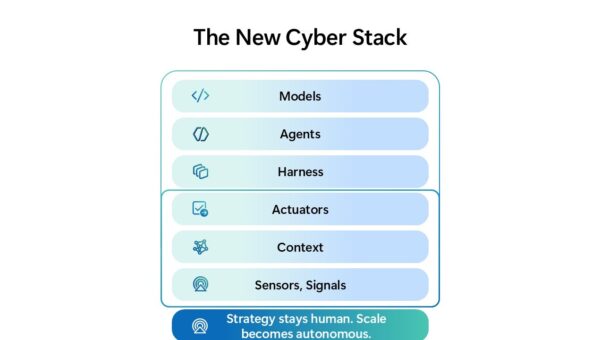
Talos' Yuri Kramarz published a blog highlighting how AI-driven vulnerability discovery has completely outpaced human patching capabilities. With frontier AI models autonomously discovering and exploiting zero-days in minutes, the traditional vulnerability lifecycle has completely collapsed. To survive this hyper-accelerated threat environment, organizations must abandon patch-reliant strategies and embrace a three-stage fallback model built on foundational security principles.
Why do I care?
Speed is the new, terrifying multiplier in the traditional risk equation. When an AI can uncover a decades-old zero-day and write an exploit for it in minutes, relying solely on vulnerability management is a losing game. Defenders must accept that some exploitation will inevitably slip through the cracks. The true measure of security is no longer just prevention, but how well your environment can absorb, detect, and survive the initial blow.
So now what?
Stop treating security basics like optional compliance checkboxes. Enforce multi-factor authentication (MFA) everywhere, harden devices using CIS benchmarks, and implement strict network segmentation to limit an attacker's blast radius. Since hardened systems only slow attackers down, deploy behavioral-based EDR, NDR, and XDR to catch the post-exploitation activity that signatures miss. Finally, validate these controls through penetration testing and purple team exercises so your incident response playbooks become muscle memory, not just wishful thinking. Read the full blog for more.
Top security headlines of the week
CISA gives U.S. federal agencies three days to fix a VPN bug under attack by Qilin
Check Point Software said the bug affects several of its remote access tools, firewalls, and VPNs, which act as digital gatekeepers to protect company networks from unauthorized access. (TechCrunch)
Anthropic launches Claude Fable 5: Mythos-class AI with cybersecurity guardrails
The AI giant says this marks the first time a model of this capability class has been deemed safe enough for widespread public and developer access. (SecurityWeek)
Microsoft fixes two high-severity zero-days disclosed by researcher
The vulnerability is a local privilege escalation, meaning it can be chained to a separate vulnerability to give users or processes with low-level privileges the ability to defeat OS protections and gain full SYSTEM rights needed to install malware. (Ars Technica)
WhatsApp catches spyware firm NSO defying no-hacking court order
According to WhatsApp, the spyware maker has violated the permanent injunction. The messaging app reported on Monday that it had recently learned of a social engineering attack that attempted to trick users into clicking on malicious links. (SecurityWeek)
High-severity vulnerability in Linux caused by a single faulty character
The presence of a single mis-issued exclamation point in code implementing nf_tables introduced a use-after-free, a class of vulnerability that corrupts memory by placing malicious code at memory addresses that haven’t been properly freed of their previous contents. (Ars Technica)
Can’t get enough Talos?
Hypotheses, telemetry, and human judgment: Inside Cisco Talos Threat Hunting
Learn how Cisco Talos Threat Hunting uses hypothesis-driven methods and multi-domain telemetry correlation to find stealthy threats operating below automated detection thresholds.
Winning the cyber marathon with Tony Giandomenico
In the high-speed world of cybersecurity, the difference between a breach and a breakthrough often comes down to endurance. Tony Giandomenico, Senior Director of Product Management with Cisco Talos, joins me to discuss Talos Threat Hunting, the challenges of leading major product launches, and the grueling discipline of Ironman triathlons.
When synthetic logs don’t lie: Generating coherent attack stories for better detection
Are your detection rules failing because your test data lacks the nuance of a real-world network? In this episode of Talos Takes, Amy sits down with David Bianco to discuss why traditional synthetic data often falls short and how his new open-source project, EvidenceForge, is changing the game.
Upcoming events where you can find Talos
- Cisco Connect Germany (June 16) Frankfurt, Germany
- Black Hat USA (Aug. 1 – 6) Las Vegas, NV
- DEF CON 34 (Aug. 6 – 9) Las Vegas, NV
Most prevalent malware files from Talos telemetry over the past week
SHA256: 9f1f11a708d393e0a4109ae189bc64f1f3e312653dcf317a2bd406f18ffcc507
MD5: 2915b3f8b703eb744fc54c81f4a9c67f
Talos Rep: https://talosintelligence.com/talos_file_reputation?s=9f1f11a708d393e0a4109ae189bc64f1f3e312653dcf317a2bd406f18ffcc507
Example Filename: VID001.exe
Detection Name: Win.Worm.Coinminer::1201**
SHA256: 96fa6a7714670823c83099ea01d24d6d3ae8fef027f01a4ddac14f123b1c9974
MD5: aac3165ece2959f39ff98334618d10d9
Talos Rep: https://talosintelligence.com/talos_file_reputation?s=96fa6a7714670823c83099ea01d24d6d3ae8fef027f01a4ddac14f123b1c9974
Example Filename: d4aa3e7010220ad1b458fac17039c274_63_Exe.exe
Detection Name: W32.Injector:Gen.21ie.1201
SHA256: a31f222fc283227f5e7988d1ad9c0aecd66d58bb7b4d8518ae23e110308dbf91
MD5: 7bdbd180c081fa63ca94f9c22c457376
Talos Rep: https://talosintelligence.com/talos_file_reputation?s=a31f222fc283227f5e7988d1ad9c0aecd66d58bb7b4d8518ae23e110308dbf91
Example Filename: d4aa3e7010220ad1b458fac17039c274_62_Exe.exe
Detection Name: Win.Dropper.Miner::95.sbx.tg**
SHA256: 9896a6fcb9bb5ac1ec5297b4a65be3f647589adf7c37b45f3f7466decd6a4a7f
MD5: 38de5b216c33833af710e88f7f64fc98
Talos Rep: https://talosintelligence.com/talos_file_reputation?s=9896a6fcb9bb5ac1ec5297b4a65be3f647589adf7c37b45f3f7466decd6a4a7f
Example Filename: sample.exe
Detection Name: Win.Tool.Procpatcher::1201