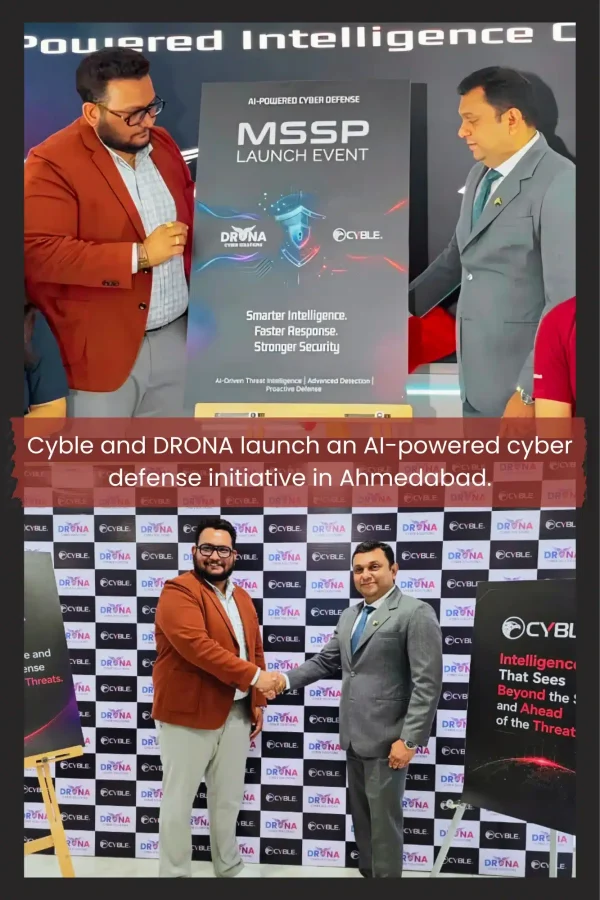
AHMEDABAD (INDIA) — Cyble, the global AI-native cybersecurity company, and DRONA Cyber Solutions, the Ahmedabad-headquartered security operations firm, have launched an AI-powered cyber defense initiative in Ahmedabad, combining threat intelligence, investigation and endpoint enforcement through a joint managed security model.
The AI-Powered Intelligence for Cyber Defense initiative was formally launched Tuesday at DRONA Cyber Solutions’ Command and Control Centre, where the companies presented a live technical demonstration showing how an intrusion attempt can be detected, investigated and contained.
The launch comes as India faces a growing cybercrime burden. India recorded 28.15 lakh cybercrime cases in 2025, a 24 percent increase over the previous year, with reported losses reaching ₹22,495 crore. The government’s 1930 cybercrime helpline received 32.4 million calls during the year. Of the complaints filed, 55,484 were converted into FIRs.
While large enterprises and banks increasingly have dedicated security teams, budgets and incident response capabilities, many manufacturers, hospital chains, schools and mid-sized businesses, particularly across Tier-2 and Tier-3 cities, continue to operate without comparable security resources.
AI-Powered Cyber Defense Takes Center Stage in Ahmedabad
Rather than focusing solely on formal remarks, Cyble and DRONA used the launch to demonstrate the initiative through a live technical exercise for the media.
The demonstration began with material recovered from infostealer logs circulating on a criminal forum, alongside a lookalike domain registered to impersonate a target organisation. Analysts traced the infrastructure, established a pattern of previous activity associated with the same actor and demonstrated the detection and containment of an intrusion attempt on an endpoint.

The final containment action was authorised by a human analyst rather than executed automatically. The demonstration brought together multiple capabilities. Cyble Vision provided the initial detection through continuous monitoring of criminal marketplaces and leak sites.
Cyble Hawk supported the investigative process and attribution, while Cyble Titan handled endpoint enforcement, using hardware-level integrity checks to support its assessment. DRONA analysts remained at the centre of the process, making decisions that the system was deliberately not permitted to make independently.

Mandar Patil, Executive Vice President at Cyble, said the initiative was designed to address a longstanding gap between threat detection and action for mid-sized businesses.
“India is not short of alerts. It is short of what happens next,” Patil said. “We have spent a long time in this industry watching mid-sized businesses get told about a threat and then having nowhere to take that information. What we are launching today is not another alert. It is a complete chain — intelligence before the attack, investigation that would stand up to scrutiny, enforcement on the device, and a person accountable for the decision at the end of it.”
Dhruv Pandit, Co-Founder and CEO of DRONA Cyber Solutions, said the initiative reflects the operational needs of organisations that require immediate action rather than another security dashboard.
“A factory owner calling us at two in the morning does not want to be shown a dashboard,” Pandit said. “He wants to know what happened, he wants it contained, and he wants someone to take responsibility for what happens next.”
From the Command Centre to Gujarat University, India
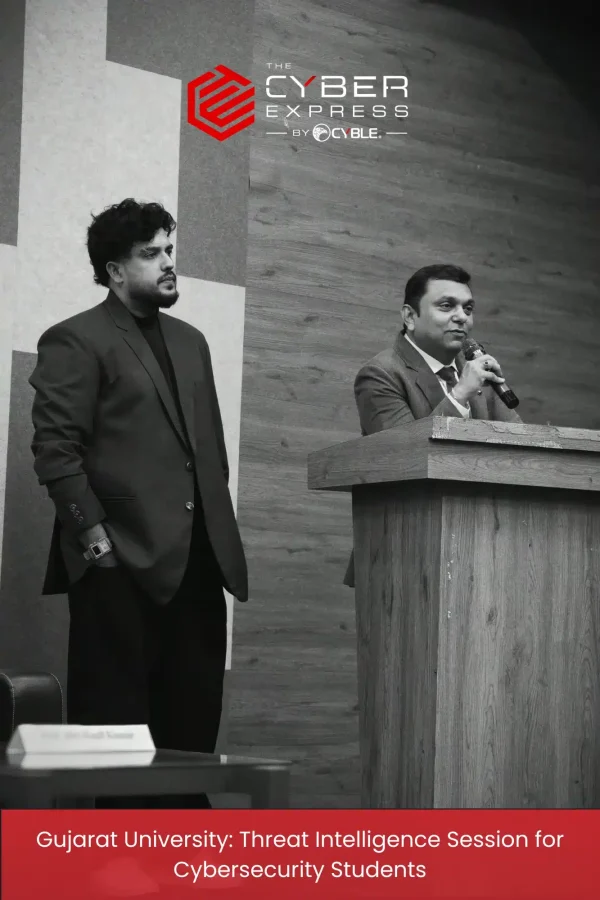
The Gujarat University engagement was not simply a conventional cybersecurity student session. It was a technical session titled “Kavach: Beyond the Surface — Threat Intelligence from the Dark Web Depths,” hosted by the Department of Biochemistry and Forensic Science, Gujarat University, in collaboration with Cyble.
The session brought together speakers from Cyble and DRONA Cyber Solutions to examine areas including dark web threat intelligence, government and PSU cybersecurity projects, digital forensics and incident response (DFIR), and the transition of threat intelligence from information to action.
Mandar Patil and Augustin Kurian of Cyble discussed the dark web threat intelligence landscape. Prathmesh Pawar spoke about government and PSU cybersecurity projects, while Brijesh Kapadiya addressed DFIR and Vijay Mali discussed moving threat intelligence from information to action. The keynote was delivered by Prof. Dr. Kapil Kumar, Coordinator, Department of Biochemistry and Forensic Science.
The session highlighted several practical aspects of cybersecurity work. The dark web was discussed not simply as a hidden part of the internet, but as a structured ecosystem requiring dedicated intelligence-gathering and threat-discovery methods. DFIR was presented as an area where speed and process are as important as technical expertise.
Another key takeaway was the importance of turning threat intelligence into action. Rather than treating intelligence as information alone, the session focused on how it can inform practical security decisions.
Patil told students that the cybersecurity industry faces a shortage of professionals with practical skills in analysing and validating threat intelligence.
“The gap this industry has is not a gap of ideas. It is a gap of people who know how to do the work,” Patil said. “What separates a useful analyst from an alert-reader is the ability to ask whether a piece of intelligence is actually true before you act on it.”
Augustin Kurian, Editor-in-Chief of The Cyber Express, told students that threat intelligence and journalism share an emphasis on verification.
Every story we publish about a breach, a ransomware group or a leaked database starts exactly where today’s demonstration started — with intelligence somebody had to go and find, verify, and decide was worth acting on,” Kurian said. The instinct we have tried to build at The Cyber Express is the same instinct a good analyst needs: do not report, and do not act on, what you have not verified.
The programme also involved technical and production teams supporting the session. Screen, sound and lighting were handled by the technical team under the guidance and supervision of Aditya More, while Misha Alagiya, Kavya Maharaja, Pathak Ami, Omi and Nandini supported stage management and photography.
A Broader Cybersecurity Collaboration
Both companies emphasised that the partnership is not intended to represent a single solution to India’s cybersecurity deficit. Cyble and DRONA maintain relationships with other partners, service providers and government bodies.
“India’s exposure is too large for any single partnership to take credit for solving,” Patil said.
“What matters is whether more of these collaborations exist a year from now, and whether the businesses we are talking about today — the ones without a security team — actually have somewhere to turn.”
The AI-Powered Intelligence for Cyber Defense initiative will be delivered through DRONA’s Ahmedabad command centre, with the companies indicating an intent to extend the service model to customers elsewhere in India over time.
The initiative also folds into DRONA’s existing Cyber Yodha Campaign, a national programme aimed at building 50 integrated cybersecurity command centre labs and training more than 100,000 defenders.