
The reported Crunchyroll data breach has sparked a new debate across the anime streaming community, not just because of the scale of the alleged exposure, but because of how it may have occurred. Early claims suggest that the alleged Crunchyroll cyberattack may have compromised sensitive user data through a third-party access point, a common weak link in modern digital ecosystems.
While the full picture remains unclear, what has emerged so far paints a technically plausible and troubling scenario involving outsourced systems, internal tooling, and the kind of data aggregation that makes streaming platforms attractive targets.
What Allegedly Happened in the Crunchyroll Cyberattack
According to reports first shared by International Cyber Digest on X, the data breach at Crunchyroll may date back to March 12, 2026. A threat actor reportedly gained access to internal systems and exfiltrated nearly 100GB of data. This dataset allegedly includes email addresses, IP addresses, passwords, and even credit card-related information tied to subscribers of the anime streaming platform.
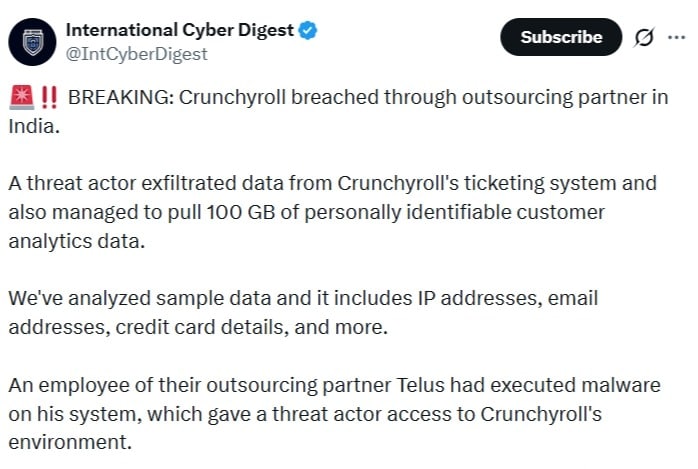
The breach is said to have originated through an outsourcing partner. Specifically, claims indicate that an employee at this third-party vendor executed malware on their system, unintentionally granting the attacker access to Crunchyroll’s internal environment. From there, the attacker reportedly accessed a ticketing system and extracted large volumes of customer analytics and support data.
Another detail emphasizes that this dataset includes IP address data alongside other identifiers, reinforcing concerns about user profiling and tracking.
Confirmed Facts vs. Unverified Claims
Despite this spread of information about the Crunchyroll data breach, the company itself has not confirmed the full extent of these allegations. At the time of writing, Crunchyroll has only acknowledged awareness of the situation and stated that “we are aware of recent claims and are currently working closely with leading cybersecurity experts to investigate the matter.”

This lack of confirmation is significant. In early-stage incidents like this Crunchyroll cyberattack, attacker claims often outpace verified findings. Screenshots, data samples, and timelines may appear convincing, but they do not always reflect the actual scope or impact.
The Cyber Express has also reached out to the anime streaming company to learn more about this alleged Crunchyroll cyberattack. However, at the time of writing this, no official statement or response has been received.
What Data May Have Been Exposed
If the claims hold true, the data breach at Crunchyroll involves a mix of personally identifiable information (PII) and support-related records. This includes:
- Email addresses
- IP addresses
- Passwords (particularly if shared in support tickets)
- Partial or full credit card details (in cases where users provided them manually)
Notably, reports indicate that most credit card information may be incomplete, often limited to the last four digits or expiration dates. However, a small subset of records could include full card numbers, depending on what users shared with customer support.
This nuance matters. Unlike structured payment systems, support tickets often contain unfiltered user input, which can inadvertently expose sensitive information in plain text.
Why the Third-Party Angle Matters
One of the most important aspects of this Crunchyroll cyberattack is the alleged involvement of a third-party vendor. Outsourcing is common in large-scale platforms, especially for customer support and ticketing operations. However, it introduces additional attack surfaces.
In this case, a single compromised endpoint, an employee system running malware, may have been enough to bypass perimeter defenses. This highlights a persistent issue in cybersecurity: organizations are only as secure as their least secure partner.
The reliance on third-party infrastructure also complicates incident responses. Determining responsibility, isolating affected systems, and validating data exposure becomes harder when multiple entities are involved.
Real-World Risks for Anime Streaming Users
Even if the Crunchyroll data breach turns out to be limited in scope, the type of data allegedly exposed carries real risks.
Email addresses and IP data alone can be leveraged for:
- Phishing campaigns targeting anime streaming users
- Credential stuffing attacks using reused passwords
- Behavioral profiling, when combined with older leaked datasets
If passwords were exposed in any form, the risk escalates further, especially for users who reuse credentials across services.
Credit card exposure, even partial, adds another layer of concern. While incomplete data is less immediately exploitable, it can still be used in social engineering or brute-force attempts in combination with other leaks.
Community Reaction Reflects Uncertainty
Online discussions reveal a mix of confusion and cautious concern. Some users question what “credit card details” actually means, whether full numbers were exposed or just fragments. Others point out that payments made through intermediaries like app stores are likely safer due to tokenization, which prevents merchants from directly storing card data.

There is also a broader sentiment that security practices across anime streaming platforms need to evolve. Several users stress the importance of two-factor authentication (2FA), with some arguing that it should be mandatory.
What Users and Security Teams Should Do Next
In situations like this Crunchyroll cyberattack, waiting for official confirmation is not a strategy. Users should act defensively:
- Change your Crunchyroll passwords immediately
- Avoid reusing passwords across services
- Monitor financial statements for unusual activity
- Be cautious of phishing emails posing as Crunchyroll communications
For organizations, the incident reinforces a familiar but often overlooked lesson: third-party risk management is not optional. Vendor access, endpoint security, and data handling policies must be treated as core components of the security architecture, not afterthoughts.



