Apple’s annual Worldwide Developers Conference (WWDC) is in full swing, with the tech giant announcing a new test version of its device operating systems.
As expected, artificial intelligence (AI) is hogging the limelight at WWDC, and the technology will be used in the new version 27 OSs for Apple devices, with on-device foundation models from Google and servers using the privacy-preserving Private Cloud Compute.
Among the documented security features – Apple tends to release vulnerability fix details only when OSs are generally rolled out – is an updated Passwords app.
Passwords will, in fact, take advantage of agentic Apple Intelligence and actively assist users to remediate weak, reused and compromised saved credentials by attempting to change them automatically at the sites in question.
Once the login credential change has taken place, the new password will be saved automatically on users’ devices.
How well the new Passwords feature will work with site that throw up additional security challenges such as multi-factor authentication and Turing-test CAPTCHA codes for user verification remains to be seen.
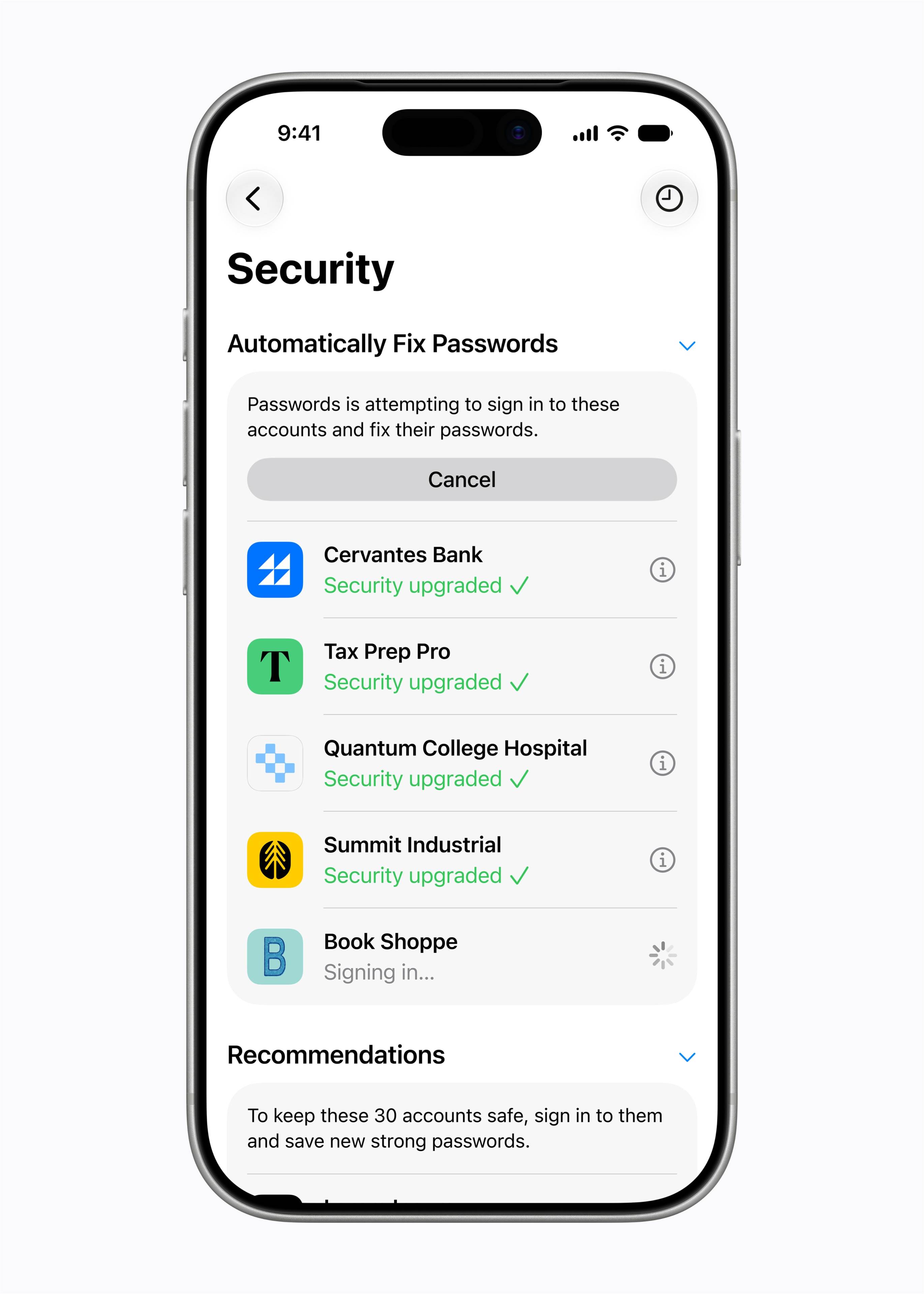
In iTnews’ testing using the first beta of iOS 27, the Passwords credentials change was not yet active.
TLS 1.3 upgrade recommended
Apple is also flagging that stricter network security requirments will be enforced.
Servers must support Transport Layer Security (TLS) version 1.2 at the minimum, with 1.3 being recommended by Apple.
Network connections use the App Transport Security (ATS) feature that requires TLS; ATS blocks insecure connections not locked down by TLS.
Apple said the uprated TLS requirement affects mobile device management (MDM) and its declarative device management (DDM) systems, software updates, and configuration profile installation.
App installations including enterprise app distribution is also affected by the network security changes, as well as automatic device enrolment, Apple said.
If administrators stay on TLS 1.2, servers must support certain key exchange algorithms that provide perfect forward secrecy (PFS) to stop attackers from decrypting older recorded sessions, if they afterwards manage to capture servers’ long-term private keys.
No macOS 27 for Intel Macs
Support for Macs based on Intel chips will also go away as macOS 27 rolls out.
This means that the minimum requirement for macOS 27 is Apple Silicon chips.
Mac mini, MacBook Pros and Air from 2020 are supported, along with iMacs (2021 onwards), and Mac Studios and Pros (2022-2023 )respectively.
Apple will support Intel Macs running macOS 26 Tahoe until 2029 with updates, however.
Apple’s budget laptop hit, the MacBook Neo with the A18 Pro chipset, is also compatible with macOS 27.
However, there is another restriction in macOS 27 which is that Apple Intelligence requires an M3 chipset, and at least 12 gigabytes of memory for the full AI feature set to be available.
This is to to ensure the chunkiest on-device foundation model for macOS 27 fits in, offering expressive voice customisation for Siri, and more advanced dictation; a current MacBook Neo won’t support these.
Child safety has also been upgraded in the 27 range operating systems with Communication Safety now blocking gore and violence in Messages and FaceTime for users under 18, as well as the current nudity blurring.
Other child safety changes include a rebuilt Screen TIme limits feature, a recommended set of apps, and Ask To Browse in Safari, to seek permission before visiting new websites.
Developers can also use the Declared Age Range application programming interface (API) to let apps requests childrens’ age ranges, without revealing their actual birthdays, to preserve privacy.