In Part 1, we established how to centralize your AppSec tools, correlate assets, and map scanner coverage across repositories. Establishing visibility is an essential baseline, but once your connectors start streaming data into a single location, prioritization becomes the primary focus.
As highlighted in our recent State of SDLC Security 2026 report, AI’s primary impact isn’t necessarily introducing entirely new risks. It’s the amplification of existing ones through faster code generation, contributing to a wider attack surface area with less time for human review.
For lean AppSec teams, the real promise of ASPM lies in how it helps prioritize application risk across their enterprise. But, as we saw with the React2Shell example, prioritization requires context across the entire application lifecycle. AppSec teams must quickly distinguish between theoretical code flaws sitting on un-deployed branches and active vulnerabilities running on internet-facing workloads.
To transform raw scanner output into actionable risk, Wiz Code executes prioritization across two distinct layers:
Finding-level prioritization: Normalizing scanner data into unified schemas, actively enriching findings with threat intelligence and network reachability, and deduplicating identical alerts across overlapping tools.
Attack path prioritization: Using the Wiz Security Graph to connect code-level findings with live cloud runtime context, elevating isolated flaws into fully validated attack paths.
Let’s look at how to operationalize both layers in your environment.
Enrich, Deduplicate, and Prioritize Individual Findings
Findings from connected scanners populate into their respective domains in the Wiz platform. For example, SAST results flow into the SAST Findings tab, SCA results populate in the Vulnerability Findings tab, and Secret results show up in the Secret Findings page. You can easily filter any table by “origin” to isolate alerts from a specific tool. In the example below, we’re filtering vulnerability findings surfaced from a Snyk SCA scan.
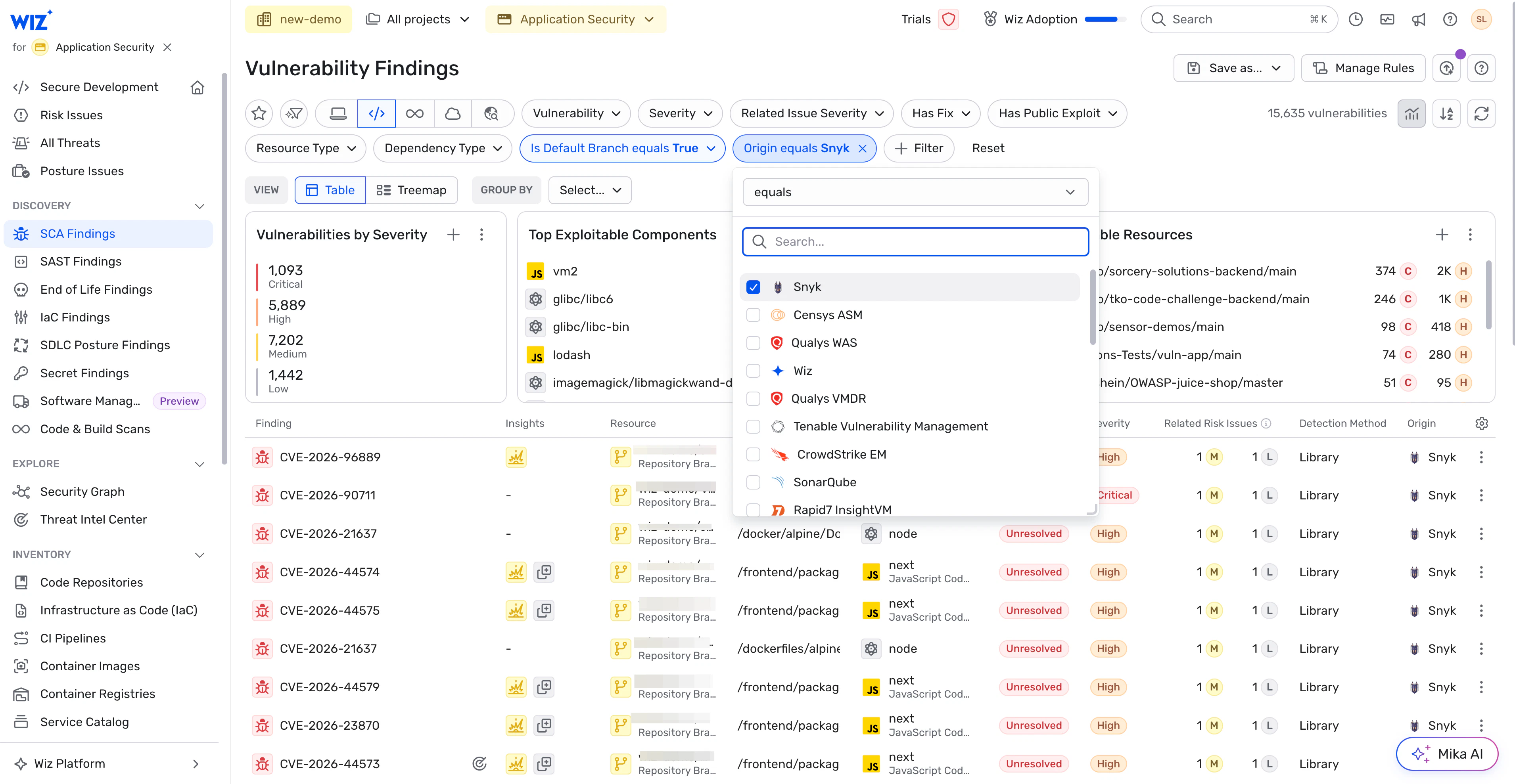
From this unified baseline, Wiz executes multiple layers of prioritization to help AppSec teams focus on what matters.
Enrichment
Imported findings are enriched with domain specific context, turning generic alerts into prioritized findings. For example:
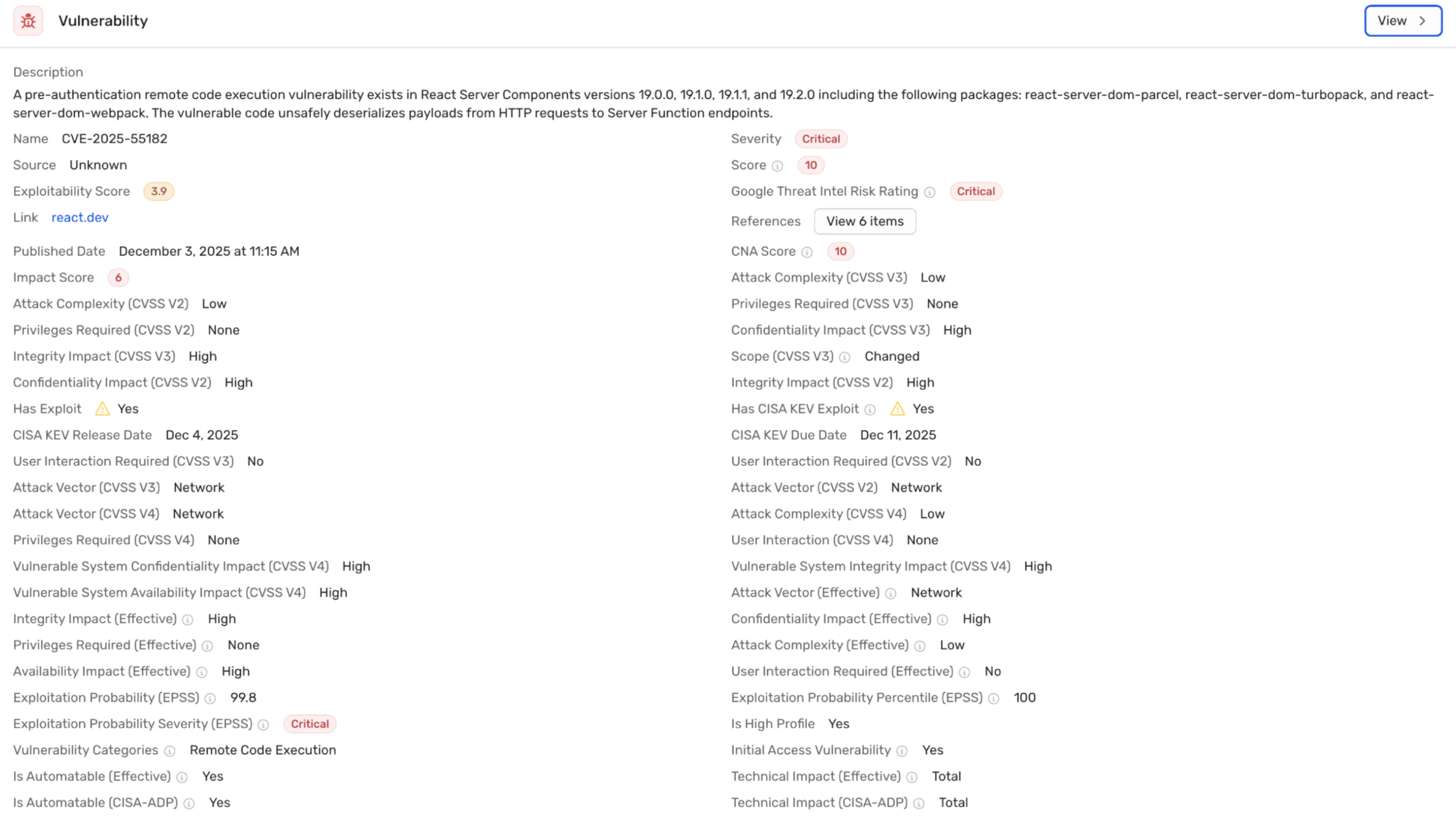
SCA: CVE-based findings are enriched with context from the NVD Vulnerability Catalog, real-time EPSS (Exploit Prediction Scoring System) probability scores, active exploit availability, and CISA KEV status. Our Threat Research team also denotes findings with active threats and writes complete advisories, so security teams have the latest insight on zero days.
SAST: CWE findings include code snippets so security teams have visibility into the location and context of weaknesses.
DAST: Wiz independently validates network exposure for the web applications with DAST findings using the Attack Surface Management (ASM) module. The ASM engine can be configured to run other checks such as secrets or sensitive data exposure checks from the perimeter on these newly created endpoints. Private-only addresses are marked differently so teams can prioritize findings with a real external attack surface.
Secrets: Wiz runs ingested secrets through databases to see if the secret was leaked, classifies secret types for understanding its impact, and assigns severities to the detected secrets based on threat research if the originating scanner did not provide any.
Deduplication
Security teams should not waste time chasing down multiple vulnerability findings for the exact same issue. When multiple tools scan the same codebase and produce duplicative vulnerability findings, Wiz can easily reconcile them.
Wiz labels one finding as “Representative” and the duplicates as “Duplicate.” Teams can apply automated Ignore Rules scoped to duplicate findings, instantly eliminating redundant noise in reporting without losing the underlying scanner audit trail. So instead of generating individual tickets for each finding, teams can create one ticket to consolidate the findings.

Prioritize Exploitable Attack Paths
Traditionally ASPM has focused on aggregating findings and prioritizing risk using simple scoring. Wiz takes a different approach by correlating findings with additional risk on the Wiz Security Graph. This is where the platform moves from managing vulnerabilities to managing exploitable attack paths.
The Wiz Security Graph correlates multiple risk factors into a single Wiz Issue (identifying toxic combinations of risk). Critically, these controls run on your third-party findings exactly the same way they run on native Wiz findings. If you connect a scanner, its data instantly becomes part of your code-to-cloud attack path analysis.
What this looks like in practice
Let’s look at how this context transforms a standard alert into a prioritized Wiz Issue. Imagine your Snyk integration flags a high-severity SAST finding (such as a remote code execution or command injection flaw) on a repository branch. In a vacuum, a developer might treat this as an urgent priority, or they might ignore it if they assume it is an internal tool.
The Wiz Security Graph evaluates the entire deployment lifecycle to uncover the actual risk. A single Wiz Issue might reveal:
The Code Flaw: A SAST finding from Snyk and a native Wiz SAST finding, both originating on the same repository branch.
The Build Artifact: That specific branch was built into a container image currently running in a production Kubernetes cluster.
The Exposure: The Kubernetes cluster is exposed to the internet via a public application endpoint.
Active Validation: An Attack Surface Management (ASM) finding confirms the endpoint is actively reachable from the outside.
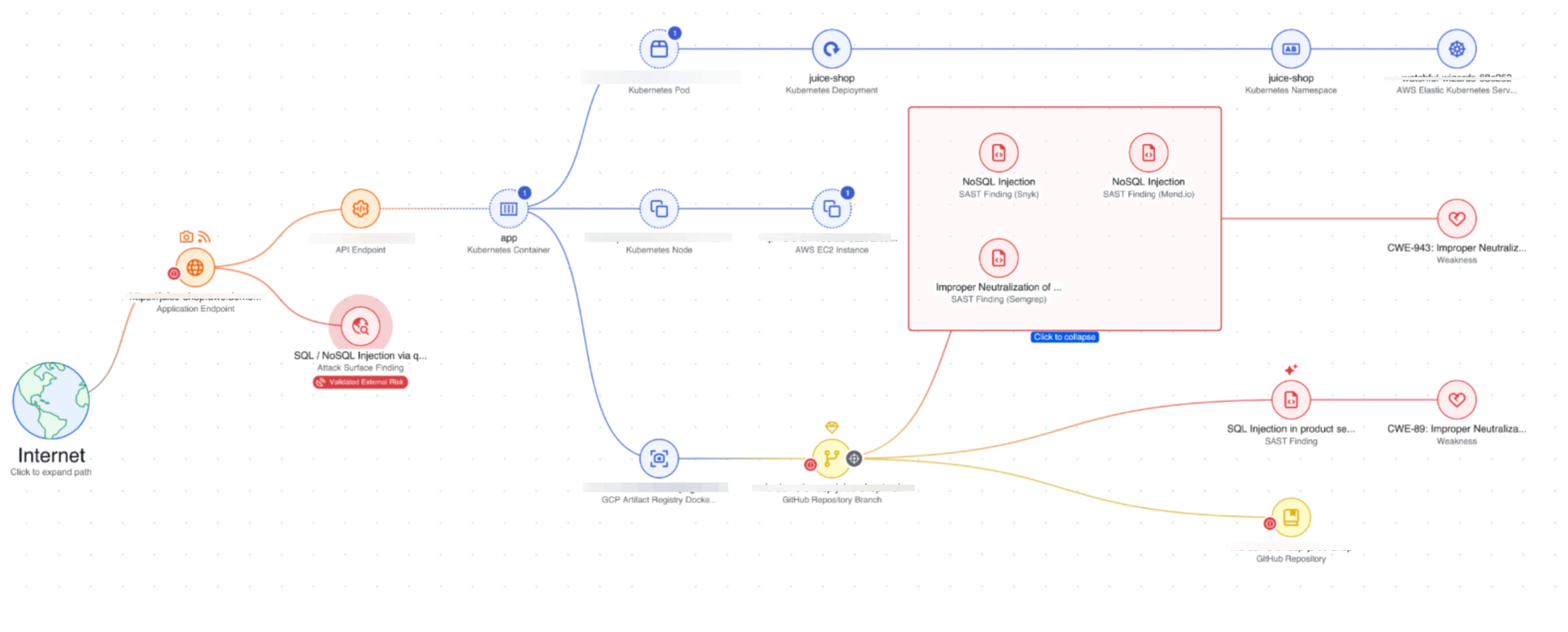
Instead of manually piecing together four separate alerts across three different tools, Wiz draws the connection natively. Because these findings all resolve to the same underlying resource and represent the same attack path, they are surfaced as one unified, high-priority Wiz Issue.
Conversely, if that same SAST flaw was detected on a branch that never ships to a running cloud workload, it remains a low-priority finding—sparing developers from interrupting their sprint for a non-exploitable risk.
Manage security debt at scale
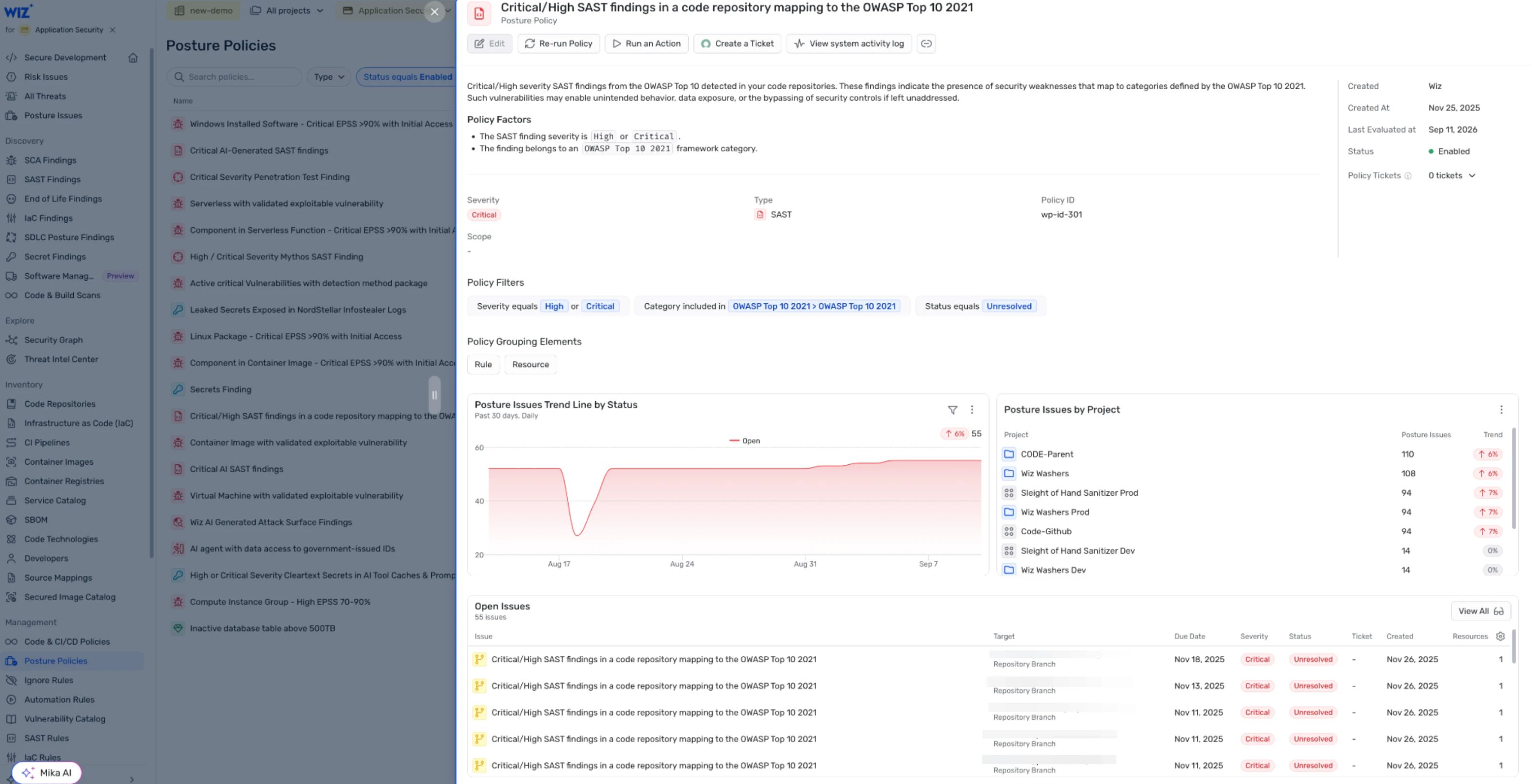
Not every finding may map to an attack path. But, lower-severity findings still represent real risk if left unaddressed. In Wiz, organizations can track and govern these findings through Posture Issues.
AppSec teams can create logical groupings of findings based on several criteria such as severity, project, code repository and more to build tailored campaigns for managing security debt. Teams can also define SLAs for remediation to align with organizational policies.
Up Next: Remediation and Automation at Machine Speed
Separating signal from noise is a massive win, but prioritization without rapid remediation is only half the battle. Once critical attack paths are identified, how do you ensure the right engineering team fixes them without slowing down release cycles?
In Part 3, the final instalment of this series, we’ll explore how to remediate at machine speed. We’ll cover how to leverage the Wiz Green Agent to generate tailored remediation plans in developer workflows and how to automate response with Wiz Workflows.