Artificial intelligence models are integrated into countless enterprise applications, but knowing exactly where these models come from remains a major security hurdle.
Cisco recently launched the Model Provenance Kit, an open-source tool for tracing the exact lineage of AI models. This release aims to bring transparency to complex AI supply chains and help organizations meet strict compliance standards.
The Opaque AI Supply Chain
Modern AI development relies heavily on open-source repositories like Hugging Face, which currently hosts over two million models.
Developers frequently download and fine-tune these models without keeping precise records of their modifications. This lack of transparency creates significant risks for organizations deploying generative AI tools.
If an enterprise deploys a model that contains poisoned data or hidden vulnerabilities, those issues silently propagate to any new versions derived from it. Tracking the source is vital for incident response and tracing the root cause of unexpected model behavior.
Additionally, organizations face regulatory pressure from frameworks such as the EU AI Act, which mandate strict documentation of training data and system components.
To solve this visibility problem, Cisco built the Model Provenance Kit to function like a DNA test for AI. Bad actors can easily fake documentation or strip metadata before uploading a model to a public repository.
Furthermore, many modern models share identical architectural foundations, making it impossible to determine origin based on configuration files alone.
The Model Provenance Kit bypasses these limitations by examining both metadata and the model’s learned parameters. It operates in two distinct stages to verify origin.
Stage one performs a rapid architectural screening by comparing model configurations and structural metadata. If the metadata is ambiguous, the toolkit proceeds to stage two to analyze the learned weights directly.
During the deep-analysis stage, the toolkit extracts five complementary signals from the model’s inner workings to create a unique fingerprint.
- Embedding anchor similarity evaluates geometric relationships between tokens to find structures that survive fine-tuning.
- Embedding norm distribution analyzes word frequency patterns learned during the original training run.
- Norm layer fingerprints read the tiny normalization layers that remain highly stable across various modifications.
- Layer energy profiles compare normalized energy curve distributions across the entire depth of the neural network.
- Weight-value cosine metrics directly contrast weight values between a subsample of corresponding layers.
Cisco tested the toolkit against a rigorous 111-pair benchmark containing both similar and dissimilar models.
The test included difficult real-world scenarios like aggressive distillation, same-tokenizer traps, and cross-organization fine-tuning. The system combines its extracted signals into a single provenance score to determine if a model pair shares common lineage.
| Evaluation Category | Tool Performance |
|---|---|
| Standard derivatives (fine-tuning, quantization, alignment) | 100% recall |
| Cross-organization derivatives (renamed/republished models) | 100% recall |
| Same-tokenizer traps (independent models sharing a tokenizer) | 100% specificity |
| Independent reproductions (same architecture, distinct training) | Correctly identified as unrelated |
| Overall classification accuracy | 107 out of 111 pairs correctly classified |
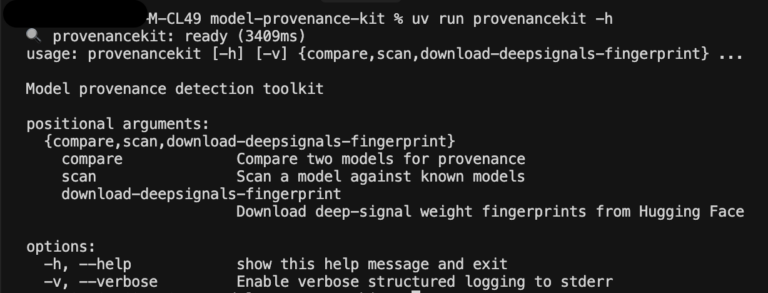
The Python-based toolkit features a command-line interface that runs efficiently on standard CPUs without requiring specialized hardware. Users can operate it in compare mode to analyze two specific models side-by-side and view a detailed breakdown of their similarity.
Alternatively, a scan mode allows users to match a single model against a database to surface the closest lineage candidates. The Model Provenance Kit is available now on GitHub, with an initial fingerprint dataset of 150 base models hosted on Hugging Face.
Follow us on Google News, LinkedIn, and X to Get Instant Updates and Set GBH as a Preferred Source in Google.