- Key takeaways
- The Cloud Moves Fast. So Do Attackers
- Ephemeral by design
- Deployment variety multiplies the attack surface
- Detection by CNAPP is good, but is the speed enough?
- Hyper-prioritization in cloud environments: cutting through the noise
- Exploitability in context, not in a vacuum
- Attack Path Analysis and Exploit Validation: Hyper-Prioritize What’s Important to You Now
- The bottom line for cloud security teams
- CNAPP for Frontier AI Era
- Start your cloud maturity journey today.

AI-powered detection has crossed a threshold. Security teams can now surface vulnerabilities, misconfigurations, and active attack paths at a speed and scale that was unimaginable a few years ago. The problem is no longer finding or knowing risk; it’s closing it fast enough to matter.
Cloud deployments compound this pressure in a specific way: the infrastructure that security teams are racing to remediate is moving, scaling, redeploying, and reconfiguring faster than any manual process can track. The question every security team is asking right now is, “How do we prioritize and remediate at the speed of detection across cloud environments that refuse to hold still?”
Key takeaways
- Cloud is a moving target; your security posture must keep pace. Scheduled scans and weekly or monthly reviews cannot keep pace with infrastructure that changes by the hour. Continuous posture management is table stakes, not a premium feature.
- CNAPP delivers the most value when detection feeds directly into remediation. Correlating findings across CSPM, CWP, and vulnerability data is necessary but not sufficient. The payoff is closing risk, not aggregating it in a dazzling dashboard.
- Hyper-prioritization separates cloud risk from cloud noise. There are thousands of misconfigurations, but only a few dozen exploitable attack paths that matter right now. Knowing the difference is the whole game.
- LLM-powered playbooks make zero-day response tractable at cloud scale. When novel threats arrive, the bottleneck is not detection; it’s producing a credible, environment-specific response plan fast enough to matter. AI changes that bottleneck.
- Durable remediation must close the loop from code commit to running workload. Patching a container without fixing the image or fixing the image without updating the pipeline policy guarantees reintroduction. All three layers must move together.
Register Now
The Cloud Moves Fast. So Do Attackers
Ask most security teams what their biggest cloud challenge is, and they will say something about visibility, too many assets, too many tools, too much data. Visibility is a real problem. But it is not the hardest problem. The hardest problem is that cloud infrastructure is inherently dynamic, undermining the assumptions underpinning traditional security programs. The weaponization window (the time from CVE publication to an active exploit in the wild) has collapsed from weeks to hours in recent years. AI is not just helping defenders; it is helping attackers discover and map attack paths faster than any human-driven analysis can keep up with. Static attack path models updated weekly are already obsolete.
Ephemeral by design
A container spun up for a batch job may live for four minutes. A serverless function executes in milliseconds. An auto-scaling group might add and remove dozens of instances in response to a traffic spike before a weekly scan has even run. Traditional vulnerability scanners were built for a world where an asset stayed in place long enough to be scanned, evaluated, triaged, and patched. In cloud environments, the asset may be gone before triage begins.
This is not a scanning frequency problem that faster scanners fix. It’s an architectural mismatch. Security programs that rely on periodic assessment cycles can’t keep pace with continuously evolving infrastructure. The response model must change, not just the scan schedule.
Deployment variety multiplies the attack surface
Modern cloud environments are not homogeneous. A single organization might run:
- Virtual machines on AWS EC2, Azure VMs, and GCP Compute Engine, each with different patching mechanisms and agent support
- Kubernetes clusters across managed services (EKS, AKS, GKE) and self-managed, with node-level and pod-level security considerations that don’t map to traditional host models
- Serverless functions in Lambda, Azure Functions, and Cloud Run — where there is no OS to patch, and the attack surface is entirely in the runtime and dependencies
- Container images built from base images that may carry vulnerabilities introduced months before the workload was deployed
- Infrastructure-as-code templates that encode misconfigurations before a single workload runs
Each of these deployment types has a different security model, remediation mechanisms, and risk profile. The same vulnerable app moves around and scales to improve availability. A single vulnerability management workflow that treats them all the same will be wrong for most of them.
Detection by CNAPP is good, but is the speed enough?
Most modern CNAPP platforms are excellent at aggregating and correlating cloud security signals across this expansive, ephemeral attack surface. They are not, in themselves, remediation platforms. The gap between a unified finding and a closed vulnerability is still predominantly a human workflow: a ticket opened, a team notified, a change approved, a deployment made, a scan re-run to confirm. In a dynamic cloud environment, that workflow takes days. The infrastructure that generated the finding may have been replaced twice by the time the ticket is resolved.
Qualys TotalCloud CNAPP is purpose-built to close that gap. The detection is immediate, real-time, and powered by cloud events. As a unified CNAPP, it correlates signals across vulnerabilities, misconfigurations, identity issues, and sensitive data findings into a single, continuous risk picture and connects that picture directly to remediation. The result is a security posture that not only sees more, but also acts faster. From a misconfigured IAM role to an actively exploitable attack path, best-in-class CNAPP solutions ensure that every signal the detection engine surfaces has a direct, automated path to resolution.
Closing that gap requires connecting a CNAPP’s correlated signal to an autonomous remediation capability that can act at the speed and scale of the cloud itself.
| A CNAPP that surfaces an exploitable attack path in seconds but takes a week to close it doesn’t offer an adequate security outcome. It just creates more backlog. |
The metric that matters is not how many vulnerabilities were detected. It is how long they stayed open for an attacker to walk through them, and manual prioritization is the primary reason they stay open as long as they do.
Complete a 5-minute Cloud Maturity Questionnaire to receive a complementary detailed report.
Hyper-prioritization in cloud environments: cutting through the noise
A mature CNAPP deployment in an enterprise organization can surface tens of thousands of findings a week. CSPM alone commonly generates tens of thousands of policy violations across large environments. Without aggressive prioritization, security teams face an impossible triage load, and default to working oldest-to-newest, or highest-CVSS-first, neither of which reflects actual risk. Moreover, most firms ignore almost a third of their perceived low-level alerts. This is problematic as relying solely on CVSS could result in bypassing alerts, based on faulty assumptions, that should be isolated and remediated immediately.
Organizations subject to compliance mandates and frameworks, such as NIST 800-53, also need to be mindful of requirements for continuous monitoring and rapid response. The answer? An advanced level of prioritization that focuses on the exploits that matter most. A kind of hyper-prioritization based on multiple criteria.
Exploitability in context, not in a vacuum
Every asset is continuously re-scored against a live threat feed as the threat landscape evolves, which also includes the following risk factors:
- Exposure: Is the affected workload internet-facing? Is the vulnerable port reachable from outside the VPC? A critical vulnerability on an isolated internal service is categorically different from the same vulnerability on a load-balanced public endpoint.
- Identity and access: Does the compromised workload have an IAM role with broad permissions? Can an attacker who exploits this vulnerability pivot to other accounts, other regions, or exfiltrate data? The blast radius of exploitation depends heavily on what the workload is authorized to do.
- Lateral movement paths: Attack path analysis across the cloud topology reveals which vulnerabilities, if exploited, provide a path to crown-jewel assets. A low-CVSS finding on a workload with network access to a production database may be a higher priority than a critical CVE on an isolated dev instance.
- Business Context: Not all assets carry equal weight. A vulnerability in the payment processing service, the customer data store, or a compliance-critical workload demands a different level of response urgency than the same finding in an internal dev tool.
- Active threat feeds: Runtime sensors that observe actual suspicious behavior, unusual process execution, unexpected network connections, credential access patterns, and elevate the priority of associated vulnerabilities from theoretical to confirmed-active.
- Compensating controls: A vulnerability behind a WAF rule that blocks the specific attack vector, or on a workload where the vulnerable code path is never executed, carries lower effective risk. Accounting for controls prevents the remediation queue from being dominated by vulnerabilities that are already mitigated.
The priority finding is not the one with the highest score on any single dimension; it is the one where multiple risk factors converge. Not thousands of findings, but instead only dozens. Vulnerabilities and misconfigurations, if left unaddressed, represent a credible path to a material breach. This is the list that autonomous remediation should act on first.
| Hyper-prioritization in the cloud goes beyond accurate scoring; it is essential for reducing an unmanageable list of thousands or exposures to the few dozen that represent real, imminent, exploitable risk in your specific environment, today. |
Attack Path Analysis and Exploit Validation: Hyper-Prioritize What’s Important to You Now
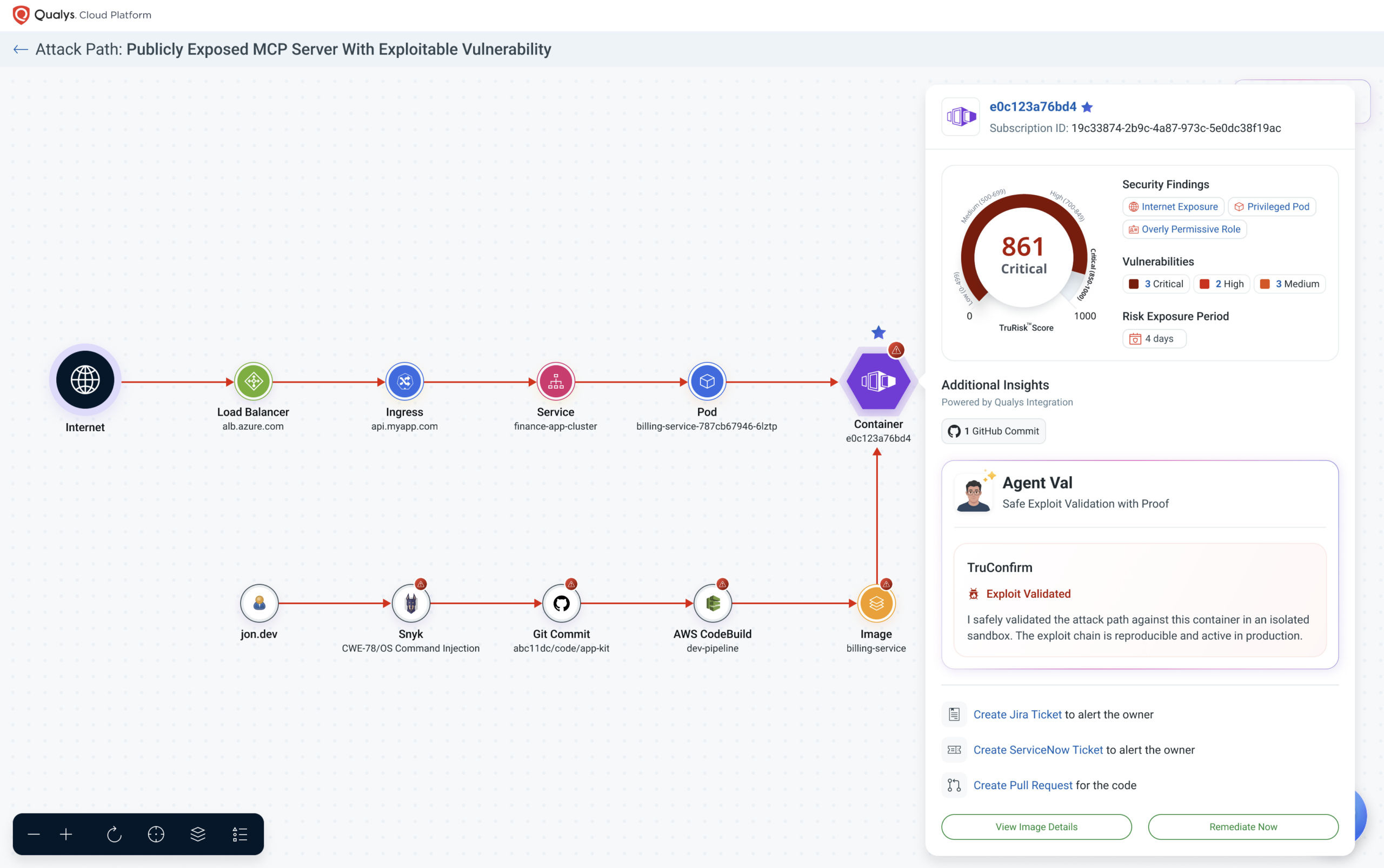
TotalCloud’s Attack Path Analysis already does the heavy lifting for autonomous remediation by mapping exploitable paths across the cloud topology with diamond precision and identifying exactly which vulnerabilities constitute a traversable route to your most critical assets. Qualys elevates that further with TruConfirm, exploit validation that confirms whether a vulnerability is actually exploitable in your live environment. The result is not a ranked list of thousands. It is a definitive, validated answer to a single question: what must you fix right now? Not today. Not this week. Right now.
Autonomous remediation in cloud environments is not a single action. It’s a spectrum of interventions, each appropriate for different classes of findings, asset types, and confidence levels. Getting the spectrum right matters as much as having the capability in the first place. Here is what it looks like in practice:
- Full automation for configuration drift. Cloud misconfigurations are the highest-confidence target. The finding is precise: this S3 bucket has public access enabled. The fix is deterministic: disable public access, and the risk of the automated action is well-understood. CSPM-driven remediation fires through the cloud provider API in seconds, and re-fires if the misconfiguration is reintroduced. Qualys TotalCloud ships with 300+ no-code playbooks via QFlow, the integrated Cloud Workflow Automation engine, covering the most common classes across AWS, Azure, and GCP with no scripting required.
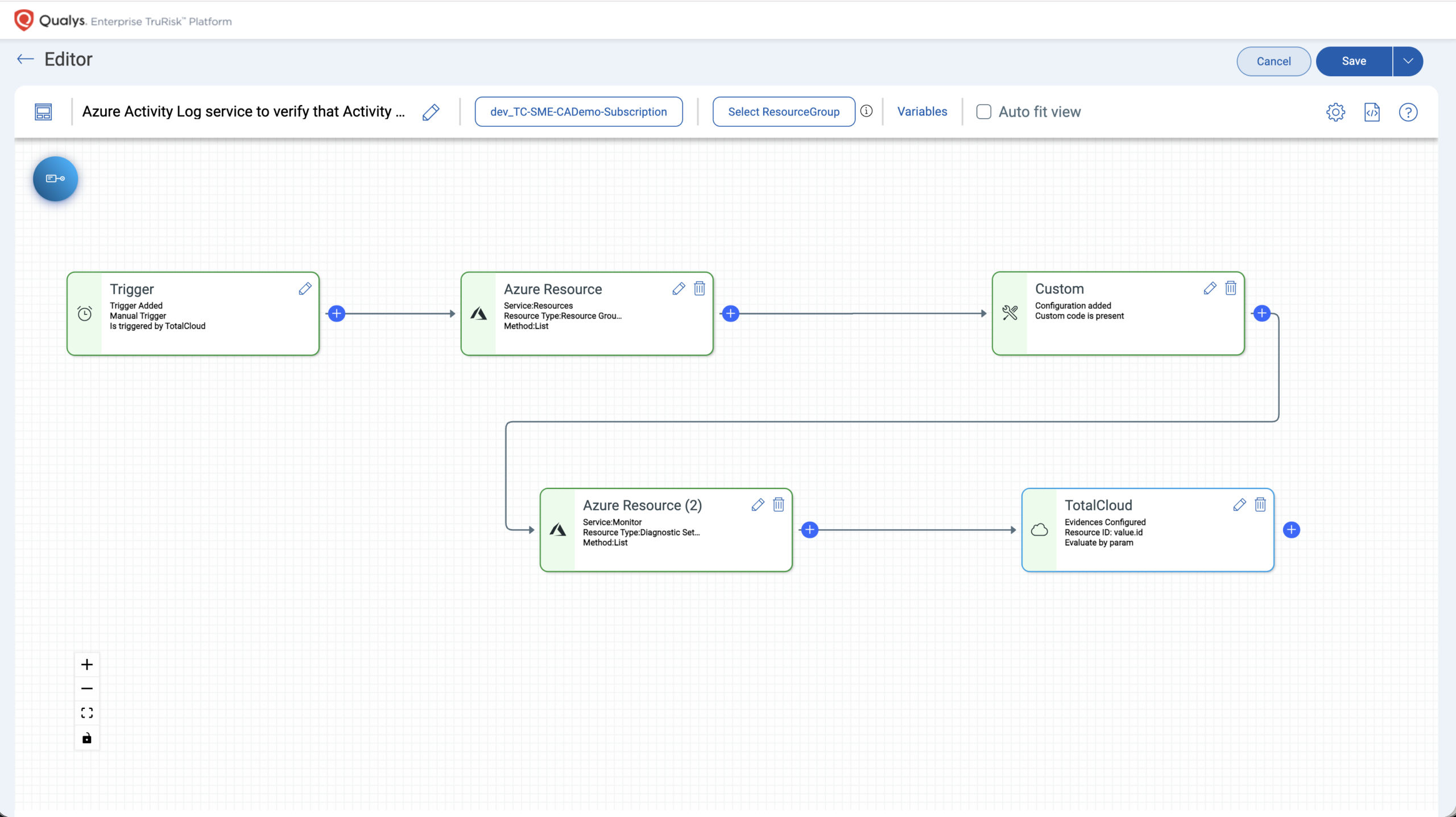
- LLM-assisted triage for novel threats. When a zero-day arrives with no existing playbook, QFlow’s LLM-driven workflow generation produces an environment-specific response plan in seconds, covering immediate containment, patchless mitigations through cloud-native controls, and the path to durable closure. A starting point produced at machine speed, ready for human review rather than authored from scratch.
- Patch, mitigate, or isolate autonomously, per workload. TruRisk Eliminate routes every finding to the right response — automatically. When a patch is available and AI-scored as reliable, it deploys autonomously. When confidence thresholds aren’t met, it holds and stages through wave-based rollout. When patching isn’t available, it applies patchless controls, WAF rules, and policy changes. And when a workload is too risky to touch, it quarantines it from the network before lateral movement can cross accounts or regions.
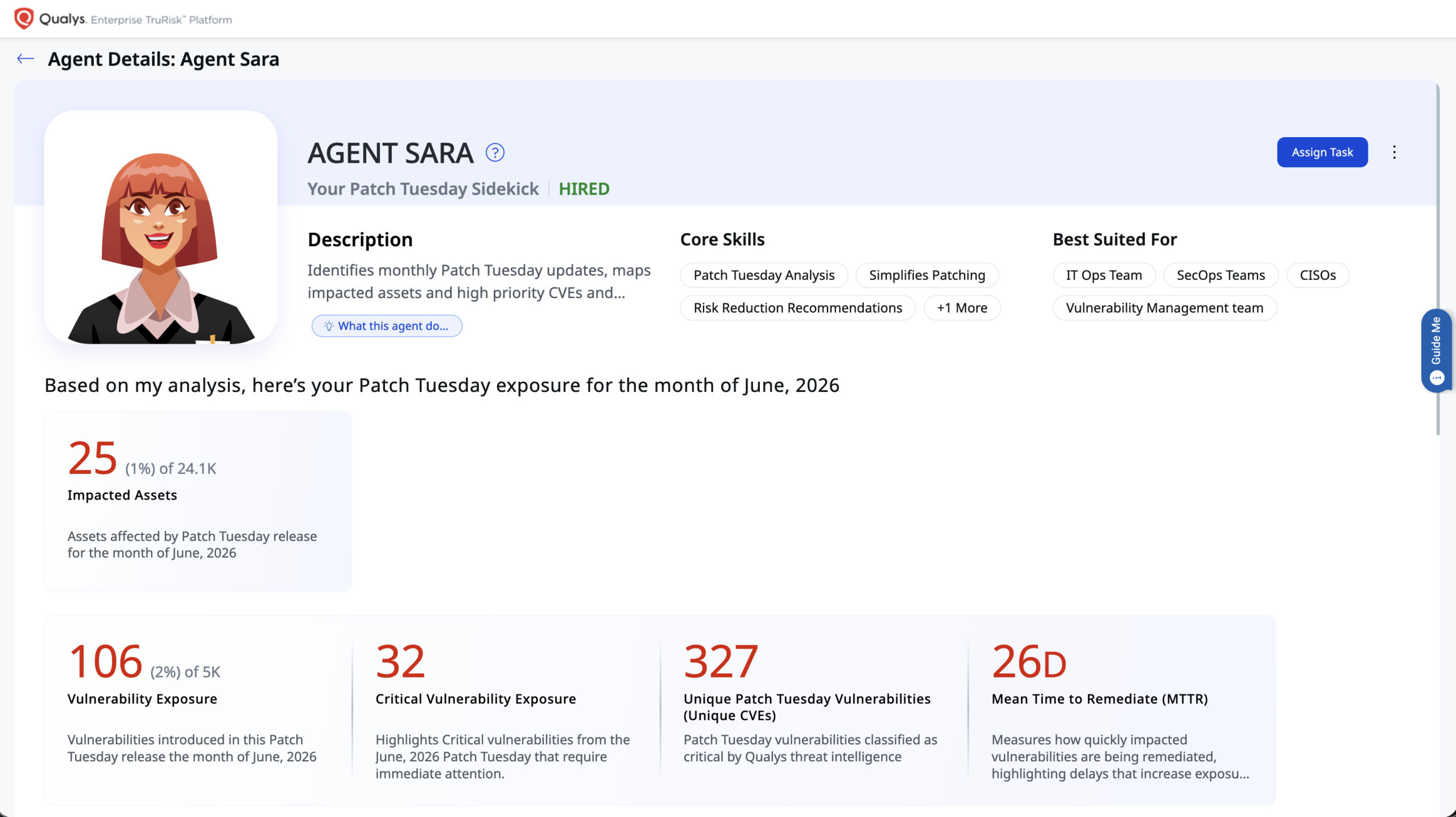
- Agent Sara orchestrates it end-to-end. Part of Qualys’ Agentic AI framework, Agent Sara triages findings, selects the right response mode, executes the action, and validates closure, without human intervention. What once required an on-call engineer coordinating across tools now runs autonomously at the speed the cloud demands.
| Autonomous remediation in the cloud is not binary. Full automation for configuration drift. Human-in-the-loop for workload changes with operational risk. LLM-assisted triage for novel threats where no playbook exists yet. |
The bottom line for cloud security teams
Cloud security is uniquely challenging because the environment it’s trying to protect is inherently dynamic. The infrastructure changes continuously, across deployment types that each carry different risk models, all managed by teams that move faster than security programs were designed to handle.
CNAPP gives security teams unified visibility across the environment. Hyper-prioritization gives them the focus to act on what matters. Autonomous remediation gives them the speed to close risks before they are exploited. None of these is sufficient alone. Together, they represent a security program that can actually keep pace with the latest AI-powered cloud threats.
CNAPP for Frontier AI Era
Qualys TotalCloud is an AI-native CNAPP that helps organizations move from visibility to autonomous risk elimination. With FlexScan, KCS, TruRisk, TruConfirm, CDR, DSPM, QFlow, and Eliminate, TotalCloud secures cloud, container, Kubernetes, identity, data, serverless, runtime, and SaaS environments while improving prioritization, compliance, and remediation speed.
Start your cloud maturity journey today.
Schedule a call with a cloud security expert.