Hackers are exploiting a critical severity vulnerability, tracked as CVE-2026-3055, in Citrix NetScaler ADC and NetScaler Gateway appliances to obtain sensitive data.
Citrix initially disclosed CVE-2026-3055 in a security bulletin on March 23, alongside a high-severity race condition flaw tracked as CVE-2026-4368. The issue impacts versions of the two products before 14.1-60.58, versions older than 13.1-62.23, and those older than 13.1-37.262.
The vendor underlined that the flaw only affected appliances configured as a SAML identity provider (IDP) and noted that action is required only for administrators running on-premise appliances.
In response to the bulletin, multiple cybersecurity firms highlighted that CVE-2026-3055 has a significant risk, noting technical resemblance to the widely exploited ‘CitrixBleed’ and CitrixBleed2’ from 2023 and 2025, respectively.
watchTowr, a company that provides adversarial simulation and continuous testing services, said on Saturday that it observed reconnaissance activity targeting vulnerable instances and warned that in-the-wild exploitation was imminent.
The next day, the researchers confirmed that threat actors started leveraging the flaw since at least March 27.to extract authentication administration session IDs, potentially enabling a full takeover of NetScaler appliances.
“In-the-wild exploitation has begun, with evidence from our honeypot network showing exploitation from known threat actor source IPs as of March 27th,” reports watchTowr.
watchTowr’s analysis indicates that CVE-2026-3055 actually covers at least two distinct memory overread bugs, not one. The first affects the ‘/saml/login’ endpoint handling SAML authentication, while the second one affects the ‘/wsfed/passive’ endpoint used for WS-Federation passive authentication.
The researchers demonstrated that the security flaw can be leveraged to “sensitive information – including authenticated administrative session IDs.”
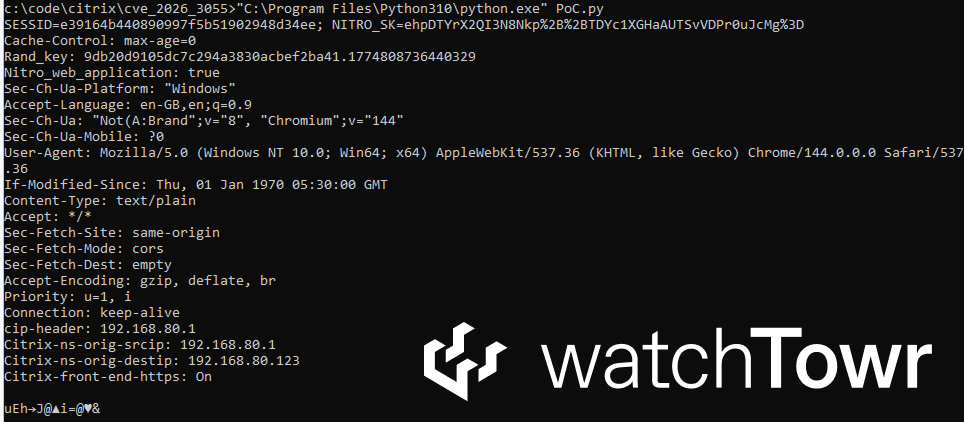
Source: watchTowr
The researchers call Citrix’s incomplete disclosure of the security issue in the security bulletin “disingenuous.” They also shared a Python script to help defenders identify vulnerable hosts in their environments.
As of publishing, Citrix’s bulletin does not mention CVE-2026-3055 being exploited. BleepingComputer has contacted the company for a comment on the reported threat actor activity targeting unpatched appliances, but we have not received a response.
As of March 28, The ShadowServer Foundation sees 29,000 NetScaler and 2,250 Gateway instances exposed online, although it is unclear what percentage of those are vulnerable to CVE-2026-3055.

Automated pentesting proves the path exists. BAS proves whether your controls stop it. Most teams run one without the other.
This whitepaper maps six validation surfaces, shows where coverage ends, and provides practitioners with three diagnostic questions for any tool evaluation.