Datacentres are routinely cast as water-guzzlers, but that reputation rests on newspaper articles written a quarter of a century ago. Modern facilities are closed-loop and use almost no water. Meanwhile, racks are hotter than ever, but water is being engineered out.
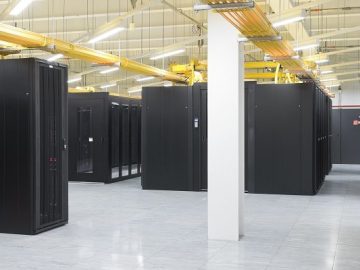
That’s according to executives from Digital Realty and Schneider Electric at the latter’s datacentre event in Conselve, Italy, this week (pictured above), where specialists explained how artificial intelligence (AI) has changed the physics of cooling and what that means for water.
Power draw densification is the backdrop. Andrew Bradner, who leads Schneider’s cooling business, said the average rack wattage in most datacentres had barely moved for 15 years, and hovered at between 8kW (kilowatts) and 12kW. That changed with AI silicon. Nvidia’s H100 pushed racks to 40kW to 80kW, while Blackwell, its successor, takes them past 100kW.
The consequence, said Mauro Leuce, senior director for the global design and engineering standards team at Digital Realty, is that the datacentre data hall itself becomes part of the machine.
“Nowadays, we are not creating a room that cools computers, but actually the room is becoming the computer,” said Leuce. “So we are going back to the 1950s, where IBM had computers which were actually the size of a room.”
Schneider is betting on that trend. At Conselve, its largest cooling manufacturing site in Europe, it is doubling production capacity for coolant distribution units (CDUs) from January 2027 and raising big-chiller output by 50% by the end of 2026, following last year’s acquisition of Motivair. A new test laboratory, due in December 2027, will triple testing capacity and validate chillers up to 4MW (megawatts), Motivair CDUs up to 5MW, and CRAH and fan-wall systems up to 800kW.
“Nowadays, we are not creating a room that cools computers, but actually the room is becoming the computer. So we are going back to the 1950s, where IBM had computers which were actually the size of a room”
Mauro Leuce, Digital Realty
“AI is fundamentally transforming the way in which our customers design and operate datacentres. It is creating unprecedented demand for advanced liquid cooling technologies that can support increasingly powerful computing systems,” said Damien Dhellemmes, senior vice-president of the secure power and datacentre business in Europe at Schneider Electric.
“By doubling our liquid cooling manufacturing capacity in Conselve, we’re strengthening our ability to deploy resilient, scalable and energy-efficient AI infrastructure, while bringing critical technologies and expertise closer to our customers in Europe,” he added.
Liquid cooling demands modest
Liquid cooling, however, is not replacing air cooling. “The idea that an AI factory is fully liquid-cooled is utopian,” said Leuce. “It doesn’t exist. First of all, because even if the rack itself is liquid-cooled, there will be a portion of heat dissipated by radiation. On top of that, customers still need a network, storage and everything else,” Leuce added. He put the balance at around “50-50 at this stage”.
The water question is where the panel was most pointed. Leuce drew the distinction between closed-loop liquid cooling and the evaporative cooling towers of the past.
“We are talking about a liquid coolant, which is no different than what you have in a radiator in a car engine. The radiator cools the engine with a closed loop of liquid coolant that constantly recirculates,” he said. “Liquid cooling has always been in existence. When NASA landed on the moon, all the computers were actually liquid cooled. It’s nothing new.”
The volume of fluid needed to fill such a loop is modest, said Leuce. “How much? It’s about the size of a swimming pool. It’s not an enormous amount to fill it because it’s a closed loop.”
If you want a sensible discussion about water usage, you need to talk about carbon intensity. We’re talking about the balance between utilising electricity to cool or utilising water to cool Mauro Leuce, Digital Realty
The deeper argument is about carbon. “If you really want to have a sensible discussion about water usage, you need to start to talk about carbon intensity,” said Leuce. “We’re talking about the balance between utilising electricity to cool or utilising water to cool.”
Evaporative cooling made sense when the grid was coal-heavy and power was the dirtier input. “Now, 50 years later, you have quite a lot of renewable energy in the grid. At that point it makes sense to use electricity because it’s greener than water.”
No operator chooses water as a first option, he said. “Nobody wants to use water. We try to stay well away from water because it costs money and it’s risky. A datacentre can be shut down if you have a Legionella issue. No datacentre operator wants to use water as a first solution,” Leuce said.
Water brings treatment costs, storage rules and discharge limits. In dense European hubs, he added, “you can’t discharge water in the public sewer – try that in Frankfurt, Paris, Milan, London; it’s impossible”.
Outdated water data
He reserved his sharpest line for where the public perception comes from. “All the searches where people ask how much water is used by datacentres provide answers picked up from newspaper articles from 25 years ago that are still referenced in searches of today,” he said.
Projected efficiency from Schneider’s own analysis brings big numbers. Tuan Hoang, who heads cooling technology and product development at the company, said higher operating temperatures cut the energy spent on cooling itself.
“We see power reduction by 60% of the overhead, from 1.2, 1.3 down to 1.15 to below 1.1 [PUE]. That is a huge opportunity, where we’re able to remove 60% of the overhead to operate these workloads,” he said.
Those are supplier studies, of course, not independent findings, and the water-free case is strongest in temperate Europe. In hotter, drier markets, the power-for-water trade-off can still run the other way.
Datacentre cooling glossary
PUE (power usage effectiveness): Total facility energy divided by the energy the IT equipment uses. A PUE of 1.0 means every watt reaches the servers; 1.2 means 20% extra goes on cooling, power delivery and losses.
WUE (water usage effectiveness): Water consumed per unit of IT energy, usually litres per kilowatt-hour. It captures water use, not the carbon intensity of the grid.
Cooling: Removing the heat that IT equipment produces so chips stay inside their operating range. Air or liquid carries the heat from the servers to the heat rejection step.
Heat rejection: Where the captured heat leaves the building – to outside air through a chiller or dry cooler, or to water.
CDU (coolant distribution unit): The pump-and-heat-exchanger unit in liquid cooling. It circulates coolant to the cold plates on the chips and separates the server (technology) loop from the building (facility) loop.
Chiller: The machine that removes heat from the water loop. Newer units combine refrigerant-based cooling (a compressor circuit) with water-coil free cooling, so they run the compressor only when the outside air is too warm and switch to water cooling when it is cool enough.
Fujitsu’s excuse for holding back its contribution to the costs of the Post Office scandal could be about to expire, along with its ineffective moratorium…
In July 2021, joint research from Enterprise Strategy Group (ESG) and the Information Systems Security Association (ISSA) found the area with the biggest shortfall in…
Table of Contents Discover, analyse, summarise Navigating the risks The humans behind the machine Amanda Stent was researching natural language processing (NLP) at a time…
Table of Contents Unifying workload management Do you need the whole suite? Will native management tooling do the job? Does your implementation focus on public…
The UK economy can unlock a £35bn productivity windfall, but only if businesses can bridge a widening “readiness gap” between basic and advanced artificial intelligence…