The crypto market went through a severe macro-level contraction during 2026’s Q1. CryptoQuant data highlights that total centralized exchange trading volume fell 48% from its October 2025 peak to $4.3 trillion in March. Instead of the exit of capital, this sharp decline signaled a structural reallocation of risk.
Sophisticated market participants responded to the cooldown by shifting their strategies toward perpetual futures and parking their collateral on the most liquid platforms. This pivot is anchored by a massive $152.9 billion custody statistic. In a cooling environment, institutions do not necessarily reduce exposure. They consolidate capital where market depth supports complex, continuous execution.
The Dominance of Perpetual Futures in a Contracting Market
Risk appetite has fundamentally moved away from spot directional trades and into the derivatives market. Perpetual futures now play a central role in shaping the pace and structure of cryptocurrency trading. According to Q1 data from CryptoQuant, monthly perpetual futures volume reached $3.5 trillion in March. This makes it over four times larger than the spot market’s $0.8 trillion.
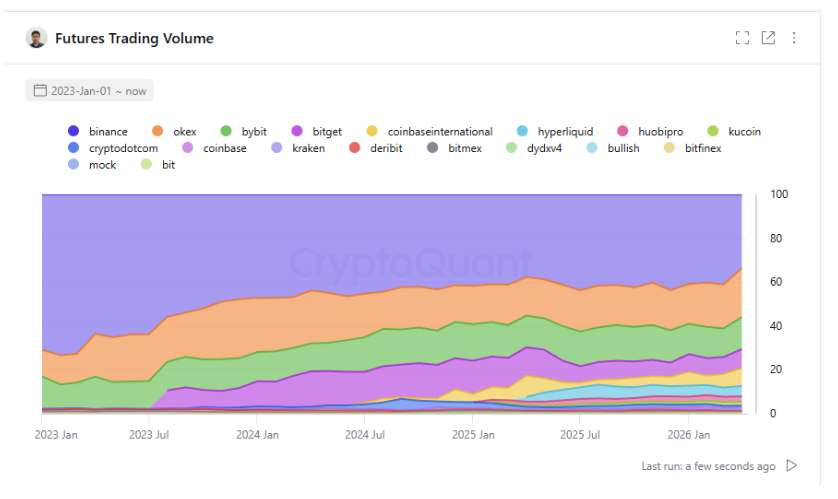
Capital efficiency and the need for continuous hedging drive this preference. Institutions require leverage and flexibility to navigate sideways or contracting price action. Binance handles $1.4 trillion in monthly perpetual volume. It is twice the size of its closest competitor, OKX, at $0.7 trillion.
Binance Co-CEO Richard Teng noted this shift, stating, “As trading activity normalized in Q1, market structure became clearer: derivatives continued to lead price discovery, while liquidity consolidated on platforms able to support scale. In a lower-volume environment, Binance’s consistent leadership across both spot and perpetual markets reflects the value users place on deep liquidity and reliable execution.”
Traders naturally migrate to venues that can process massive order flow without severe slippage. Open interest reflects this exact dynamic. CoinGlass data shows Binance maintained a 29.9% share of open interest, which is 2.2 times higher than Bybit.
The Role of Scale in Hedging and TradFi Integration
Concentrated capital allows trading desks to execute complex cross-asset strategies that bridge the gap between digital assets and traditional finance. Legacy financial markets leave participants exposed to a 49-hour weekend gap where risk cannot be managed. Institutional desks now use the cryptocurrency perpetual model to hedge traditional assets continuously.
TradFi perpetual contracts processed over 113 billion trades and reached $153 billion in cumulative volume by March 2026. This activity proves that institutional risk appetite is expanding into synthetic traditional exposures.
The market is evolving on dual tracks. While centralized liquidity consolidation handles the bulk of institutional demand, decentralized alternatives are securing highly specialized segments.
Hyperliquid captured $492.7 billion in derivatives volume and recorded $6.0 billion in average open interest during the first quarter. Institutions demand either the massive scale provided by centralized platforms or highly specific on-chain infrastructure to execute their programmatic strategies. A unified account structure reduces fragmented collateral pools. It provides the exact operational efficiency required for round-the-clock global trading.
Capital Retention as the Ultimate Indicator of Market Confidence
Executing billions in derivatives volume requires an immense foundation of collateral. Institutions cannot safely run complex perpetual strategies without unmatched reserve depth backing their positions. The concentration of custodial assets tells a very specific story about how market participants view platform reliability.
According to Q1 data from CoinGlass, Binance holds $152.9 billion in user assets. This represents 73.5% of all major centralized exchange assets combined. The reserve pool is 9.6 times larger than the nearest competitor, OKX, which holds $15.9 billion.
The concentration of these custodial assets heavily outweighs the concentration of pure trading volume. Platforms are acting as long-term parking for capital rather than functioning merely as transactional venues. Large holders prioritize structural safety and verifiable reserves when choosing where to anchor their liquidity.
Spot market dynamics mirror this flight to quality. Binance saw its spot market share increase from 34.0% in January to 35.4% in March despite the 23% broader market contraction. Capital gravitates toward established infrastructure when macroeconomic conditions become uncertain.
The Maturation of Institutional Risk Deployment
The first quarter of 2026 was defined by precision rather than euphoria. The massive $152.9 billion custody reserve serves as the necessary foundation that allows $3.5 trillion in monthly perpetual volume to function smoothly.
Institutions have structurally adjusted their approach to the market. They rely heavily on platforms offering execution certainty across digital and traditional asset derivatives. Liquidity concentration on platforms capable of supporting complex hedging will dictate how risk strategies are deployed for the remainder of the year.
Market participants clearly value execution quality and collateral security above all else. The move away from simple spot exposure toward more advanced perpetual instruments reflects a maturing market structure. As this transition continues, capital may increasingly concentrate in venues with the deepest liquidity and strongest execution capacity.