A malicious GitHub repository impersonating Anthropic and claiming to offer free access to “Claude Opus 5” is delivering RevStealer, Windows information-stealing malware that targets passwords, cryptocurrency wallet data and login credentials, according to Morphisec.
Repository README using Claude Opus 5 branding and a “Free” hook (Source: Morphisec)
“RevStealer is a Windows information stealer that is built to work quietly,” researchers explained. The campaign relies on social engineering, with victims steered to GitHub repositories that look like legitimate free software and to game-cheat-themed sites.
The repository, called Claude-Opus-5-Free-Desktop, offers a download named ClaudeOpus5-desktop.zip, listed at about 101 MB, alongside screenshots and model comparison charts.
Running the file opens no window. The program first checks the computer’s memory, processor count, hostname and username against a blocklist, along with its graphics hardware. It then tries to add the user’s AppData folder to the Windows Defender exclusion list, decrypts a bundled file, and launches RevStealer in the background.
“Once running, the native RevStealer payload lives up to the theme. It resolves Windows APIs without a normal import table, keeps its configuration encrypted until the moment of use, calls the kernel through indirect system calls to slip past user-mode hooks, streams stolen data straight to its server instead of leaving one archive on disk, and finally deletes itself,” Morphisec wrote.
“Even its command-and-control channel is designed to disappear: if the primary server is down, RevStealer reads a fallback address from a smart contract on the Polygon blockchain, letting the operator rotate infrastructure without rebuilding the malware,” they added.
The malware targets browser databases and saved credentials, extension storage, Windows Credential Manager entries, files from a dozen password managers, files from more than fifty cryptocurrency wallet applications, VPN and remote access credentials, messaging app data, game launcher accounts, OBS streaming profiles, clipboard content, screenshots and selected user documents.
One victim described the infection on a forum cited in the report, saying their Microsoft and EA accounts were compromised soon after running the download.
How RevStealer avoids analysts
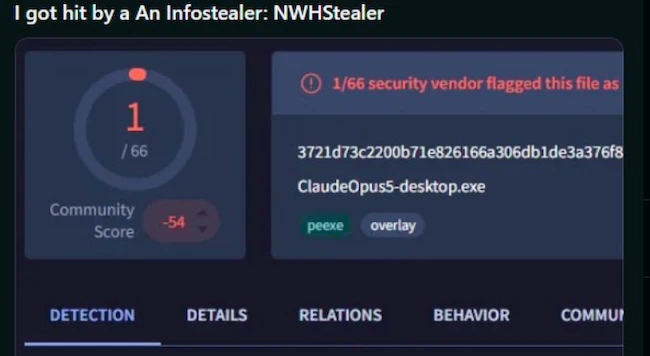
A screenshot in the report shows the malicious file was flagged by only one out of 66 antivirus engines at the time it was checked.
Before collecting anything, the native RevStealer payload runs ten separate checks meant to detect virtual machines and sandboxes, covering running processes and analysis tools, CPU and memory characteristics, graphics hardware, system identity and uptime, among other signals. Each check adds to a hidden score, and once the score is high enough the malware waits several seconds and shuts itself down.
A regional check also ends the process outright on systems set to Russian, Ukrainian or several Central Asian languages, separate from the scoring system.
Under a specified condition, the malware also opens a fake verification window with a random challenge code. Entering the wrong answer, or closing the window, stops execution.
RevStealer registers a vectored exception handler around its data collection routines, so a fault in one collector does not end the theft session.
For Chrome and Edge browsers using newer App-Bound encryption, it launches the browser under debugger control and sets a hardware breakpoint to capture the App-Bound key when it becomes available in memory.
Once collection finishes, the malware can receive a task list from its server. Confirmed actions include downloading and running a file, or running an operator-supplied command line, in some cases with a request for elevated Windows permissions that may trigger a UAC prompt but does not bypass UAC.
“Attackers will keep changing lures, packaging, hashes and infrastructure to slip past tools that hunt for known indicators. A GitHub repository impersonating an AI vendor today is a different lure tomorrow. Prevention works differently: it targets the execution techniques the chain depends on, which stays effective even as the variants change,” said Shmuel Uzan, Security Researcher at Morphisec.
“Against a threat built to be silent, the objective is not faster detection. It is making the execution environment itself unreliable, so the theft never completes,” concluded Uzan.
Morphisec published indicators of compromise alongside the report.