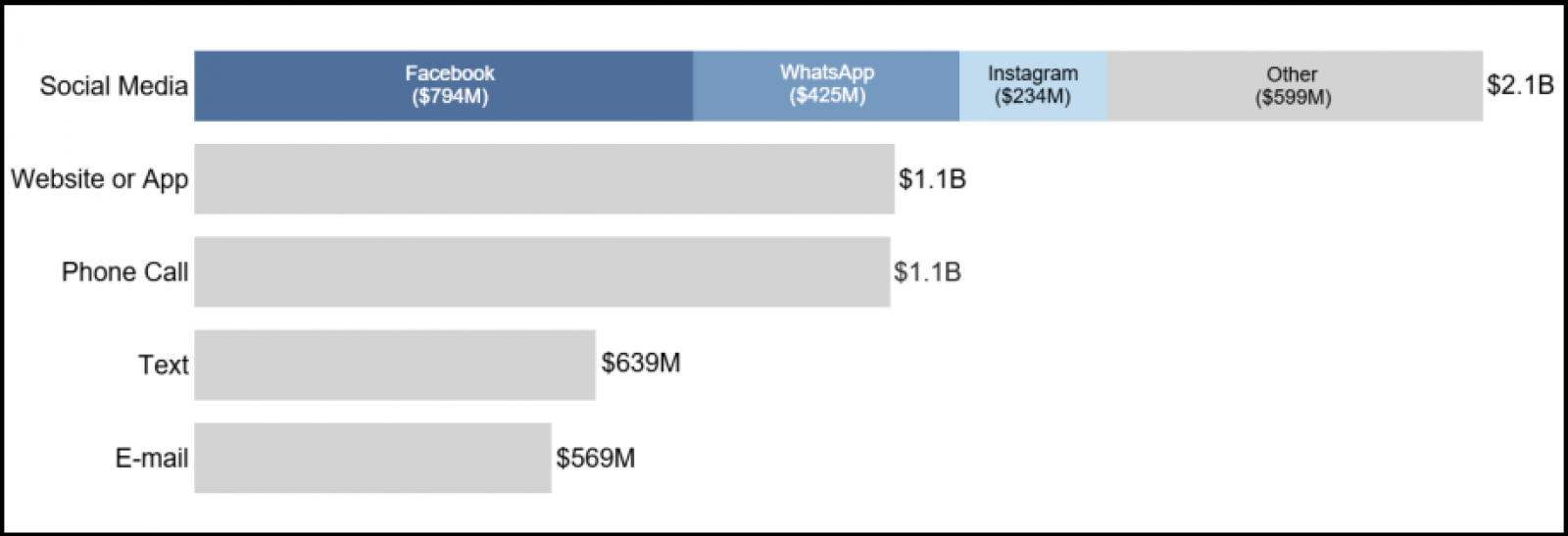
The U.S. Federal Trade Commission (FTC) warned of a massive increase in losses from social media scams since 2020, exceeding $2.1 billion in 2025.
According to reports to the FTC’s Consumer Sentinel Network, all age groups (except those 80 and over, who were mainly targeted via phone calls) lost more money to scams originating on Facebook than to any other social media platform.
Reports linked to WhatsApp and Instagram were distant second and third, and people reported losing far more money to Facebook scams alone than to text or email scams combined.

In all, as the Commission found, almost one in three Americans who lost money to scammers last year were contacted via a social media platform.
“In 2025, nearly 30% of people who reported losing money to a scam said that it started on social media, with reported losses reaching a staggering $2.1 billion. Social media scams produced far more in losses—an eightfold increase since 2020—than any other contact method used by scammers to reach consumers,” the FTC warned today.
“Social media creates easy access to billions of people from anywhere in the world, making a scammer’s job easier at very little cost. Scammers may hack a user’s account, exploit what a user posts to figure out how to target them, or buy ads and use the same tools used by real businesses to target people by age, interests or shopping habits.”
In response to this wave of scams targeting social media in general and its users in particular, Meta introduced new anti-scam protections across WhatsApp, Facebook, and Messenger last month. Among these new tools, Meta is testing warnings that flag suspicious Facebook friend requests based on signals such as a profile location that doesn’t match the user’s region or a small number of mutual connections.
It rolled out another set of tools in October to help users detect potential scams more easily, including a more advanced scam-detection system for suspicious chats that will warn when a new contact sends a potentially scammy message. Meta also introduced new WhatsApp warnings that alert users to only share their screen with people they trust when starting video calls with unknown contacts.
In August, WhatsApp also added a security feature designed to help users spot potential scams when being added to a group chat by unknown contacts.
Meta removed over 159 million scam ads and took down over 10.9 million accounts on Facebook and Instagram linked to criminal scam operations in 2025.
In its 2025 Internet Crime Report, the FBI said it received over 1 million complaints through its Internet Crime Complaint Center (IC3) last year, linked to nearly $21 billion in losses from cyber-enabled crimes such as investment scams, business email compromise, tech support fraud, and data breaches.
To avoid getting scammed online, the FTC recommends limiting who can view your posts and contacts on social media and refraining from allowing someone you’ve only met through social media to influence investment decisions. Additionally, it’s wise to research any company before making a purchase by searching for its name online along with terms like “scam” or “complaint.”

AI chained four zero-days into one exploit that bypassed both renderer and OS sandboxes. A wave of new exploits is coming.
At the Autonomous Validation Summit (May 12 & 14), see how autonomous, context-rich validation finds what’s exploitable, proves controls hold, and closes the remediation loop.
Claim Your Spot