In an era where cyber threats, geopolitical tensions, and physical security risks increasingly overlap, resilience has become central to how organizations and governments approach security. Few people have worked as actively to connect these conversations across borders and disciplines as Bonnie Butlin, co-founder and executive director of the Security Partners’ Forum.
Over the past decade, Butlin has helped build international networks that bring together professionals from across the security and resilience ecosystem—from corporate security leaders and policymakers to educators and emerging professionals. Through initiatives such as the Canadian Security Executive Forum and the Women in Security & Resilience Alliance, she has focused on breaking down silos in the industry while creating new pathways for collaboration, leadership, and mentorship.
In this conversation, Butlin discusses the evolving nature of global risk, the growing importance of resilience in an increasingly complex threat landscape, and why collaboration remains one of the most powerful tools in modern security.
Read the full interview excerpt below.
Bonnie Butlin on Why Modern Security Requires Global Cooperation
TCE: Our Women’s Day theme this year is “Give to Gain.” What does this theme mean to you personally and professionally?
Bonnie Butlin: I have always been passionate about security. It is more than a career to me; rather, something of a calling. Contributing to more secure and resilient communities doesn’t just benefit security professionals themselves, but also the families and societies they live in. Additionally, so much of the work that is done in professional security is done through associations, which rely on professionals and members to “Give to Gain”. Whether individually or collectively, this theme is relevant for security and resilience.
TCE: Can you share a moment in your career where supporting or mentoring others also helped shape your own growth as a leader?
Bonnie Butlin: My career trajectory seems too unconventional for traditional mentoring. I prefer to take more of a strategic and structural approach. Understanding the structure and flow of the whole profession to help build capacity and connectivity, and create more points for people to enter, progress and move within security, will enable others to bring their own contributions to security and resilience.

I often hear from women – especially at awards events – that they were mentored or had supportive spouses, which enabled them to succeed. Not everyone has the fortune of knowing the right person at the right time or having a strong support system. Strategically easing the friction points within the system as a whole, and growing networks, such as the Security Partners’ Forum (SPF), may help those without supports move more easily into and within the profession.
TCE: You have built international platforms connecting professionals across security and resilience. What gap did you see in the industry that led to the creation of the Security Partners’ Forum?
Bonnie Butlin: One of the biggest problems were the silos and lack of interconnectivity among disciplines and associations in security and resilience. While threats were becoming increasingly complex and interconnected, security experts and associations were often not communicating or even aware of each other.
By connecting them, we were able to build an international network of security and resilience professionals and bodies. By interacting and learning from each other, problem solving was accelerated and the network expanded without reinventing the wheel or experiencing problems already encountered by others.
TCE: Security today spans cyber, physical, and geopolitical risks. How do you see the concept of “resilience” evolving for organizations?
Bonnie Butlin: The international power structures are being re-ordered, the great powers are competing at the grand-strategic level, legal frameworks and alliances are being strained, and ground rules are changing. This presents formidable challenges for organizations that operate at the strategic level at best, but are striving to be resilient.
These conditions and trends also create gaps, seams and chaotic conditions in which complex threats can thrive and take advantage – and often do at scale. This is pushing the boundaries of professional security and resilience, and under compressed timelines, which may drive resilience innovation out of necessity, but with increased funding to fuel it.
TCE: Over your career in security and international affairs, what has been the most significant shift in how organizations approach risk?
Bonnie Butlin: I am noticing, particularly in recent years, a sea change in risk tolerance, including even a bifurcation in risk tolerance. At one end of the spectrum, ‘zero risk’ was introduced as a concept (e.g. locking down economies to prevent even one pandemic death), while at the other end of the spectrum ‘absolute risk’ acceptance (e.g. the possibility of nuclear war, which would not have been so easily accepted previously). This bifurcation between absolute risk intolerance and absolute risk acceptance is not consistent with traditional security models and experience, yet has been appearing in recent years, almost without question. This may signal a change in the Western ‘way of war’.
TCE: You work closely with leaders across multiple countries. How important is global cooperation in addressing modern security threats?
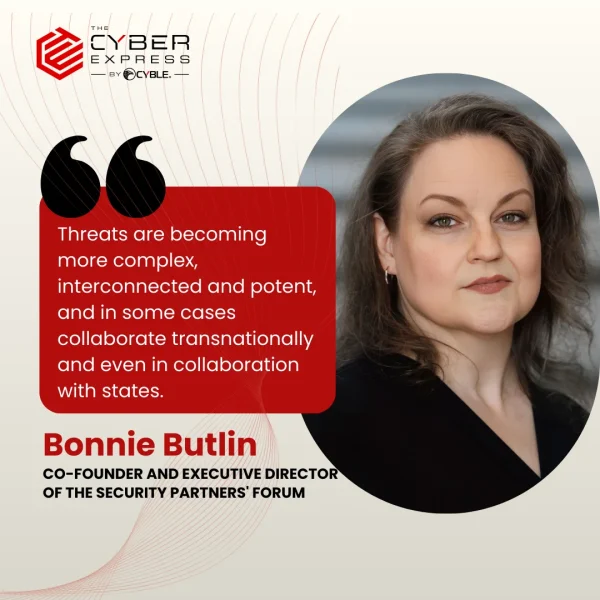
Bonnie Butlin: Threats are becoming more complex, interconnected and potent, and in some cases collaborate transnationally and even in collaboration with states. The mass injections of money into the international system during the pandemic almost certainly fuelled threat groups at scale, unintentionally.
The current wars, great power grand-strategic competition and international re-ordering currently underway, offers even greater opportunities for complex and significant threats. Combatting international, empowered, and collaborative threats, while states and regions are at war, re-ordering international systems, and while traditional state and regional alliances are strained, will be exceptionally difficult – even more so without international cooperation on the security and law enforcement fronts.
Managing both conflict and cooperation among states will be a fine line in the current context, as threat groups operate relatively unrestrained.
TCE: The security industry is gradually seeing more women step into leadership roles. What changes still need to happen to accelerate this progress?
Bonnie Butlin: In the current global and economic contexts, jobs are becoming scarce and more competitive, often requiring the latest education and skills. I am deeply concerned about ageism and career disruptions, both for women and men.
Longer-run focus on and flexible commitment to existing employees and cohorts may help accelerate women’s access to leadership roles and prevent permanent loss of talent from the workforce.
Cohort diversity can enhance mentoring and build opportunities all the way up the career ladder, while retaining experience and knowledge within the organization and security and resilience professions.
It can also capture talent from other sectors and disciplines, and recapture lost talent, experience and knowledge resulting from career disruptions or organizational change and lay-offs.
TCE: With rapid technological advancement, what emerging risks should security leaders start preparing for today?
Bonnie Butlin: Emerging risks to consider may include:
First, setting an appropriate risk tolerance for an organization, in relation to technology adoption (especially AI), to get the right balance between under- and over-reliance on, and confidence in, new technology.
Second, building an appropriate security and resilience posture against, for example, catastrophic attacks on critical infrastructure. This is particularly important as low probability, but high impact events (such as wartime attacks), are becoming more likely; and as fintech, drone technology, and newly unveiled experimental weaponry are playing new and prominent roles in conflict. Traditional threat assessment models and methodologies may have to be adapted.
Third, the risk of government or organization overreach in terms of data access and surveillance – enabled by technology that is itself being super-funded and channeled in the context of great power grand-strategic competition and conflict, evolving privacy and legal landscapes, and more frequent appeals to national security necessity.
TCE: What skills or mindset shifts are most important for young professionals—especially women—entering the security and resilience field?
Bonnie Butlin: The issue may be structural, and young professionals may benefit from understanding trends and pressures. The preference for specialists vs. generalists in the workplace has oscillated over time. With technology advancing more rapidly than ever, the preference may be trending toward an extreme – ultra-specialization – which may itself have limitations.
The recent mass tech lay-offs, in part, reflected substituting a programmer workforce with an AI workforce, rather than retraining/adapting existing employees. This substitution approach may make the tech sector more precarious for workers, especially older and more established workers, while education, training and up-skilling become more onerous.
Over time, this (substitution approach) may reduce the sector’s desirability for new entrants, may increase burnout risk in the profession, and will likely make long-run career planning more difficult.
Selecting and navigating an entire career trajectory from the outset may become even more difficult, whereas choosing an ultra-specialty in the short-run may be relatively easier. That said, the trend may eventually shift back to a preference for a more generalist and adaptable workforce, particularly if there is social pressure on the sector after a prolonged period of instability in the global economy, persistent career disruptions, and downward pressure on global workforce mobility.
TCE: What advice would you give to organizations looking to build stronger and more inclusive security leadership teams?
Bonnie Butlin: Organizations might consider, where possible, longer-run loyalty to, and investment in employees and their progression and growth – including with training, up-skilling opportunities, and mentoring. This may be strategically sound, particularly if the initial enthusiasm for AI wanes. Even if ultra-specialization continues to be preferred, promoting a more balanced workforce, across cohorts and time, may be beneficial.
Balancing newly graduated and younger hires with older cohorts, employees re-entering the workforce after career disruptions and employees newly entering the tech space after previous careers in other sectors or specialties, will likely build more balanced workforces, with diverse thinking and experience, especially over time. This broader net in terms of experience and background may yield better and more nuanced result for communities and societies.