Cybercriminals are buying the same Meta ad inventory that legitimate brands use. They use it to push the SYS01 infostealer, which targets Facebook Business accounts and turns each stolen account into funding for the next wave of ads.
Thousands of ads were observed, and individual ads reached tens of thousands of people, mostly men aged 45 and over. Nearly a hundred malicious domains handled both distribution and live command and control (C2).
When antivirus vendors blocked one dropper version, the operators added stronger obfuscation and relaunched the ads.
Ads typically pointed to a MediaFire download, which delivered a .zip archive containing an Electron application.
The archive’s app.asar file held a password-protected archive, a standalone 7-Zip binary (7za.exe), an obfuscated main.js, optional PowerShell intermediaries and a text file of GPU models.
The GPU list works as a sandbox check. The script enumerates the host’s graphics hardware, and if the model is not on the list, nothing malicious runs.
If the check passes, 7-Zip extracts a bundled PHP interpreter and IonCube-encoded scripts (index.php, include.php and sometimes test.php). A working decoy app runs in the foreground, so victims see nothing unusual.
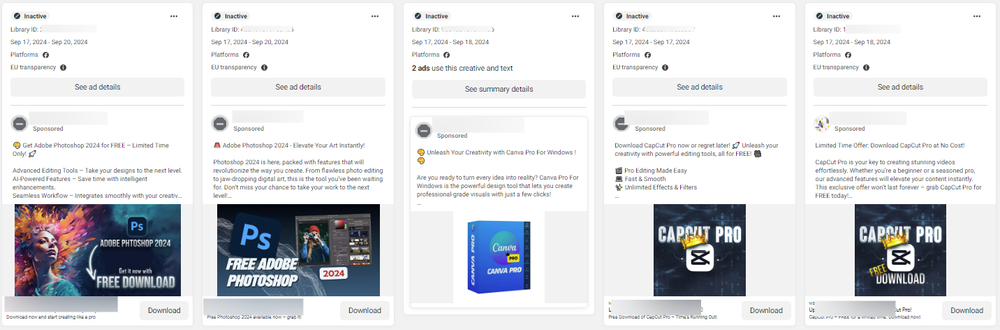
Bitdefender Researchers said that, the ads impersonated CapCut, Canva, Adobe Photoshop, Office 365, Netflix, Telegram, ExpressVPN and games such as Super Mario Bros Wonder.
Fake Facebook Ads
The include.php script creates two Task Scheduler entries. WDNA runs the PHP stealer every two minutes. WDNA_LG re-runs include.php and index.php at each logon, which restores persistence if the tasks are tampered with.
Memory analysis of the stealer showed the SYS01 string and many C2 domains. It can fetch more domains through Telegram bots or Google Pages, and it checks C2 health with an /api/rss?a=ping request.
It queries Firefox’s moz_cookies table and receives commands such as get_ck_all to harvest cookies and tokens. It also receives Meta Graph API calls that enumerate the victim’s Facebook pages and ad accounts. Anti-sandbox checks run before every stage.
Stolen Facebook Business credentials let attackers buy ads through accounts that already have a trusted history. That helps the ads bypass Meta’s filters.
Each hijacked account then funds more malicious ads, so the operation grows without phishing emails or new fake profiles. The accounts can also be sold on dark web markets.
The operation has since escalated. On November 26, 2026, Bitdefender disclosed SYS010, which it assesses as likely the second major version of SYS01.
It uses ads for free animated wallpaper apps, including Wallpaper Engine and Lively Wallpapers. The “Wallpaper Engine.exe” file is a renamed, signed MeisterTask desktop binary built on Electron 11.0.3.
That Electron version does not verify its resources, so it loads the attacker’s app.
The final payload has moved into the browser. BleepingComputer reports that the malware abuses enterprise-style browser management to force-install extensions in Chrome, Edge and Firefox.
The extensions steal cookies and Meta Business data, read recent Gmail and Outlook messages, and can delete emails.
Stolen session cookies can bypass passwords and MFA. Bitdefender found Vietnamese-language artifacts and build timestamps consistent with UTC+7, but the operator remains unidentified.
Morphisec first documented SYS01stealer in late 2022. It was then spread through Google ads and fake Facebook profiles.
Users should avoid installing software advertised on social media and should refuse unexplained administrator prompts.
Businesses should audit who has access to Meta Ads accounts, remove unnecessary permissions, and watch for unfamiliar ads, unusual charges and payment-detail changes.
Defenders should also look for the WDNA and WDNA_LG scheduled tasks, bundled php.exe processes, and unexpected browser management policies.
IOCs
| Role | URL |
|---|---|
| Malware hosting domain | hxxps://krouki[.]com |
| Malware hosting domain | hxxps://kimiclass[.]com |
| Malware hosting domain | hxxps://goodsuccessmedia[.]com |
| C2 domain | hxxps://musament[.]top |
| C2 domain | hxxps://enorgutic[.]top |
| C2 domain | hxxps://untratem[.]top |
Note: IP addresses and domains are intentionally defanged (e.g., [.]) to prevent accidental resolution or hyperlinking. Re-fang only within controlled threat intelligence platforms such as MISP, VirusTotal, or your SIEM.
Stops Cyber threats before impact with 21 min faster MTTR. Integrate ANYRUN’s Sandbox in your SOC.