- Why Security at the Code Stage Costs Fractionally Less
- Aligning Security Controls with Pipeline Pace
- How Wiz Secures Code at Every Phase
- 1. Secure Foundations at the Root
- 2. Developer Session and Local Commit Gates
- 3. Pull Request and Repository Scanning
- 4. CI/CD Pipeline Build Gates
- Stop Chasing Risk. Start Preventing It.

A developer pulls node:20-slim as a base image. It’s a sensible default and what most documentation reaches for. It also ships with 14 known CVEs, three of them critical.
Caught in the Dockerfile, fixing it takes a one line change. Swap the image tag, commit, keep moving. That’s a few seconds of developer focus. Caught in production, you’re patching every live container running that image. You need a maintenance window, service ownership across teams, and regression testing. Before any of that begins, your incident team has to answer one question. How long was this image reachable, and did anyone exploit it?
Same 14 CVEs. Two drastically different bills.
That cost gap isn’t new, but frontier AI models are drastically accelerating the clock alongside it. Finding a flaw, confirming reachability, and writing a functional exploit used to require days of skilled manual research. Today, AI agents can analyze open source commits, identify unpatched CVEs, and generate working zero-day exploits in minutes, which represents a shift that has already been documented across real-world web applications. Reconnaissance runs continuously, weaponization happens at machine speed, and the window between a public fix and an automated attack has virtually vanished. Patching faster is necessary, but it hits a hard floor set by deployment cycles. The real solution is creating less vulnerable code in the first place and resolving risk long before the production clock starts ticking.
Why Security at the Code Stage Costs Fractionally Less
Shift left security isn’t about throwing another scanner at developers. It’s about engineering economics. Three dynamics make fixing issues in code exponentially cheaper.
The fix stays localized. In code, you modify the source. In production, you fix every instance the source created. One line in a Dockerfile versus dozens of running microservices. Risk scales as it travels. In code, it hasn’t gone anywhere.
Context is fresh. The expensive part of a fix isn’t typing code, it’s rebuilding context. A developer who wrote a function an hour ago understands the logic and intent. A developer handed a ticket for code written last quarter has to pause everything to rebuild that mental map. Long feedback loops destroy throughput.
The exposure window never opens. A production finding forces an immediate investigation into blast radius and exposure. A code level finding carries zero exposure. There’s no blast radius to calculate because the risk was never live.

Aligning Security Controls with Pipeline Pace
If a security check slows down deployment or breaks a workflow, developers will bypass it. That isn’t a discipline problem, it’s what happens when controls block delivery goals. Security checks must match the pace of the pipeline stage they occupy.
In the agent session. Catching issues directly inside the IDE or AI workspace gives you the fastest, cheapest fix available. Pattern-based problems like hardcoded secrets, bad defaults, and vulnerable packages get flagged instantly. The person or AI writing code holds the context to fix it immediately, keeping exposure at absolute zero.
At commit and push. Sitting right at the local repository gate, this stage acts as a baseline policy guardrail. Catching a leaked credential or policy violation here stops bad code from ever entering git history, where rotation gets expensive. Clean commits become the standard outcome.
On the pull request. Authorization flaws, business logic gaps, and architectural weak spots only show up when analyzing how a change fits into the broader codebase. Because pull requests represent a natural pause in delivery, deeper analysis fits right into the workflow without disrupting engineering momentum.
Against the repository. Committing code to version control doesn’t automatically mean it goes to production. Continuous repository scanning acts as a preventive gate. Scheduled scans or merge triggers catch vulnerabilities, secret leaks, and misconfigurations long before deployment pipelines run, ensuring flawed code never gets built.
In the pipeline. The build phase is your final preventive checkpoint before artifacts move toward release. Dependencies are fully resolved, compilation context is complete, and build artifacts like container images are fully formed. Scanning here ensures packaged software matches security standards before reaching a registry.
The real boundary in cloud security isn’t between the IDE and the pull request. It’s between pre-deployment code and live, unmonitored production. Moving a fix from a pull request to an agent session saves a review cycle. Moving a fix out of live production into early stages eliminates exposure entirely.
How Wiz Secures Code at Every Phase
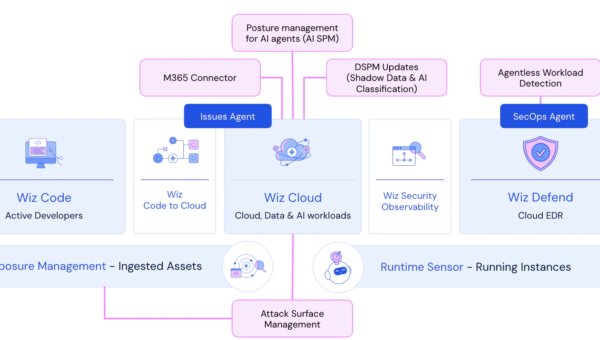
Wiz Code integrates directly across all phases, giving teams unified visibility and dev-friendly guardrails without impacting velocity.
1. Secure Foundations at the Root
To eliminate base image vulnerabilities before code ever reaches your pipelines, WizOS provides a catalog of hardened, near-zero CVE base images. Adopting WizOS at the foundation layer removes inherited OS level flaws at the source, ensuring developers start with clean images rather than carrying third party vulnerabilities into every build.

2. Developer Session and Local Commit Gates
The WizCLI and MCP server work alongside AI coding agents to run local checks against code as it’s generated. Results can be fed back into the agent context to correct CVEs, exposed secrets, and pattern flaws in real time before code ever leaves the local machine.

3. Pull Request and Repository Scanning
On pull requests and repository schedules, Wiz runs a complete scanning suite covering SAST, SCA, hardcoded secrets, and IaC misconfigurations. Findings post directly into review threads, while the Wiz Security Graph correlates code structure with live cloud context to prioritize issues based on actual exploitability.

4. CI/CD Pipeline Build Gates
At the build phase, Wiz integrates into CI/CD pipelines to inspect compiled container images and artifacts. Applying customizable policy gates allows Wiz to automatically break builds if critical security violations are detected, ensuring non-compliant, vulnerable, or malicious artifacts never reach a deployment registry, and are therefore never exposed to a runtime environment.

Stop Chasing Risk. Start Preventing It.
Runtime security and production patching will always be essential because prevention is never 100%. But treating production as your primary security gate is a losing strategy.
Every vulnerability resolved in code is one less ticket in your queue, one less emergency patch window, and one less incident clock ticking down. Patching faster keeps you in the race. Fixing in code means you don’t have to race at all.
Read the Wiz Remediation Playbook to learn how to streamline risk resolution across your entire pipeline, and burn down your security backlog at machine speed.