For a $1,000 investment, traditional routes into US equities create a round-trip friction cost of approximately $130. This substantial figure encompasses bank foreign exchange spreads, international wire transfer fees, account minimums, per-trade charges, custody fees, and multi-day settlement delays.
Stablecoin settlement changes that equation. By allowing eligible users to fund stock purchases directly with digital dollars or existing crypto balances, digital asset platforms reduce much of the operational complexity that has historically separated banking, payments, and investing. The result is not simply lower transaction costs, but a fundamentally different financial architecture.
Rather than requiring users to move money across multiple institutions before purchasing an investment, capital can increasingly move across multiple financial products on the same underlying settlement rail. As access costs continue to decline, the central question becomes whether removing these structural barriers could meaningfully expand participation in global capital markets.
The Access Gap: 82% of the World Locked Out
The structural barrier to capital markets is stark. Currently, 82% of the global population lacks meaningful access to the US equity market. While US equities account for approximately half of global equity market capitalization, and above 60% on a free-float-adjusted basis, foreign investors hold only around 18%. 62% of Americans hold equities, yet participation outside the US remains broadly below 20%.
Closing that gap requires more than simply offering additional investment products. It requires reducing the operational friction that separates saving, payments, currency conversion, and investing into independent financial experiences.
“Most fintech ‘super-apps’ are just bundles separate products stitched behind one login,” says Binance Interim Chief Marketing Officer Eowyn Chen. “The next generation of financial infrastructure won’t be a bundle; it’ll be a system, where every product compounds the value of the next. That’s what Binance is building for the next three billion users: crypto, traditional markets, payments, yield, and everyday money movement on a single secure rail proven to operate at global scale.”
That philosophy increasingly reflects how crypto platforms are evolving. Binance recently expanded beyond digital assets through BStocks, giving eligible users access to more than 7,000 U.S. stocks and ETFs with fractional investing starting at US$5, 24/5 trading, zero-commission stock trading, and funding through stablecoins, fiat, or existing crypto balances.
Rather than functioning as a standalone brokerage product, equities become another financial service operating on the same underlying infrastructure as payments, digital assets, and money movement.
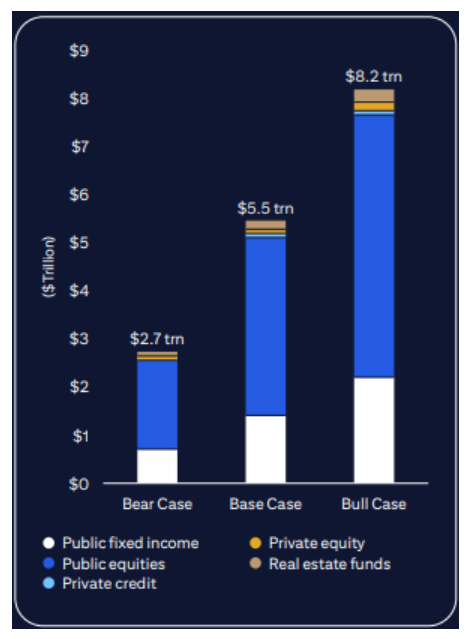
A recent Citi Institute report (PDF) states that modern, digitally native investors increasingly expect 24×7 access to financial assets. If just 10% of US retail investors transition to on-chain solutions by 2030, it could create about $2.6 trillion of new demand for tokenized public equities.
Artem Korenyuk, Head of Enterprise Digital Assets, Citi Client Business Development commented in the report, “The tokenization of financial assets is more than just technology; it is unlocking Wall Street for the digitally-native generation.”
How Stablecoin Settlement Eliminates Hidden Costs
For users conducting cross-border transactions, stablecoins offer a clear mathematical advantage. They eliminate an average 3.6% and roughly $40 per transaction in off-ramp costs, while completely removing the operational friction of routing funds through a local bank before reaching a separate brokerage account.
A recent Liminal analysis observed that traditional cross-border payment costs remain at 6 to 7%, with some specific geographic corridors exceeding 10%.
Simultaneously, Mordor Intelligence data published by Forbes indicates that digital remittance segments are growing at 15.92% annually, confirming robust structural demand for lower-cost rails.
Stock trades placed on Binance settle directly in stablecoins such as USDC, USDT, USD1, and $U, or via BNB. Bypassing traditional banking intermediaries entirely strips away layers of hidden spread extraction and multi-day settlement delays that make cross-border equity investing prohibitively expensive for most international retail participants.
Fractional Shares and the $5 Minimum
Traditional brokerage minimums typically range from $500 to $10,000, creating an immediate liquidity barrier. On Binance, the minimum entry point is $5. Recent fractionalization data highlights exactly why this matters for global inclusion.
Shares of technology companies like Sandisk and Micron surged to $1,716 and $1,064 respectively. Since the average worker across Africa and Southern Asia earns below $300 per month, a single whole share represents several months of wages.
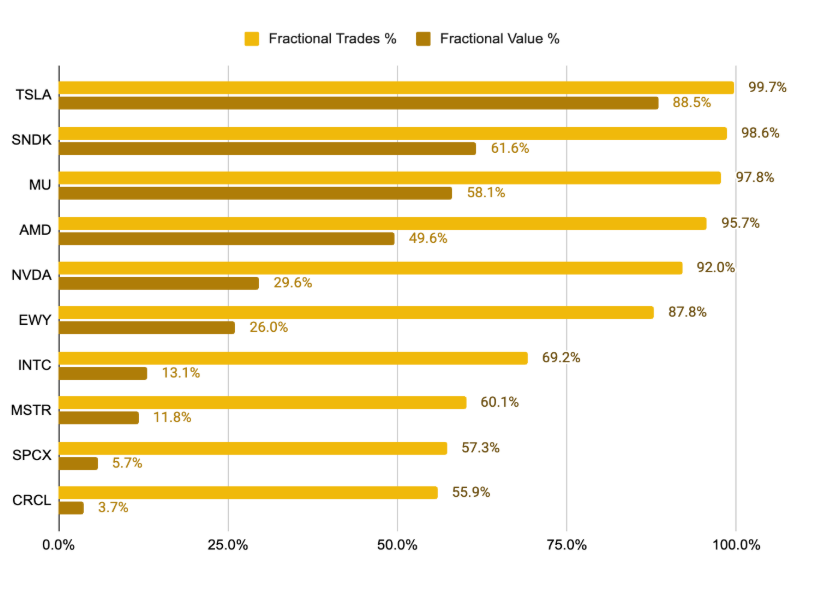
First-week data showed approximately 39% of all trades were placed for under $100. This represents a distribution curve structurally impossible through most traditional brokerage routes. Additionally, approximately 25% of these stock users were under 25 years old.
A World Economic Forum report confirms that fractionalization reduces administrative burdens and barriers to entry, widening the addressable market considerably for populations previously excluded from wealth generation.
What bStocks Add: Tokenized Securities and 24/7 Composability
The platform utilizes a two-track architecture to serve different investor needs. Direct stock trading offers over 7,000 US stocks and ETFs. To complement this, bStocks are tokenized securities issued via BTECH Holdings in the Abu Dhabi Global Market. Backed 1:1 by real shares at a regulated custodian, they add 24/7 trading, self-custody through BNB Chain wallets, and decentralized finance composability.
Over 80% of bStock trades are fractional, and the product crossed $100M in assets under management within 15 days of launch.
This approach is not merely digitizing existing instruments for cosmetic purposes. It adds functional utility layers, including staking for platform benefits, always-on trading capabilities, and self-custody protocols. Traditional brokerages simply cannot replicate these features, marking a fundamental difference in how digital-first investors interact with their acquired equity positions across global time zones.
The Structural Shift Toward On-Chain Equity Markets
These evolving market structures carry significant implications. Tokenized stocks with utility features like staking create a persistent supply-sink effect. Staked tokens are withdrawn from circulating supply, and each locked token requires the custodian to purchase an equivalent share. Furthermore, direct stock trading may normalize TradFi-linked perpetuals funding rates toward the prevailing risk-free rate.
Conclusively, early data suggests the binding constraint on global equity participation has always been access, not appetite. Stablecoin-settled equity trading on crypto rails actively removes that barrier, establishing a new paradigm for cross-border financial inclusion.