Introducing ISPM’s Identity Posture Assessment, an on-demand report that shows exactly where your identity defenses stand and how fast you can fix them.
Attackers love Microsoft 365, and they rarely need anything fancy to get in. Last year, 79% of the critical and high-severity incident reports our SOC sent out were tied to identity threats. Most of those attacks didn’t start with a zero-day. They started with a missing MFA policy, a legacy protocol nobody turned off, or an admin account with more access than it needed.
The hard part is seeing those gaps before an attacker does. Microsoft 365 has hundreds of settings spread across Entra, Exchange, SharePoint, and Teams, and few teams have time to audit them all. Huntress data shows more than half of recommended controls are missing in over 60% of tenants, even ones that already have posture tooling in place.
That’s why we built the Identity Posture Assessment. It’s a clear, shareable snapshot of any Microsoft 365 tenant, scored against the Huntress Identity Security Framework, and it’s available now in Huntress Managed ISPM.
The Identity Posture Assessment can also be co-branded.
What’s inside the identity posture report?
The assessment is built so anyone can pick it up and understand it in minutes, from the security engineer to the CEO.
Compliance rating: Your headline number. This shows what percentage of assessed controls are configured correctly and breaks every control into four buckets: Compliant, Not Compliant (Huntress can deploy the fix), Manual Action (an admin needs to change it in Microsoft 365), and Risk Accepted (your team has signed off). Better yet, it shows how high your rating could climb just by turning on Huntress ISPM recommendations. The report only scores controls your tenant is licensed for, so you’re never penalized for Microsoft features you don’t have.
Posture by capability: Controls are grouped into three Huntress capabilities, each built around a specific threat model, and mapped to Managed ITDR.
Unwanted access covers authentication and external access, including MFA, legacy auth, guest access, admin protection, and email security.
Shadow workflows covers Exchange, Teams, and SharePoint settings attackers use to bypass controls or hide their activity.
Rogue apps covers OAuth consent and app creation, limiting the risk of unapproved or overprivileged apps landing in your tenant.
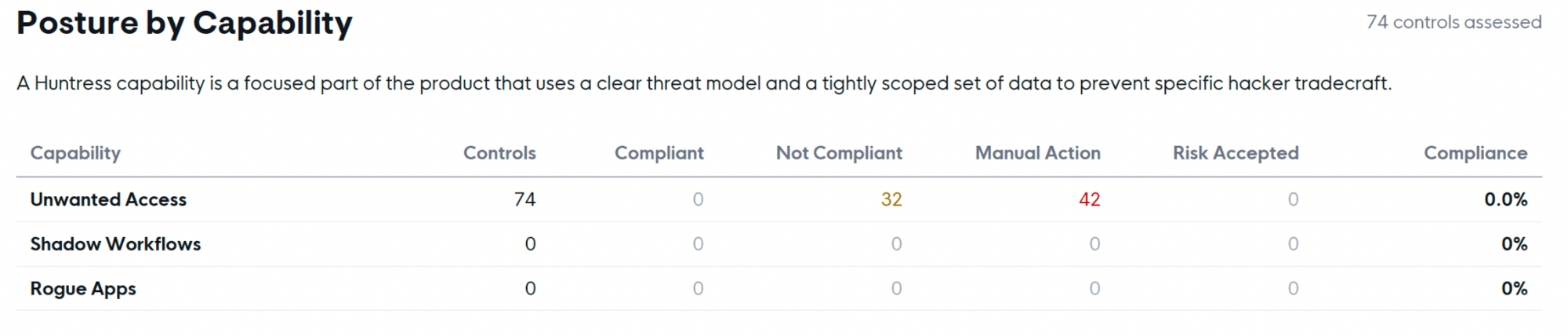
Managed ISPM maps to Managed ITDR capabilities.
Microsoft Secure Score: Your Secure Score appears as a separate reference point. It’s reported by Microsoft and kept apart from the Huntress rating, so you get an independent third-party view alongside the vendor’s own grade.
Gaps and next steps: This is where the report earns its keep. Every non-compliant control is listed with its severity, category, and capability, then sorted into two groups: controls you can deploy with Huntress ISPM in one click, and controls that need manual configuration. No guessing about what to fix first or who owns it.
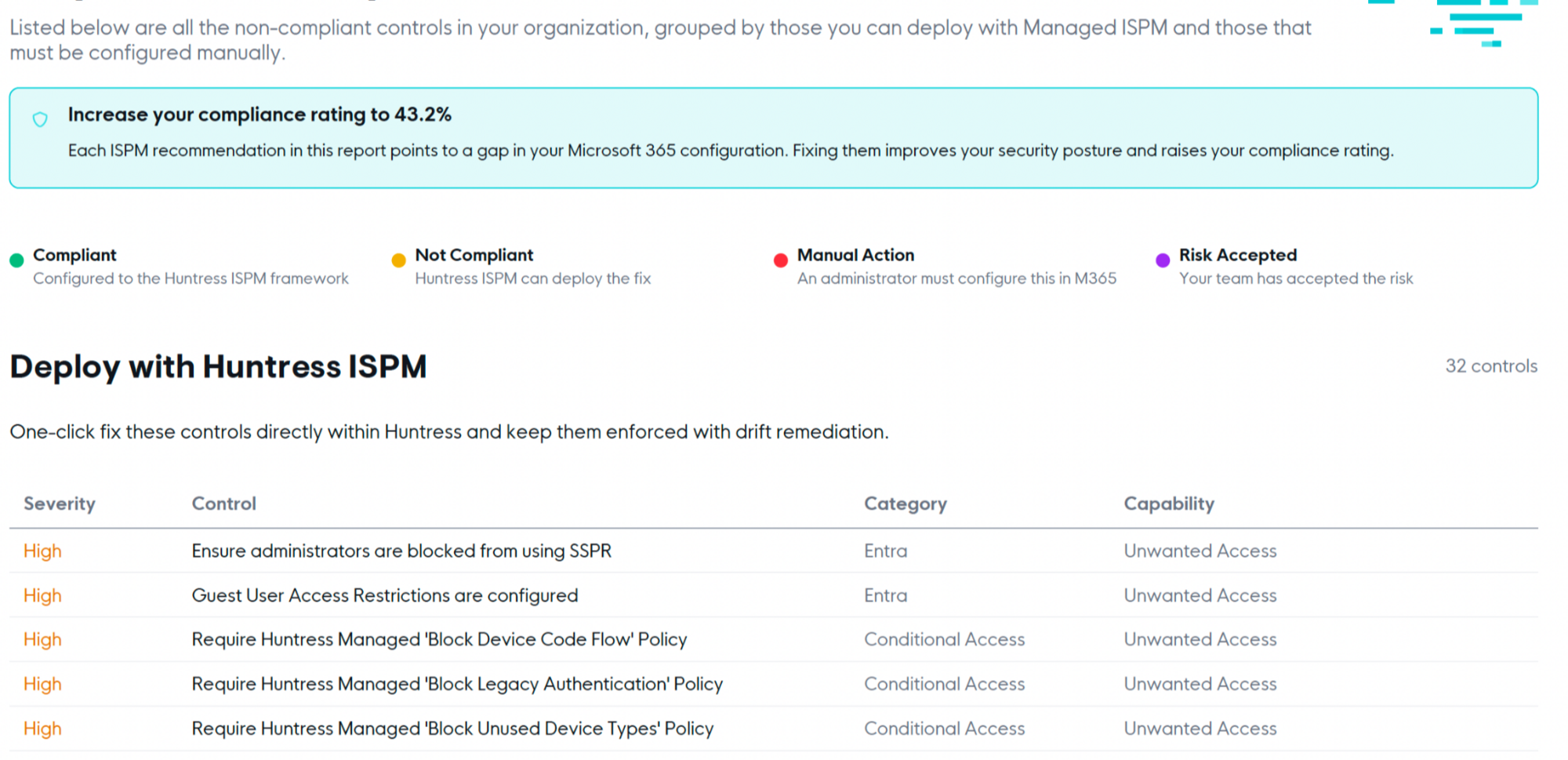
Non-compliant controls you can deploy and fix with Managed ISPM.
Compliance breakdown by capability: This is a deeper look at each capability, with the status of every control so you can pinpoint exactly where the gaps are.
Your ongoing protection: A short recap of how Managed ISPM keeps working after the report: hardening before attackers strike, deploying controls in one click, and catching drift automatically so your posture doesn’t quietly slide backward.
Why this matters
If you’ve used the Identity Security Assessment from Huntress Managed ITDR, you already know how powerful a single report can be. The Identity Posture Assessment from Managed ISPM brings that same clarity to the prevention side of identity security.
Together, they tell the full identity resilience story. ITDR shows how attackers are getting in. ISPM shows which doors are still open and closes them. Our own data backs this up: 35% of ITDR incidents over a six-month period could’ve been prevented by fully deployed ISPM policies.
Identity resilience means attackers have fewer easy ways in, less time to operate, and less chance to turn a compromised account into real business damage. This report shows you how close you are to that goal and what it’ll take to get there.
For MSPs: your new favorite prospecting tool
Every MSP knows the hardest part of selling security is making the risk feel real. This report does that for you.
Run an assessment during a prospect’s trial and walk into the meeting with a scored, prioritized list of their Microsoft 365 gaps. A low compliance rating with dozens of high-severity findings starts a conversation no slide deck can.
Add your own logo and colors, and the report goes out under your brand, powered by Huntress. Use it to open new deals, justify upsells at QBRs, and show existing clients how far their posture has come since onboarding. When a client asks what they’re paying for, you’ll have the answer on paper.
For internal security teams: make the case to leadership
Getting budget and buy-in for identity security usually means translating technical risk into business language. The ISPM Posture Assessment does that translation for you.
Hand leadership one number they can track over time. Show them how many gaps Huntress can close immediately and how many need your team’s attention. Use it to support audit prep, cyber insurance renewals, and board updates. And when you need to prove progress, run a fresh assessment and show the before-and-after.
Getting your report takes seconds
Reports are generated on demand from the ISPM dashboard, at either the account or organization level. Pick the organization, click Generate, and the PDF downloads straight to your browser. The assessment currently supports Microsoft 365.
See what your tenant is hiding
Most organizations are more exposed than they think. The only way to know for sure is to look.
With the Identity Posture Assessment, looking now takes about as long as reading this sentence.
Start your free trial of Huntress Managed ISPM and generate your first Identity Posture Assessment today.