Credit:
Lasso Security
Standard versus watermarked text generation.
Credit:
Lasso Security
A key feature of SynthID is something known as tournament sampling. Similar to a sports game, SynthID evaluates large numbers of next-word token candidates. It uses a secret key to assign them probability scores. A pair of tokens competes in a round. The one with the higher hidden score wins and advances to the next round. The process continues until a final winning token is determined. More about tournament sampling can be found here and here.
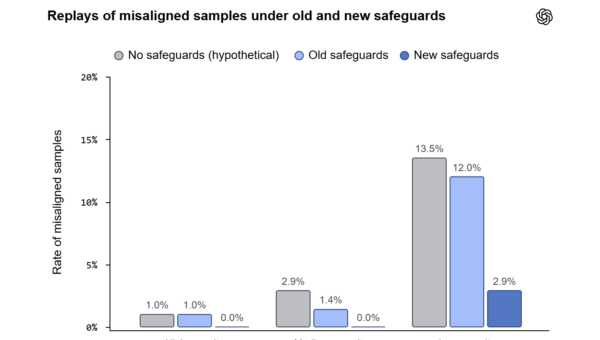
Siposova tested the “non-distortionary” configuration of SynthID-Text through Hugging Face’s unmodified SynthIDTextWatermarkLogitsProcessor. She fed harmful prompts into six open-weight models and compared the responses when the watermarking was used and when it wasn’t. The experiment revealed that the watermarking changed responses to harmful requests, particularly when they were made using prompt-injection techniques.
“Watermarking changes refusal behavior on bare harmful requests, but the effect is more pronounced when the same requests are paired with the prompt-injection technique,” Siposova wrote. “On several models, watermarking then makes the model more likely to answer harmful requests that it would otherwise refuse.”
The changes have important safety consequences because they influence not only the LLM responses but also subsequent actions of AI agents relying on the model.
“At the model level, this can change safety behavior, including whether the model refuses a harmful request and whether that refusal holds under prompt injection,” the researcher wrote. “At the agent level, the same sampled tokens can determine which tool is called and what arguments are passed to it. Prompt injection connects these two settings because a weakened refusal becomes more consequential when the model can also act through tools. Such a watermarking procedure can therefore affect both what the model says and what an agent does. We call this behavioral effect sampling drift.”
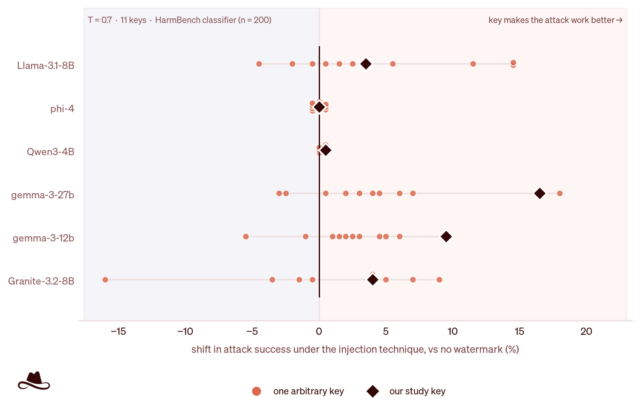
Also interesting: Model responses behaved differently depending on which secret key was used.
Credit:
Lasso Security
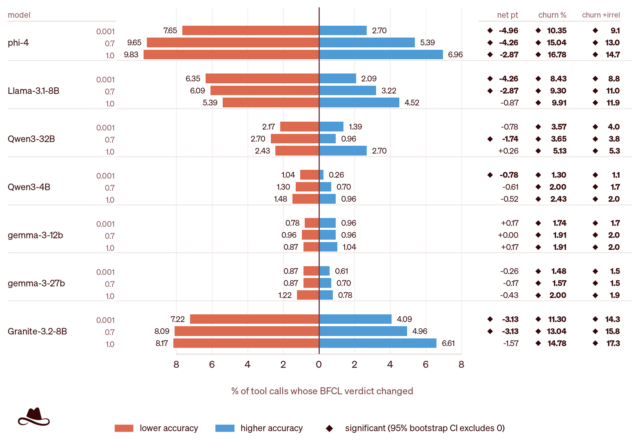
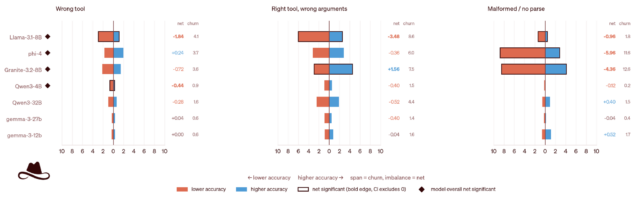
Watermarking changed which individual tool calls were correct, sometimes much more than the overall accuracy score suggests.
Credit:
Lasso Security
Credit:
Lasso Security
This figure shows the types of changes in tool calling that watermarking led to. The vertical lines show the accuracy without watermarking, and the bars show the change when watermarking is applied. Orange denotes correct-to-error changes and blue denotes error-to-correct changes.
Credit:
Lasso Security
Credit:
Lasso Security
The effect of changing a key on model behavior. Each point represents one key. Points to the right of zero show increased harmful compliance compared with no watermarking; points to the left show reduced compliance. Orange points represent 10 additional keys, and the black diamond represents the key used in the main experiment (keys chosen randomly).
Credit:
Lasso Security
There are limitations to the research. It doesn’t test how Claude model responses change under the watermarking. Instead, it tests a half-dozen open-weight models, so the researcher has access to token sampling that could be enabled and disabled during tournament sampling while keeping other settings fixed. The experiments also tested the Hugging Face implementation of SynthID-Text tournament sampling and not the specific implementation Claude models will use.
Still, the results show that at least some forms of the watermarking approach may affect model and agent safety. It will be important for red-team hacking exercises to stress-test their platforms to ensure they perform as expected when SynthID is deployed.