Hackers are leveraging large-scale malvertising campaigns to distribute a newly identified macOS backdoor dubbed FlutterShell, marking a significant evolution in financially motivated adware operations.
Security researchers tracking the activity attribute it to a broader cluster known as CL-CRI-1089 and have named the ongoing campaign Operation FlutterBridge.
The campaign builds on earlier activity linked to the JSCoreRunner malware first observed in August 2025. While previous operations primarily delivered adware, the latest wave introduces full backdoor functionality, significantly increasing the threat level.
FlutterShell is actively under development, with new variants and capabilities appearing in rapid succession.
Palo Alto said in a report shared with GBhackers, Operation FlutterBridge relies heavily on Google Ads infrastructure to reach victims globally, particularly in English-speaking and Western European regions.
Attackers used a network of Google-verified advertiser accounts tied to shell companies to distribute hundreds of malicious ads at scale. These ads redirect users to convincing download pages hosting trojanized macOS applications disguised as legitimate tools such as podcast players and PDF viewers.
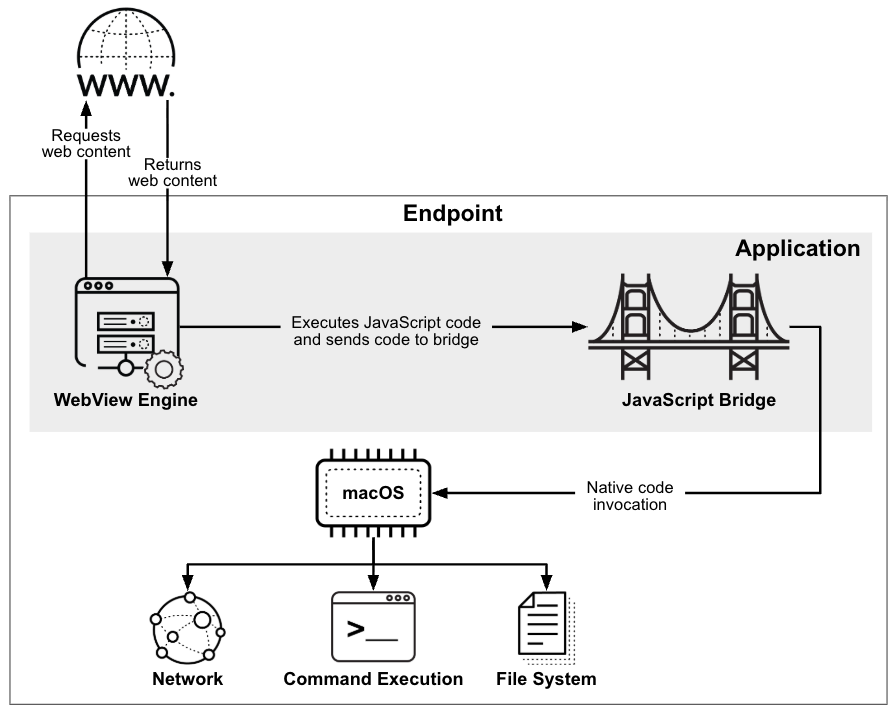
FlutterShell is built using the Flutter framework and employs a WebView-based architecture with a JavaScript-to-native bridge.
This design allows the malware to load malicious logic dynamically from attacker-controlled servers rather than embedding it directly in the binary.
As a result, threat actors can modify behavior in real time without redistributing the application, complicating detection and analysis.
Once executed, FlutterShell supports a range of backdoor capabilities, including arbitrary shell command execution, file system access, and environment variable exfiltration.
In observed infections, the malware primarily acts as adware by hijacking browser activity. It modifies Google Chrome’s Secure Preferences file to redirect searches and new tabs through attacker-controlled domains, enabling ad fraud and traffic monetization.
Malicious Ads Target macOS Users
A notable feature in newer variants is the abuse of artificial intelligence summarization tools. Instead of processing documents locally or via legitimate APIs, FlutterShell routes user data through attacker infrastructure before forwarding it to an AI service.
This enables silent data exfiltration while presenting users with expected functionality, increasing the likelihood of remaining undetected.
Researchers identified multiple variants of FlutterShell, including applications masquerading as PodcastsLounge, PDF-Brain, and PDF-Ninja.
These samples were signed with valid Apple Developer IDs and successfully passed Apple’s notarization checks at the time of distribution.

Despite their malicious behavior, some samples initially showed zero detections on security scanning platforms, highlighting the campaign’s sophistication.
Technical analysis reveals that FlutterShell delays execution by waiting for instructions from its command-and-control server before loading malicious web content.
This delay helps evade sandbox detection and builds user trust. The malware retrieves commands via endpoints such as “/getConfig” and “/getUpdateThanksConfig,” which define execution logic in JSON format and allow continuous updates.
The campaign infrastructure demonstrates a high level of operational planning. Shell companies such as AdsParkPro LTD and Advantage Web Marketing LLC were used to register and age advertiser accounts, bypassing fraud detection systems.
These entities exhibit characteristics typical of front organizations, including minimal digital presence and templated websites.
Despite its sophistication, the operation shows occasional operational security lapses, including poorly translated ad content and asset reuse across campaigns.
However, these flaws have not significantly limited its reach, as the campaign continues to evolve and expand.
The connection between FlutterShell, JSCoreRunner, and Windows-based malware families such as RecipeLister and Calendaromatic confirms a broader cross-platform strategy.
Advantage Web Marketing LLC has been observed not only spreading malicious advertisements but also acting as the signatory for Windows adware variants associated with the CL-CRI-1089 cluster.

All strains share a similar WebView-driven architecture and browser hijacking behavior, indicating a unified development approach.
The emergence of FlutterShell highlights a growing trend in modular malware design, where core logic is decoupled from binaries and delivered dynamically.
This approach not only enhances flexibility for attackers but also presents new challenges for defenders attempting to detect and analyze threats in macOS environments.
Follow us on Google News, LinkedIn, and X to Get Instant Updates and Set GBH as a Preferred Source in Google.