Executive Summary
AI is rapidly transforming vulnerability discovery, outpacing many security teams’ ability to adapt. Microsoft’s July 2026 Patch Tuesday addressed a record 622 vulnerabilities, an early signal of AI-accelerated discovery at scale compounding an already-large backlog that manual remediation can no longer keep pace with. Qualys TruRisk Eliminate’s AI-Powered Patch Reliability Score assesses whether a patch is safe to deploy using crowd-sourced signals from patch deployments across the internet, continuously evaluated for signs of breakage, while zero-touch automation handles future updates for low-risk applications, freeing teams to focus on patches that need a second look. Organizations that adapt fastest by adopting autonomous remediation will avoid chasing a backlog growing faster than they can patch it.
AI is changing vulnerability discovery faster than most security teams have adjusted to. AI-powered research tools are now finding, validating, and even weaponizing vulnerabilities at a pace that traditional discovery methods never matched, and that shift is already visible in the numbers.
Microsoft’s July 2026 Patch Tuesday put it on full display: the release addressed 622 vulnerabilities, the highest of all time. This wasn’t an anomaly. It’s an early signal of what AI-accelerated vulnerability discovery looks like at scale.
The Backlog Problem Just Got a Lot Harder
IT and SecOps teams were already buried under large backlogs of known, unresolved vulnerabilities. Now, AI is compounding that problem from every angle: accelerating discovery, validation, and exploit development all at once. The backlog isn’t just growing. It’s growing faster, and it’s more dynamic than ever.
The conclusion is simple: manual remediation can’t keep pace with this threat. It will never offer the speed the current landscape demands. Security teams need to move to autonomous remediation.
How to Patch at Machine Speed Without Breaking Production
Autonomous remediation doesn’t mean deploying every patch blindly across the environment. Breaking production systems in the name of speed defeats the purpose. That’s exactly the gap TruRisk Eliminate’s AI-Powered Patch Reliability Score closes.
The Patch Reliability Score tells you whether a patch is safe to deploy before your team has to find out the hard way. It’s built from crowd-sourced signals from patch deployments across the internet, continuously evaluated for signs of breakage.
- High reliability — the patch has shown no signs of breakage and can be deployed with confidence.
- Low reliability — test before deploying broadly.
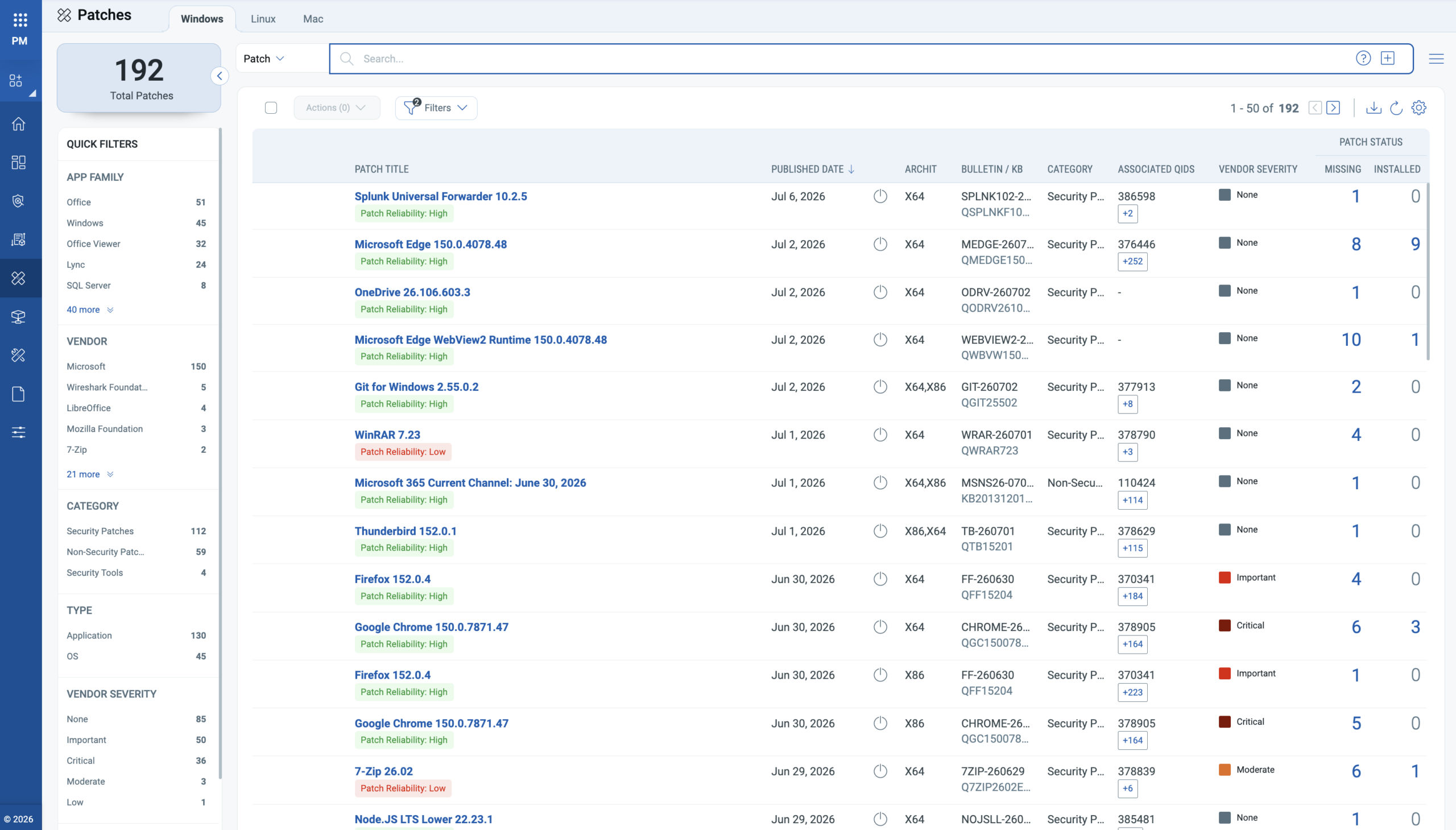

Read More
Zero-Touch Automation for Low-Risk Applications
Not every patch needs the same level of scrutiny. Low-risk applications, such as browsers and other standalone software with a minimal blast radius, are safe candidates for zero-touch automation, since even a problematic update is unlikely to disrupt business-critical services.
With zero-touch patch automation, your team sets up the patching job once. From there, every new update for that application deploys automatically, with no manual intervention required, freeing up your team to focus on the patches that actually need a second look.
As AI reshapes both sides of the vulnerability equation, discovery and defense, the organizations that adapt fastest will be the ones running autonomous remediation, not chasing a backlog that’s growing faster than they can patch it.
Start your 30-day trial of Qualys TruRisk Eliminate and learn how TruRisk Eliminate patches at machine speed without the risk.
Frequently Asked Questions (FAQs)
What is the AI-Powered Patch Reliability Score?
It is a high-confidence TruRisk Eliminate score that predicts whether a patch is safe to deploy. It’s built from crowd-sourced signals from patch deployments across the internet, continuously evaluated for signs of breakage, to reduce the risk of production breakage.
What is zero-touch automation?
Zero-touch automation enables low-risk applications (such as browsers and other standalone software with a minimal blast radius) to receive patches automatically after a one-time setup. This frees security teams to focus on the patches that actually need a second look.
Does autonomous remediation mean deploying every patch immediately?
No. Autonomous remediation doesn’t mean deploying every patch blindly across the environment — breaking production systems in the name of speed defeats the purpose. High reliability patches can be deployed with confidence, while low reliability patches should be tested before deploying broadly.
How does TruRisk Eliminate help teams move faster without increasing operational risk?
By combining the AI-Powered Patch Reliability Score with zero-touch automation for low-risk applications, teams can move faster on patching while cutting the risk of breaking critical services.