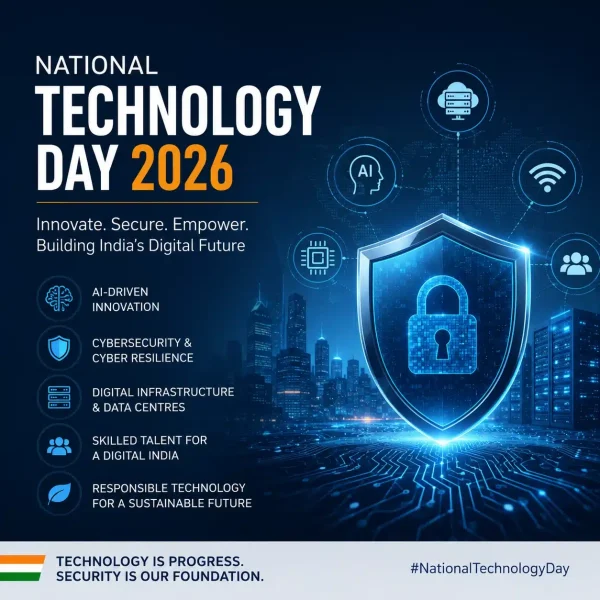
As India marks National Technology Day, industry leaders say the country’s technology ambitions are now closely tied to cybersecurity, AI infrastructure, and digital resilience. With businesses rapidly adopting artificial intelligence, cloud platforms, and connected systems, experts believe the next phase of growth will depend on how securely and responsibly these technologies are deployed.
Across industries, organisations are moving beyond experimental AI projects and integrating intelligent systems directly into operations, customer engagement, healthcare, infrastructure, and enterprise decision-making.
At the same time, cybersecurity leaders are warning that the rise of AI-driven environments is also creating faster and more sophisticated cyber threats.
National Technology Day 2026 Reflects India’s AI-First Push
According to Ritesh Kapadia, Field Chief Technology Officer, iLink Digital, technology discussions are increasingly centred around how AI systems behave and interact within organisations rather than just the tools themselves.
Kapadia said AI is evolving from passive software into active systems capable of analysing context, triggering actions, and supporting enterprise decisions. He noted that organisations are gradually building “AI-first enterprises” where intelligence becomes part of daily workflows instead of operating as a separate technology layer.
“Technology conversations today are becoming less focused on tools and more focused on behaviour. AI systems are evolving from passive platforms into active collaborators that can analyse context, trigger actions and support enterprise decision making. This shift is laying the foundation for AI first enterprises, where intelligence is embedded into everyday operations, workflows and business decisions rather than functioning as a separate layer of technology.”

He added that enterprises are focusing on connected systems that can respond intelligently while maintaining governance and operational clarity.
The growing use of AI across enterprise environments is also increasing cybersecurity concerns. Security teams are now dealing with automated attacks, deepfakes, AI-assisted vulnerability discovery, and identity-based threats that can move at machine speed.
Cybersecurity, Core Part of Digital Transformation
Sunil Sharma, Managing Director & VP – Sales (India & SAARC) at Sophos, said National Technology Day 2026 is a reminder that innovation and cybersecurity must grow together.
According to Sharma, organisations can no longer depend only on traditional or reactive security models. Businesses are now being pushed toward continuous threat monitoring and real-time response frameworks as attackers use AI to scale operations faster than before.
He also highlighted identity security as a major challenge for enterprises managing cloud systems, remote access environments, and interconnected digital ecosystems.
“The threat landscape is evolving rapidly,” Sharma said, pointing to deepfakes, automated attacks, and AI-driven vulnerability discovery as some of the biggest emerging concerns.
Industry leaders believe cyber resilience is becoming equally important as digital transformation, especially as Indian enterprises continue accelerating cloud adoption and AI integration.
AI Infrastructure and Data Centres Gain Importance
Technology executives also stressed the importance of building infrastructure capable of supporting India’s growing AI ecosystem.
AS Prasad, Vice President, Product Management, Vertiv, said the future of AI will depend heavily on infrastructure decisions being made today, particularly around power systems, cooling technologies, and data centre architecture.
“The next decade of AI will be won in the infrastructure layer, in the power systems, the cooling architecture, and the data center design decisions being made right now.
Prasad noted that AI workloads require scalable and reliable infrastructure to operate efficiently at enterprise and national levels.
That view was echoed by Narendra Sen, Founder & CEO, RackBank & NeevCloud, who described data centres as critical to India’s digital future.
Sen said India’s policy initiatives, including the IndiaAI Mission and data localisation efforts, are creating momentum for sovereign AI infrastructure and homegrown cloud ecosystems. He added that infrastructure readiness will determine how effectively India can scale AI adoption across industries and government systems.
Responsible AI Adoption Expands Across Industries
The life sciences sector is also witnessing increased AI adoption as companies look to improve operational efficiency and decision-making.
Duraisamy Rajan Palani (Durai), Founder and CEO of Archimedis Digital, said AI is helping accelerate innovation in drug discovery, clinical trials, and patient engagement.
However, he noted that as AI systems move beyond automation and begin supporting expert-level decisions, accuracy, accountability, and regulatory compliance become increasingly important.
Industry experts say responsible AI adoption will remain a key focus area as organisations balance innovation with governance requirements.
Meanwhile, Vikram Prabakar highlighted how technology is also being used to address sustainability and inclusion challenges.
He said AI-powered waste traceability and digital recycling platforms are helping improve transparency and efficiency while supporting India’s broader sustainability goals.
India’s Technology Growth Also Depends on Skilled Talent
While India continues to invest heavily in AI infrastructure and digital transformation, experts say the shortage of specialised talent remains a growing challenge.
Milind Shah, Managing Director, Randstad Digital India, said demand for professionals skilled in AI, cybersecurity, cloud computing, and digital infrastructure is increasing rapidly.
He added that many of these specialised roles have emerged only recently, making workforce development a critical priority for businesses, academic institutions, and policymakers.
“India is on track to become one of the world’s largest digital infrastructure markets within this decade, supported by sustained investments, policy momentum, and accelerating demand. What now requires equal emphasis is the depth, quality, and readiness of the talent pipeline. AI, cloud, and advanced digital infrastructure rely on highly skilled engineers, architects, and operators capable of managing complex, rapidly evolving environments. Many of these roles have emerged only recently, making workforce readiness a strategic priority rather than a secondary consideration. Addressing this gap will require coordinated action across industry, academia, and policy frameworks to build both scale and specialisation.”
As National Technology Day 2026 highlights India’s progress in AI and digital innovation, industry leaders say long-term success will depend on building secure infrastructure, strengthening cyber resilience, and preparing a workforce capable of managing increasingly complex technology environments.