A new malicious kit called EvilTokens integrates device code phishing capabilities, allowing attackers to hijack Microsoft accounts and provide advanced features for business email compromise attacks.
The kit is sold to cybercriminals over Telegram and is under continuous development, its author stating that they plan to extend support for Gmail and Okta phishing pages.
Device code phishing attacks abuse the OAuth 2.0 device authorization flow, in which attackers gain access to a victim account by tricking the owner into authorizing a malicious device.
The technique is well-documented and has been used by various threat actors, including Russian groups tracked as Storm-237, UTA032, UTA0355, UNK_AcademicFlare, and TA2723 [1, 2, 3], and the ShinyHunters data extortion group.
EvilTokens attacks
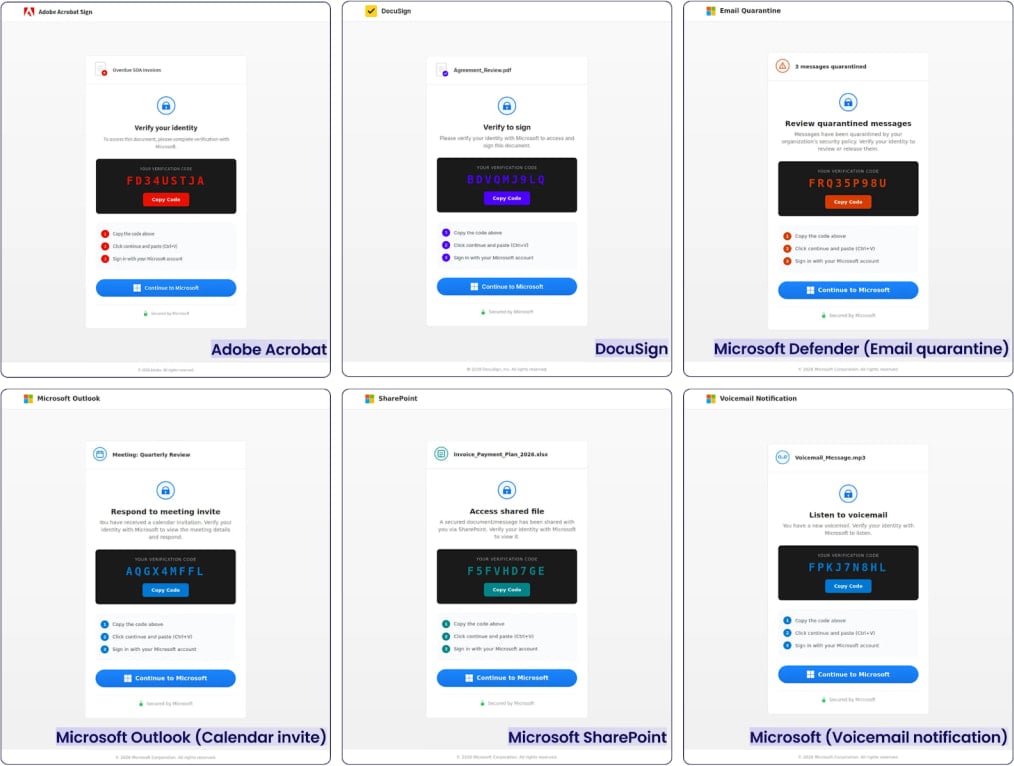
Researchers at threat detection and response company Sekoia observed EvilTokens attacks where the victims received emails with documents (PDF, HTML, DOCX, XLSX, or SVG) that contained either a QR code or a hyperlink to an EvilTokens phishing template.
These lures impersonate legitimate business content such as financial documents, meeting invitations, logistics or purchase orders, payroll notices, or shared documents via services like DocuSign or SharePoint, and are often tailored to employees in finance, HR, logistics, or sales roles.
Source: Sekoia
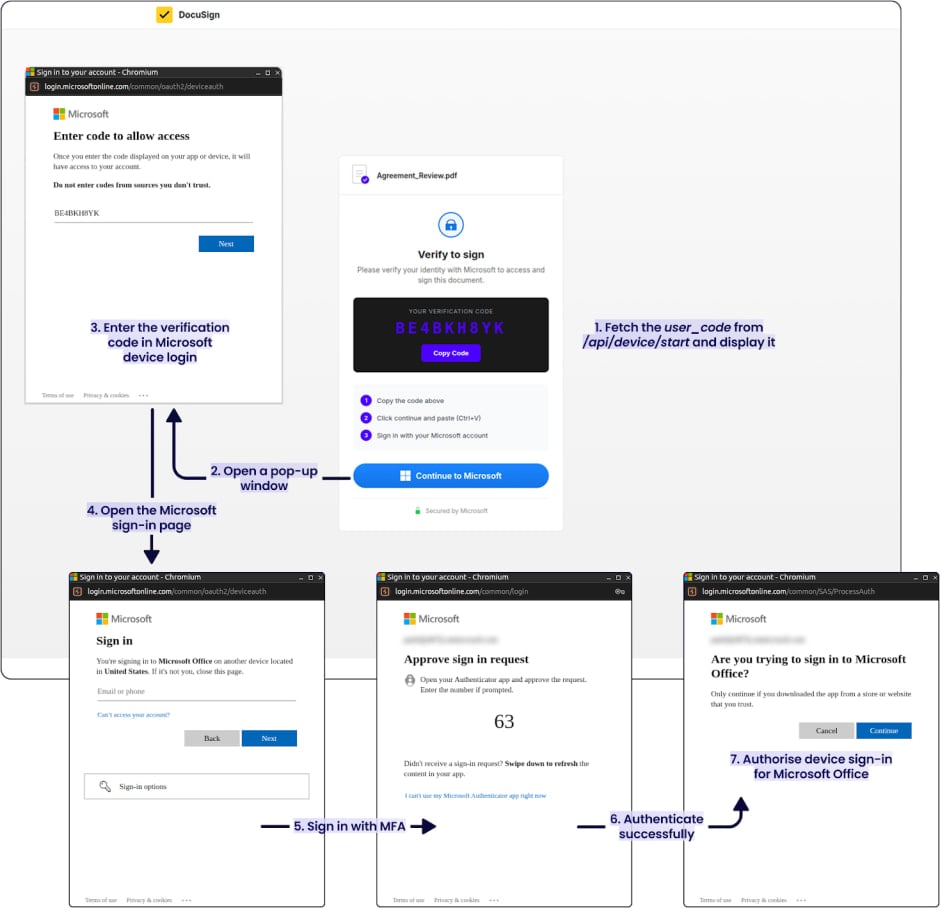
When the victim opens the link, they are presented with a phishing page that impersonates a trusted service (e.g., Adobe Acrobat or DocuSign), which displays a verification code and instructions to complete identity verification.
The page prompts the user to click a “Continue to Microsoft” button, redirecting them to the legitimate Microsoft device login page.
At this step, the attacker uses a legitimate client (any Microsoft application) to request a device code. Then, they trick the victim into authenticating to the legitimate Microsoft URL from the threat actor.
Source: Sekoia
This way, the attacker receives both a short-lived access token and a refresh token for persistent access.
These tokens give the attacker immediate access to the services associated with the victim account, including email, files, Teams data, and the capability to perform SSO impersonation across Microsoft services.
Sekoia researchers examined EvilTokens’ infrastructure and uncovered campaigns with a global reach, the most affected countries being the United States, Canada, France, Australia, India, Switzerland, and the UAE.
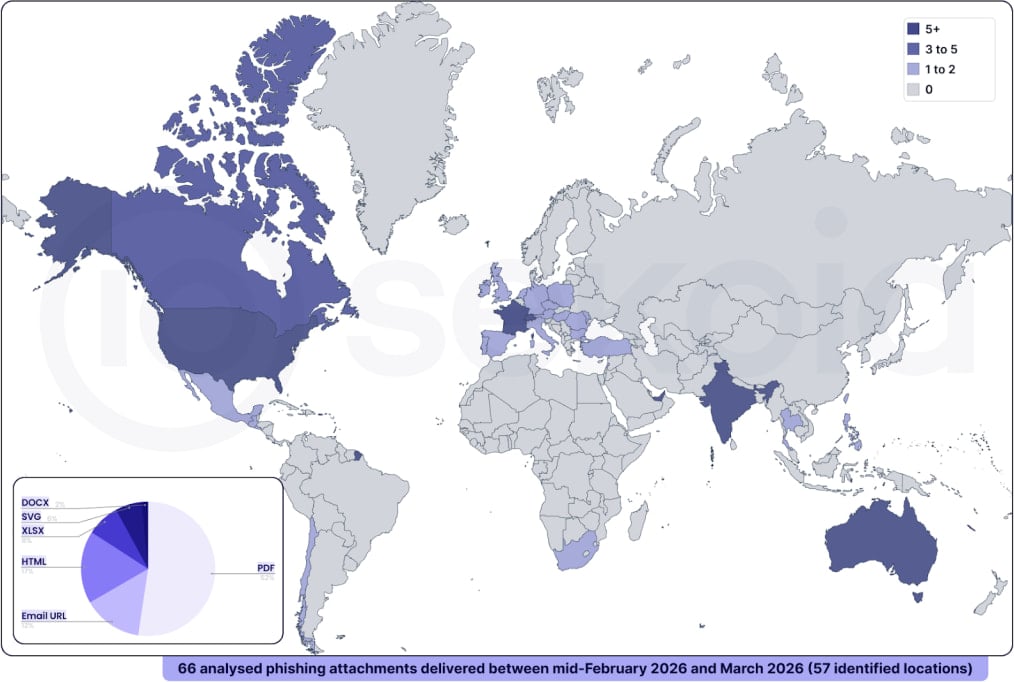
Source: Sekoia
Apart from advanced phishing, Sekoia researchers say that the EvilTokens phishing-as-a-service (PhaaS) operation also provides “advanced features to conduct BEC [business email compromise] attacks” through automation.
The variety of the campaigns suggests that EvilTokens is already being used at scale by threat actors involved in phishing and business email compromise (BEC) activities.
Sekoia provides indicators of compromise (IoC), technical details, and YARA rules to help defenders block attacks leveraging the EvilTokens PhaaS kit.

Automated pentesting proves the path exists. BAS proves whether your controls stop it. Most teams run one without the other.
This whitepaper maps six validation surfaces, shows where coverage ends, and provides practitioners with three diagnostic questions for any tool evaluation.