A decentralized network of pro-Iran hacktivist groups is intensifying cyber operations against critical infrastructure, government entities, technology providers, and organizations perceived as aligned with U.S., Israeli, or Western interests.
The activity is dominated by distributed denial-of-service attacks, defacements, credential-focused operations, data-leak claims, and propaganda designed to convert limited technical disruption into outsized psychological and reputational impact.
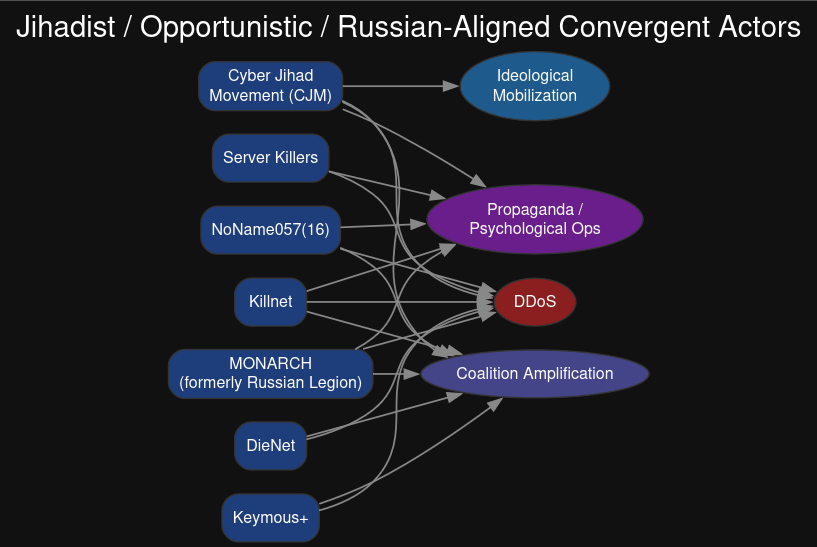
Rather than operating as a single command structure, the ecosystem combines Iran-aligned personas, militia-branded collectives, jihadist propagandists, and opportunistic pro-Russian actors.
Telegram channels, temporary leak sites, shared target lists, commercial stresser services, and coordinated social-media posts form the operational backbone of this loose wartime cyber coalition.
Claims commonly surface soon after kinetic events, allowing participants to portray cyber activity as retaliation while preserving plausible distance from formal Iranian state structures.
The most visible threat remains DDoS. In late April, Canonical confirmed that its web infrastructure was targeted in a sustained attack attributed by public reporting to the Islamic Cyber Resistance in Iraq, also known as 313 Team.
The incident affected high-profile Ubuntu and Canonical services, illustrating how commodity attack infrastructure can create operational friction across globally used open-source platforms.
The 313 Team reportedly paired the disruption campaign with extortion-style demands, demonstrating the increasingly blurred boundary between hacktivism, coercion, and financially framed cybercrime.
While the incident did not establish a data breach, the targeting of software distribution, support, and security-related services showed how attackers can exploit the visibility of widely depended-on digital infrastructure.
Handala Hack Team presents a more serious risk category. Unlike DDoS-focused crews, Handala has built its profile around hack-and-leak activity, intimidation, identity exposure, and coercive messaging.
Hacktivist Groups Launch DDoS
Domaintools observed increased activity by pro-Iran personas, including Handala, following regional escalation, although much of the reported activity consisted of DDoS, defacements, and unverified compromise claims.
Recent claims tied to Handala have raised particular concern because of alleged destructive activity against medical-technology company Stryker.
The group claimed a mass wiping operation, while independent reporting noted the claim and the broader uncertainty surrounding its full scope.
Security analysis indicates that the reported intrusion may have involved compromised privileged credentials and abuse of Microsoft Intune’s legitimate remote-management capabilities, rather than a bespoke wiper delivered through a traditional malware campaign.
This distinction is critical: public claims, screenshots, and leaked samples do not by themselves prove current access, full compromise, or destructive capability.
Yet even exaggerated operations can achieve strategic objectives by driving media attention, forcing incident-response expenditure, and eroding confidence in targeted organizations.
Other actors including Cyber Fattah, Fatimiyoun/FAD Team, Dark Storm, Keymous+, DieNet, RipperSec, Cyb3rDrag0nz, and coalition-adjacent groups such as NoName057(16) and Killnet primarily contribute attack volume, propaganda amplification, and symbolic targeting.
Their collective value lies in the appearance of a broad transnational cyber front rather than consistently demonstrated advanced intrusion capability.
For defenders, the immediate risk is moderate to high for availability disruption, credential abuse, doxxing, false breach narratives, and reputational damage.
Organizations in telecommunications, healthcare, finance, logistics, government, cloud services, and open-source infrastructure should strengthen DDoS mitigation, validate CDN and WAF capacity, enforce phishing-resistant MFA, monitor for leaked credentials, and establish rapid communications procedures for disputed breach claims.
The central lesson is that low-cost cyber disruption can become effective asymmetric warfare when it is synchronized with geopolitical messaging.
In the current conflict environment, the impact of these operations will often be determined less by malware sophistication than by visibility, timing, and the attackers’ ability to weaponize public perception.
Stop Accepting SLAs Written for 2019 SOCs – Here’s the 2026 AI SLA Vendor Checklist – Download Free AI SOC SLA Guide