- Key Takeaways
- Why Are Lambda Functions Difficult to Secure?
- Why Serverless Security Needs More Than Posture Checks
- Qualys Delivers Automated Vulnerability Scanning for AWS Lambda
- Closing the AI-Native Security Gap in Serverless Workloads
- Securing Serverless at the Speed of AI Innovation
- Contributors
- FAQs
- What problem does this new capability solve?
- How is scanning triggered?
- Does this replace CSPM for serverless?
- What AWS environments are supported?
- Why does this matter specifically for AI-native applications?
- How does Qualys help prioritize remediation?

Key Takeaways
- Qualys now delivers automated AWS Lambda vulnerability scanning, extending serverless security beyond posture checks (CSPM) into workload-level risk visibility.
- CSPM alone only catches misconfigurations (excessive permissions, exposure, logging, encryption) — it can’t detect vulnerable open-source packages or outdated libraries inside function code.
- Lambda’s granular permissions model, dynamic execution environments, and lack of persistent infrastructure make traditional security controls hard to apply.
- This gap matters most for AI-native apps, where Lambda functions often handle sensitive data, call model endpoints, and process prompts/responses — a vulnerable dependency here can expose risk across the entire AI pipeline.
- Scanning is event-driven and automated: functions are scanned at deployment and rescanned when created or updated, with no manual triggering needed.
- Coverage spans cross-account and multi-region AWS environments.
- Qualys combines vulnerability data with cloud security context (permissions, exposure) to help teams prioritize remediation based on actual risk, not just the presence of a CVE.
Serverless functions have become a core building block for modern cloud and AI-native applications. With AWS Lambda, developers build and scale applications faster without managing underlying infrastructure. But as Lambda functions increasingly process sensitive data, connect to APIs, invoke AI services, and power critical workflows, securing the code and dependencies running inside them matters just as much as securing their configurations.
Why Are Lambda Functions Difficult to Secure?
Securing Lambda functions is fundamentally different from securing VMs or containers. There’s no persistent infrastructure to monitor, no fixed runtime to instrument, and functions spin up and tear down in seconds. Each function also requires its own IAM role, meaning permissions are managed individually across potentially hundreds of functions — making misconfigurations easy to miss.
The result is a widening blind spot: organizations can see that a function exists and whether its configuration looks healthy, but not what’s inside it — the vulnerable packages, outdated libraries, and transitive dependencies attackers can exploit.
This blind spot is especially dangerous for AI-native applications, where Lambda functions may retrieve sensitive data, call model endpoints, process prompts and responses or trigger downstream business logic. A vulnerable dependency here can expose risk across the entire AI pipeline, not just the function itself.
Today, Qualys is closing that gap by expanding serverless workload security with automated vulnerability scanning for AWS Lambda, giving security teams deeper insight into the vulnerabilities that matter most. With this enhancement, organizations can move beyond serverless discovery and CSPM posture checks to understand the vulnerable packages and dependencies running inside their Lambda functions.
Why Serverless Security Needs More Than Posture Checks
Serverless simplifies infrastructure management, but it doesn’t eliminate security responsibility. While AWS manages the underlying infrastructure, organizations remain responsible for securing the code, dependencies, permissions, configurations, and data that power their Lambda functions.
Traditional CSPM for serverless helps answer important posture questions:
- Is the function exposed?
- Does it have excessive permissions?
- Is logging enabled?
- Is encryption configured correctly?
These checks identify misconfigurations, but they don’t reveal whether a function contains vulnerable open-source packages or outdated libraries that attackers can exploit. To secure modern serverless applications, organizations need visibility into both configuration risks and software vulnerabilities.
Qualys Delivers Automated Vulnerability Scanning for AWS Lambda
With automated Lambda function scanning, Qualys helps security teams close a key visibility gap in serverless security. Lambda functions are automatically discovered and scanned during deployment. As functions are created or updated, event-driven scanning keeps vulnerability insights current — continuously assessing serverless workloads without manual intervention.
This enhancement delivers:
- Continuous security for serverless workloads with automated scanning
- Real-time visibility into newly created and updated AWS Lambda functions
- Cross-account and multi-region coverage for distributed AWS environments
- Reduced operational overhead with event-driven automation
- Efficient scan management to prevent duplicate scans and reliably process scan events
The capability supports both same-account and cross-account AWS configurations and deploys using provided CloudFormation templates. Once configured, it runs with minimal manual effort — a practical answer for teams asking how to secure AWS Lambda functions at scale.
Closing the AI-Native Security Gap in Serverless Workloads
Serverless applications move fast. AI-native applications move even faster. A Lambda function may sit between sensitive data, APIs, cloud services, and AI models. If that function contains vulnerable dependencies — especially combined with excessive permissions or external exposure — the risk can extend far beyond the function itself.
By combining vulnerability insights with cloud security context, Qualys capabilities help teams identify the highest-risk functions, understand where they’re deployed, and prioritize remediation based on exposure and impact, including automated TruRisk Scoring, which combines business and exposure impact with the latest vulnerability intel.
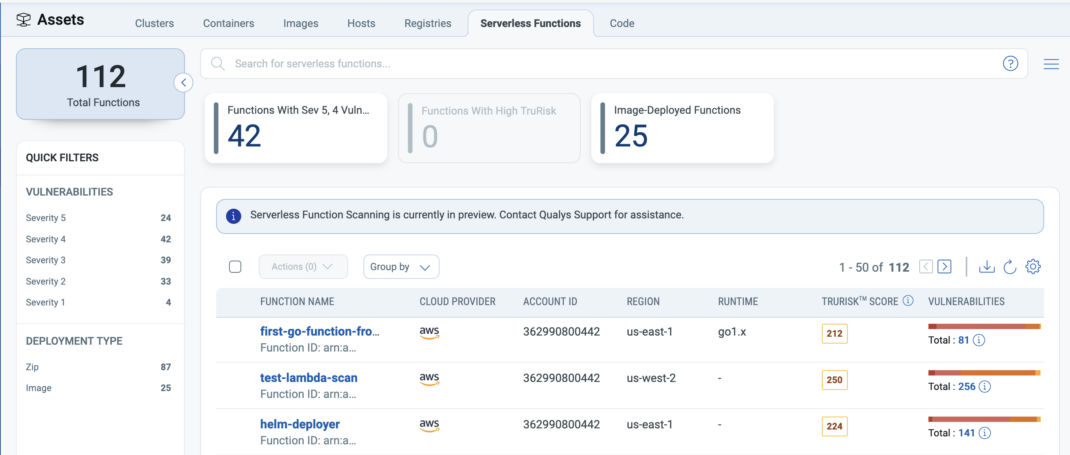
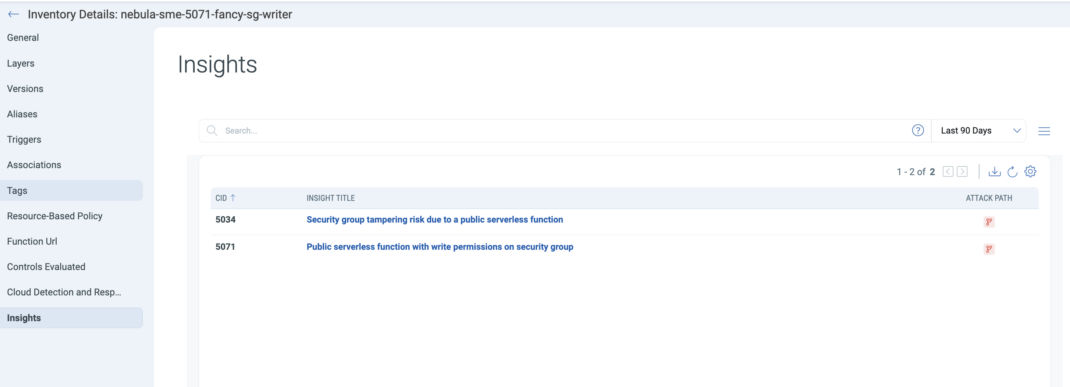
By combining zero-day vulnerabilities with unified attack path prioritization — which merges CSPM and real-time detections including threats, overly permissive identities, and exposure — Qualys enables hyper-prioritization and remediation of the serverless attack paths that are truly remediation-worthy. This is Qualys Lambda scan for AI applications in practice: connecting code-level risk to business impact.
Securing Serverless at the Speed of AI Innovation
Serverless has helped developers build faster and scale more easily. Now, as serverless becomes a key execution layer for AI-native applications, security needs to keep pace. With serverless workload vulnerability management built into the platform, Qualys extends serverless security from discovery and posture to deeper workload risk visibility — helping organizations secure the functions powering modern cloud and AI applications.
Security should not slow down serverless innovation. It should move at the same speed.
Don’t let vulnerable code hide in your serverless functions. See Qualys for AWS Lambda in action →
Contributors
- Milind Chaturvedi, Product Evangelist, Qualys
FAQs
What problem does this new capability solve?
It closes the visibility gap between serverless posture management (CSPM) and actual software vulnerabilities inside Lambda function code and dependencies.
How is scanning triggered?
Automatically and continuously, via event-driven scanning that runs when Lambda functions are created or updated — no manual intervention is needed.
Does this replace CSPM for serverless?
No. It complements CSPM by adding vulnerability and dependency visibility on top of existing configuration and posture checks.
What AWS environments are supported?
Both same-account and cross-account AWS configurations, with coverage across multiple regions.
Why does this matter specifically for AI-native applications?
Lambda functions in AI workflows often sit between sensitive data, APIs, and model endpoints — a vulnerable dependency here can expose risk across the entire AI pipeline, not just the function itself.
How does Qualys help prioritize remediation?
By correlating vulnerability findings with cloud context like permissions and exposure, teams can focus on the highest-risk functions first rather than treating all vulnerabilities equally.