AI is reshaping foreign malign influence operations in subtle but consequential ways. Our analysis of pro-Russia and pro-China inauthentic accounts on X across 2024–2026 shows actors are not leveraging AI primarily to flood platforms with volume.
Instead, they are using AI to refine content quality, create more believable personas, and broaden linguistic and visual reach moves designed to evade detection and increase persuasive power among real users.
Using a novel machine-learning pipeline that blends unsupervised clustering with supervised classifiers trained on human-labeled signals, we identified likely inauthentic accounts with high confidence (average precision 86%, recall 83%).
Applying this methodology longitudinally produced three core findings. First, malign networks dramatically reduced posting frequency: median post volumes fell by roughly half between 2024 and 2026.
There was no material increase in original post length, and the active population of inauthentic accounts remained on the order of thousands (approximately 5,000–11,000 per actor group), indicating actors favored repurposing existing accounts over mass-creating new ones.
Second, AI has been adopted to enhance content quality rather than automate scale. The most visible use cases are image generation and machine translation.
According to twosix, proportion of original posts containing images increased markedly more than quadrupling for pro-Russia accounts and doubling for pro-China accounts with a subset of images identifiable as AI-generated.
Visuals include both overtly synthetic cartoons and more subtly manipulated or fabricated photographic scenes intended to corroborate false narratives.
Russian and Chinese Actors Use AI
Concurrently, linguistic footprint expanded: pro-Russia accounts moved from a median of two languages in 2024 to six by 2026, while pro-China accounts increased English usage and reduced Chinese-language posts.
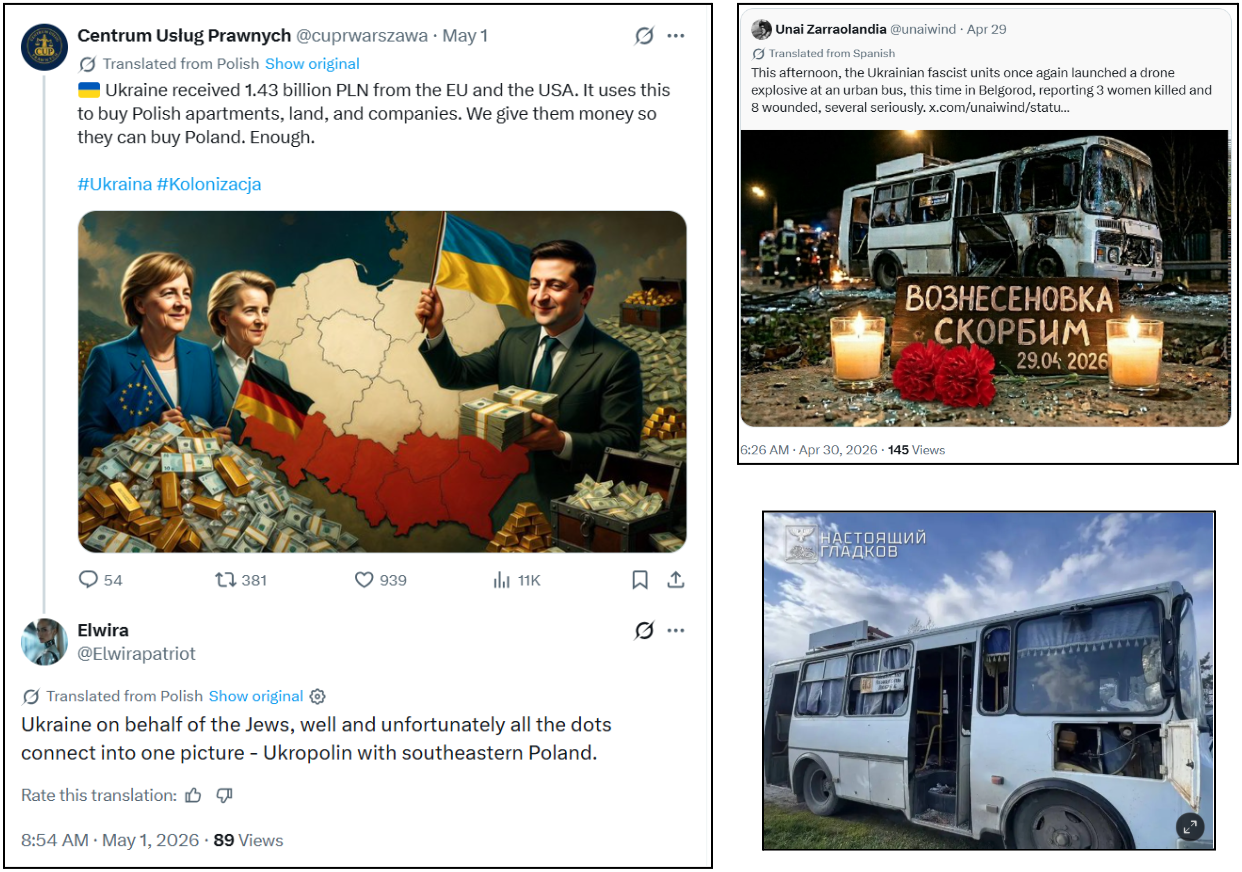
These patterns point to LLM-driven translation workflows enabling wider reach into foreign-language audiences.
Third, behavioral signals grew more human-like. Posting cadence slowed and daily inactivity periods became more common, particularly among pro-Russia accounts tactics that mimic human diurnal cycles and reduce bot-detection signals.
As a result, the vast majority of accounts produced minimal engagement typically one interaction per every 3–50 posts indicating that the quality-over-quantity approach largely failed to scale organically.
However, a small set of outlier pro-Russia accounts achieved substantial reach, averaging 17–22 engagements per post and maintaining large follower counts.
These outliers generated disproportionate amounts of original content and likely functioned as seed nodes that amplify narratives via a surrounding network of lower-engagement inauthentic accounts.
The shift in narratives likely took place because of Moscow’s dashed hopes that President Trump might strong-arm Ukraine into ending the war on terms favorable to Moscow.
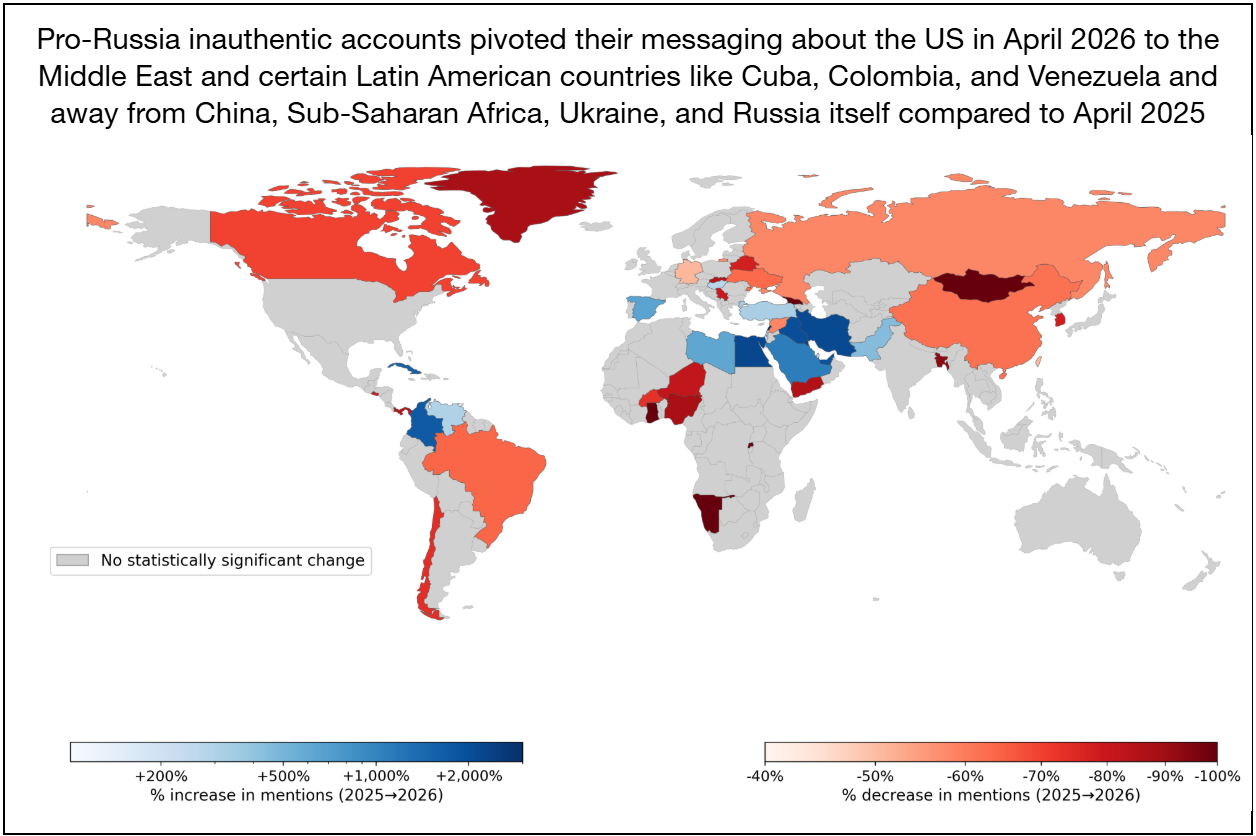
Narrative analysis using LLM-assisted classification revealed thematic shifts. Pro-Russia networks pivoted from earlier pro-Trump framings to heavily anti-US messaging by 2026: ad hominem attacks against US figures rose sharply, and content emphasizing US military weakness, imperialism, and conspiracy theories increased substantially.
Pro-China networks consistently framed the US as destabilizing and, since 2025, emphasized China’s AI prowess as a comparative advantage. Regional focus also shifted, with Japan particularly its leadership portrayed as a US proxy in 2026 narratives.
Operationally, these trends complicate detection and mitigation. AI-enabled detection translation and image synthesis increase surface area across languages and modalities, while slower, more variable posting mimics organic behavior and defeats simplistic bot heuristics.
Defenders should therefore prioritize multimodal detection models that incorporate image provenance checks, cross-lingual content similarity measures, and temporal-behavioral features rather than relying on volume or account-creation signals alone.
Follow us on Google News, LinkedIn, and X to Get Instant Updates and Set GBH as a Preferred Source in Google.