- Key Takeaways
- Why Point-in-Time Audits No Longer Reflect Real-World Risk
- The Growing Gap Between Security Risk and Audit Cycles
- Why Misconfigurations Continue to Drive Risk
- Moving from Audit Preparation to Continuous Audit Readiness
- Simplifying Policy Creation with AI Assistance
- Continuous Monitoring Requires Continuous Evidence
- Not All Findings Matter Equally
- The Future of Audit Readiness
- Modernize Your Audit Readiness
- FAQ
- References
- Related

Key Takeaways
- Periodic audits provide a point-in-time assessment, but they cannot demonstrate whether controls remain effective between audit cycles.
- Qualys platform data shows 10.5 billion configuration findings across customer environments but only 1.6% represent meaningful exposure and under 1% are prioritized, business-critical findings.
- Verizon’s 2026 DBIR found the median time to resolve weak passwords and misconfigured permissions is about 8 months.
- Across 1 billion misconfiguration findings, risk concentrates in access control (38%), ransomware-mapped exposure (30.7%), and audit logging gaps (26%).
- Continuous audit readiness is a continuous cycle of discovering gaps, prioritizing risk, remediating issues, collecting evidence, and monitoring for control drift, operationalized through Qualys Policy Audit and Audit Fix.
Why Point-in-Time Audits No Longer Reflect Real-World Risk
Compliance has long followed a familiar cycle: prepare for an audit, collect evidence, remediate findings, and repeat. But today’s environments change faster than that cycle can account for.
Cloud infrastructure changes daily. New applications are introduced continuously. Security configurations drift over time. And attackers are no longer limited by manual techniques. Emerging AI-driven attack methods can identify, and chain seemingly isolated weaknesses faster than traditional compliance processes can address them.
The challenge for security and compliance teams is no longer simply passing the next audit. It’s maintaining audit readiness every day. Periodic audits remain necessary, but they cannot show whether controls remain effective between assessments.
The Growing Gap Between Security Risk and Audit Cycles
Most organizations conduct assessments against frameworks such as the National Institute of Standards and Technology (NIST), Center for Internet Security (CIS), Payment Card Industry Data Security Standard (PCI DSS), Health Insurance Portability and Accountability Act (HIPAA), Security Technical Implementation Guides (STIGs), and Digital Operational Resilience Act (DORA), and internal security policies. These assessments provide valuable insight into control effectiveness at a specific point in time.
The problem is that environments rarely stay static. A configuration that passes today may fail tomorrow due to a software update, infrastructure change, administrative error, or policy drift. Meanwhile, security teams are often managing thousands or even millions of configuration findings across servers, databases, middleware, cloud assets, and applications. Qualys platform data puts the real number closer to 10.5 billion findings across customer environments, of which only 164.3 million (1.6%) represent meaningful risk exposure and just 431,000 (under 1%) rise to the level of prioritized, business-critical findings.
As a result, compliance teams frequently find themselves trapped in a cycle of:
- Manual evidence collection
- Point-in-time assessments
- Lengthy remediation efforts
- Repeated audit preparation exercises
By the time evidence is gathered and findings are addressed, the environment may already have changed. Independent research backs this up: Verizon’s 2026 Data Breach Investigations Report found that the median time to resolve weak passwords and misconfigured permissions is approximately 8 months.
Compliance is no longer only a periodic event. It is a continuous operational challenge.
Why Misconfigurations Continue to Drive Risk
Across security assessments, risk repeatedly concentrates in the same fundamental control areas:
- Privileged access management
- Configuration management
Across 1 billion misconfiguration findings, risk consistently concentrates in three areas: 38% Access Control failures (weak MFA, excessive privileges, poor credential hygiene), 30.7% Ransomware Exposure (misconfigurations that map directly to known ransomware attack patterns), and 26% Audit Logging gaps (audit trail gaps invisible to compliance teams).
Individually, these issues may appear manageable. But attackers increasingly view them as connected opportunities rather than isolated findings. A weak password, excessive privileges, and an overlooked access control gap may each be classified as relatively low-risk findings on their own. Combined, they can create a viable attack path.
Compounding control failures expose the disconnect between traditional compliance programs and modern threats. 80% of security exposures are caused by identity and credential misconfigurations, with a third of those exposures putting critical assets at direct risk of breach. The real threat isn’t always a single vulnerability. It’s the combination of risks that creates an attack path. 75% of breaches result from multiple control failures compounding simultaneously.
Passing an audit does not automatically mean an organization is resilient against evolving attack techniques.
Moving from Audit Preparation to Continuous Audit Readiness
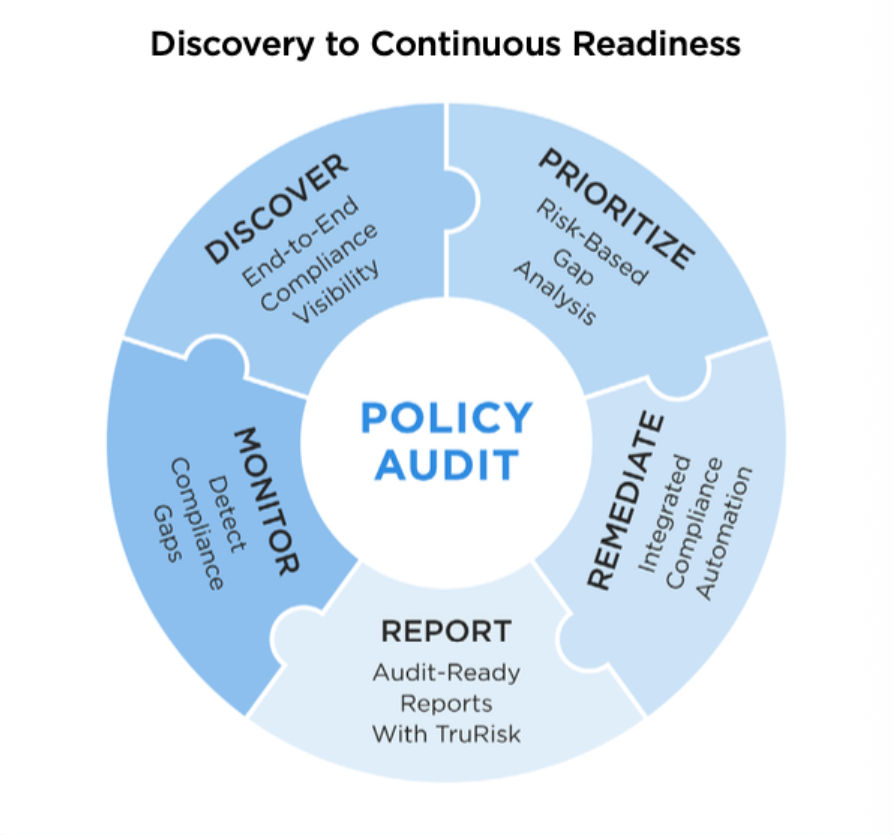
Closing this gap requires treating compliance as a continuous operating discipline, not a periodic audit project. That operating discipline requires security and compliance teams to continuously:
- Discover control gaps
- Prioritize findings based on risk
- Remediate issues efficiently
- Collect evidence automatically
- Monitor controls for ongoing compliance
Together, these steps define continuous audit readiness. Rather than asking, “Are we compliant today?” organizations can answer a more important question:
“Are we maintaining compliance as our environment changes?”
Simplifying Policy Creation with AI Assistance
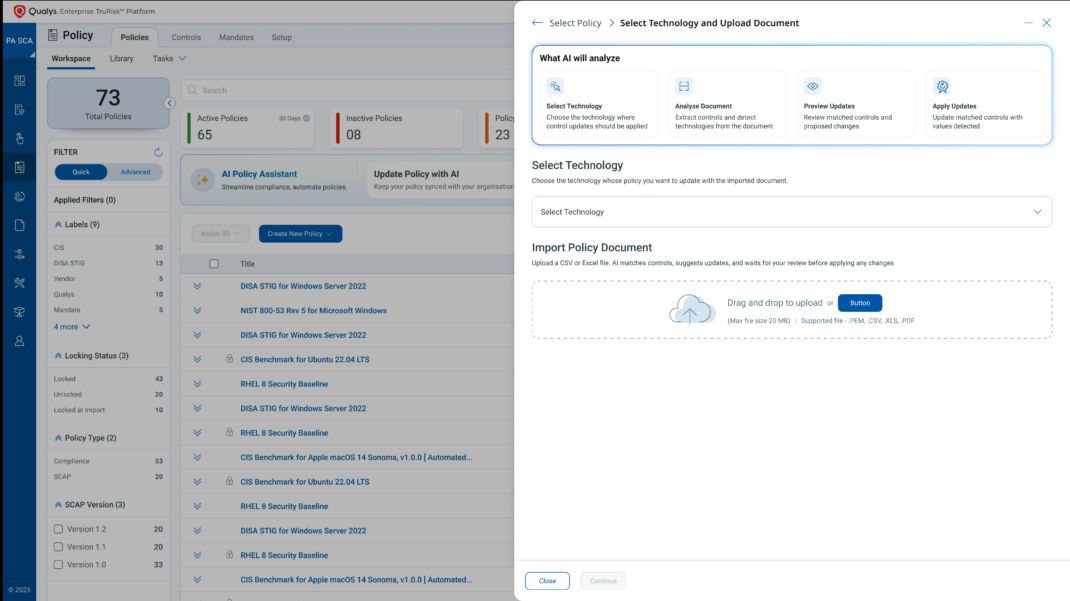
The continuous-readiness loop begins with translating frameworks, benchmarks, and internal policies into actionable technical controls. Many organizations spend significant time interpreting requirements, mapping controls, and validating policy logic across multiple frameworks.
For this first step, Qualys introduced AI-Powered Policy Creation for Policy Audit.
The capability enables teams to upload frameworks, benchmarks, vendor guidance, or internal policies and use AI assistance to map controls to policy logic, assessment criteria, and expected values. Importantly, policy validation remains under human control, ensuring that experts review and approve mappings before publication.
The goal is not to replace compliance expertise. It’s to help compliance teams accelerate the process of operationalizing compliance requirements while maintaining governance oversight.
Continuous Monitoring Requires Continuous Evidence
Once policies are operationalized, continuous readiness depends on keeping audit evidence current. Security and compliance teams often spend weeks gathering screenshots, configuration data, reports, and control evidence from multiple systems. That requires a continuous evidence model.
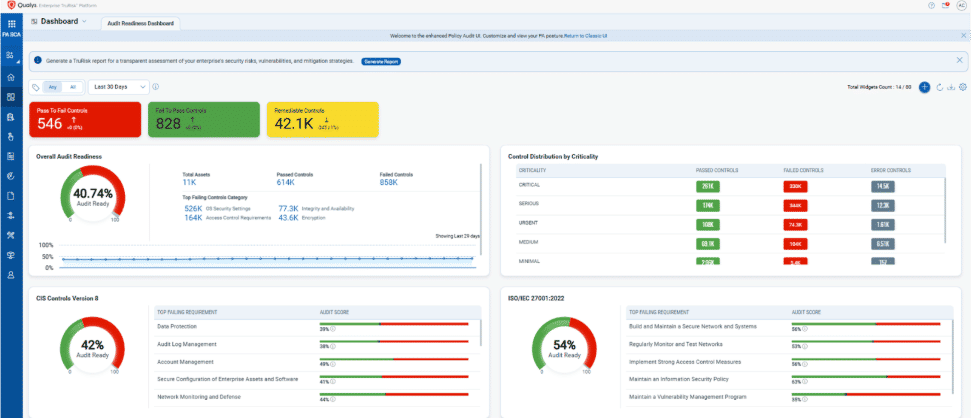
With the introduction of Audit Insights, Policy Audit extends beyond periodic assessments by continuously monitoring controls, detecting compliance drift, and automatically collecting evidence. Instead of scrambling to gather evidence before an audit, organizations can maintain an ongoing record of compliance status and control effectiveness throughout the year. Keeping that evidence current turns audit preparation from a major project into a routine operational process.
Not All Findings Matter Equally
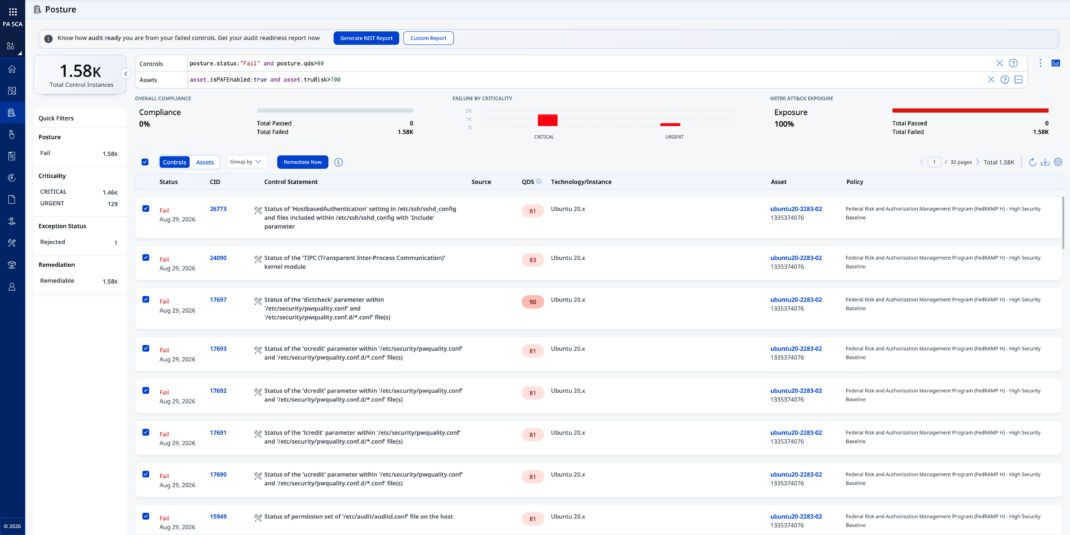
Configuration assessment tools can generate large volumes of findings without enough context for prioritization. Security teams don’t have the resources to address every failed control immediately. The practical question is which findings represent the greatest business risk.
Policy Audit adds that context by incorporating factors such as:
- Security risk indicators
By connecting compliance findings with risk intelligence, teams can focus their remediation efforts where they will have the greatest impact. The result is a shift from pass/fail reporting to risk-informed decision-making.
Risk-informed prioritization only matters if teams can resolve the right issues quickly and consistently.
To close that loop, Qualys introduced Audit Fix, an enhancement designed to streamline the process of correcting compliance findings through pre-built remediation content and automated workflows. By integrating remediation into operational processes, organizations can move beyond identifying failed controls to actively restoring compliant configurations and validating that fixes remain in place over time.
Together, these capabilities create a closed-loop approach to compliance operations:
The result is a more sustainable model for continuous readiness, with measurable operational impact. Automating evidence collection and control mapping reduces manual audit effort by up to 90%. Organizations report up to 95% fewer audit failures and 50% lower audit costs as a result of moving from manual, point-in-time remediation to a continuous, automated model.
The Future of Audit Readiness
AI is changing the pace of cybersecurity. As environments become more dynamic and threats move faster, organizations cannot rely solely on periodic reviews and point-in-time assessments.
For security and compliance leaders, the practical question is whether they can detect control drift, identify which gaps create the greatest business risk, remediate them efficiently, and preserve current evidence.
Continuous audit readiness is more than a compliance strategy. It is becoming a security imperative.
By combining AI-assisted policy creation, continuous monitoring, automated evidence collection, risk-based prioritization, and automated remediation, organizations can shift from reacting to audit findings to maintaining readiness every day.
A practical starting point is to ask: How quickly can we detect drift? Can we produce current evidence without a manual scramble? Can we verify that remediation remains in place?
In an AI-driven world, waiting for the next audit may already be too late.
Modernize Your Audit Readiness
Al has changed the speed of discovery and exploitation. Learn how leading organizations are closing the gap between detection, remediation and audit readiness. Read the white paper.
FAQ
Q: What is continuous audit readiness?
A: It is the operating discipline of discovering control gaps, prioritizing by risk, remediating, collecting evidence automatically, and monitoring for drift so the organization stays audit-ready as the environment changes.
Q: Why is point-in-time compliance no longer enough?
A: Cloud, applications, and configurations change daily. A control that passes today can fail tomorrow. Point-in-time audits cannot show whether controls remained effective between assessments.
Q: How does Qualys Policy Audit support continuous readiness?
A: AI-Powered Policy Creation maps frameworks to controls, Audit Insights monitors drift and collects evidence continuously, risk context prioritizes findings, and Audit Fix remediates and validates that fixes stay in place.
Q: Does AI replace compliance experts?
A: No. AI assists with mapping frameworks to policy logic. Humans review and approve mappings before publication.
Q: Which misconfigurations drive the most risk?
A: Qualys data across 1 billion findings shows concentration in access control (38%), ransomware-mapped exposure (30.7%), and audit logging gaps (26%).
References
- Verizon 2026 Data Breach Investigations Report (DBIR), p. 11 — median time to fix password and permission misconfigurations.
- Panaseer, 2026 Security Leaders Peer Report, November 2025. panaseer.com
- Qualys press release, Qualys Unveils Policy Audit with Enhanced Efficiency for Continuous Audit Readiness, April 24, 2025;
- Qualys Policy Audit datasheet, Stay Ready. Stay Compliant.