Water and wastewater systems have become strategic gray‑zone targets for Russia, China, and Iran, driven by chronic underinvestment and weak operational‑technology (OT) defenses that make these utilities easy to probe and exploit.
Internet‑facing human‑machine interfaces (HMIs), exposed programmable logic controllers (PLCs), default credentials, and poor IT/OT segmentation create low‑cost access paths whose impact is disproportionately high: disruptions affect public health, erode trust in institutions, and create political leverage without crossing the threshold into open war.
Recent advisories from U.S. agencies and industry CISA, FBI, NSA, EPA, and the Government Accountability Office document a shift from opportunistic nuisance operations to deliberate, state‑aligned campaigns.
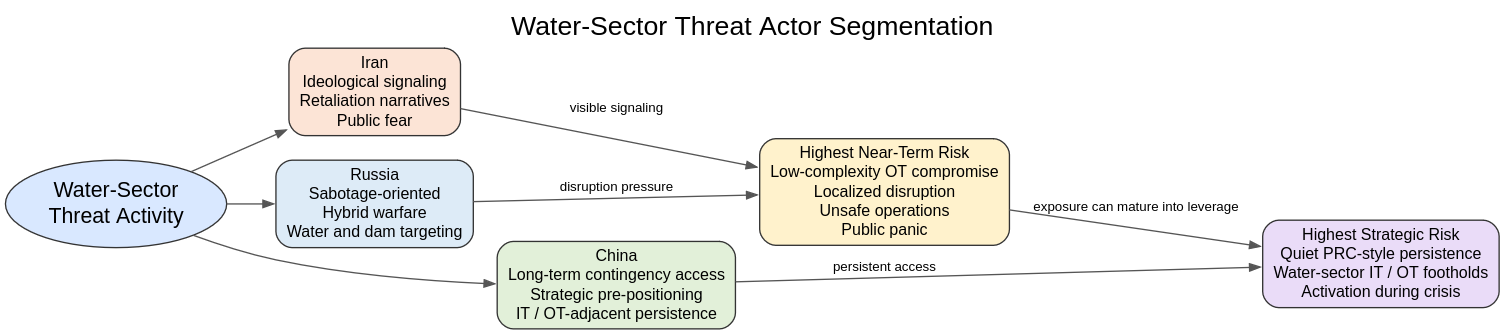
Iran‑linked actors, notably IRGC‑affiliated groups such as CyberAv3ngers, have repeatedly exploited exposed PLCs and weak authentication to deface HMIs and signal capabilities; advisory reporting highlights exploitation of Unitronics Vision Series devices and other widely deployed controllers.
These intrusions emphasize symbolic signaling and opportunistic disruption rather than large‑scale cyber‑physical destruction, but they demonstrate how simple misconfigurations can yield tactical access to critical processes.
Russian and pro‑Russian actors present a more sabotage‑oriented pattern. Incidents in 2024–2025 included municipal water‑system manipulation that produced visible physical effects overflowing tanks and opened floodgates consistent with Moscow’s hybrid warfare playbook of coercion, intimidation, and resilience testing.
According to Domaintools, Groups linked to GRU operations have shown willingness to use OT access for direct disruption, using relatively unsophisticated techniques against poorly defended targets to force emergency responses and public alarm.
Water and Wastewater Systems
China’s approach contrasts with Iran and Russia: Volt Typhoon attack and other PRC‑linked campaigns emphasize long‑term pre‑positioning, reconnaissance, and strategic persistence inside U.S. critical‑infrastructure networks, including water utilities.
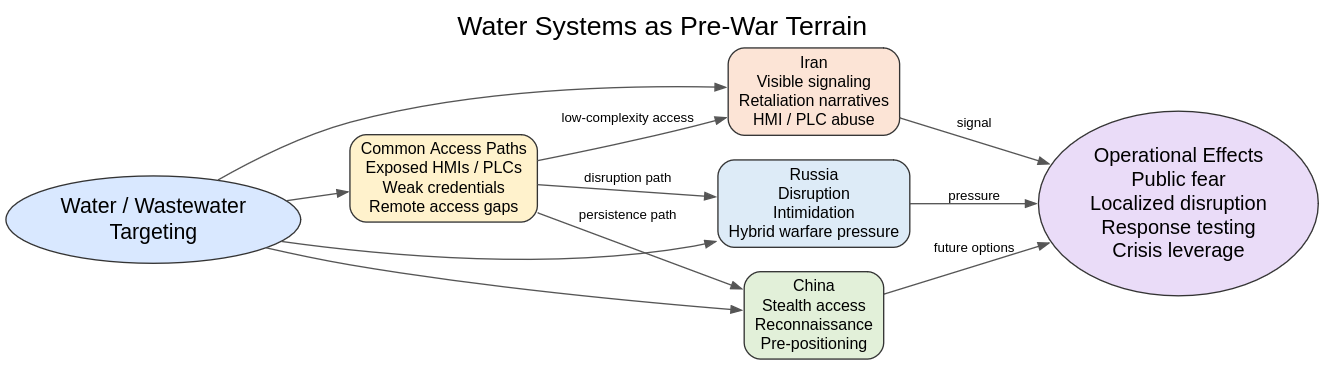
The goal is not immediate spectacle but durable access patterns that could be leveraged during a future crisis. Allied agency reporting from 2024 warned that such footholds create contingency options that materially change strategic calculations in a high‑intensity scenario.
A series of non‑attributed and criminal incidents further underscores the sector’s fragility. Ransomware and intrusion events affecting billing systems, backup servers, and administrative interfaces have repeatedly forced utilities to shift to manual operations.
Those cases illustrate an important point: attackers do not need bespoke ICS malware to inflict operational disruption.
Credential theft, exposed remote‑access tools, and compromised vendor connections provide effective routes into control environments or critical adjacencies like GIS and identity systems.
Geographically, the risk is highest where utilities are small, underresourced, or situated in geopolitically sensitive regions. Europe and NATO‑adjacent states face acute Russian pressure, Poland’s breaches in 2025 highlight the vulnerability of logistics hubs, and U.S. utilities remain attractive targets for PRC pre‑positioning and opportunistic Iranian activity.
Across regions the common exploited weaknesses repeat: internet‑exposed HMIs/PLCs, default or shared accounts, legacy unsupported controllers, insufficient monitoring, and blurred IT/OT boundaries.
Strategically, water‑sector intrusions serve multiple roles: coercive signaling, resilience probing, public‑opinion shaping, and contingency creation.
The immediate threat profile favors low‑complexity compromises that can provoke fear and consume emergency resources; the existential risk lies in persistent, stealthy access that could be activated during major geopolitical crises.
Because the U.S. water sector comprises roughly 170,000 systems with widely varying cyber maturity, systemic remediation is difficult but essential.
Mitigation requires prioritized hardening of internet‑facing assets, enforced credential hygiene, vendor access controls, network segmentation, and sustained federal–state assistance for small utilities.
Public advisories from CISA, EPA, and the GAO provide technical guidance and threat context; operators should treat ransomware and criminal intrusions as indicators of the same structural weaknesses that nation‑states exploit.
In today’s hybrid‑warfare environment, safeguarding water infrastructure is not only an operational imperative but a strategic necessity preventing low‑cost access that adversaries can transform into political leverage.
Indicators of Compromise
| Indicator | Type | Year | Relevance |
|---|---|---|---|
135.136.1[.]133 | IP address | March 2026 | Used by Iranian-affiliated APT actors to communicate with Rockwell Automation / Allen-Bradley PLCs |
185.82.73[.]162 | IP address | Jan 2025–Mar 2026 | Same |
185.82.73[.]164 | IP address | Jan 2025–Mar 2026 | Same |
185.82.73[.]165 | IP address | Jan 2025–Mar 2026 | Same |
185.82.73[.]167 | IP address | Jan 2025–Mar 2026 | Same |
185.82.73[.]168 | IP address | Jan 2025–Mar 2026 | Same |
185.82.73[.]170 | IP address | Jan 2025–Mar 2026 | Same |
185.82.73[.]171 | IP address | Jan 2025–Mar 2026 | Same |
Note: IP addresses and domains are intentionally defanged (e.g., [.]) to prevent accidental resolution or hyperlinking. Re-fang only within controlled threat intelligence platforms such as MISP, VirusTotal, or your SIEM.
Follow us on Google News, LinkedIn, and X to Get Instant Updates and Set GBH as a Preferred Source in Google.