Password audits are a standard part of most security programs. They help organizations demonstrate compliance, reduce obvious risk, and confirm that basic controls are in place. However, in many cases the accounts that show up in an audit report aren’t always the accounts attackers target.
Most password audits focus on signals like complexity and expiry policies. While important, those audits miss potential risks like over-privileged users, forgotten access, service accounts, or credentials that have already been exposed in a breach.
To understand the risks, it’s important to look at where password audits typically fall short, and what security teams can do to make them more effective without losing sight of regulatory requirements.
Strength without context doesn’t stop attacks
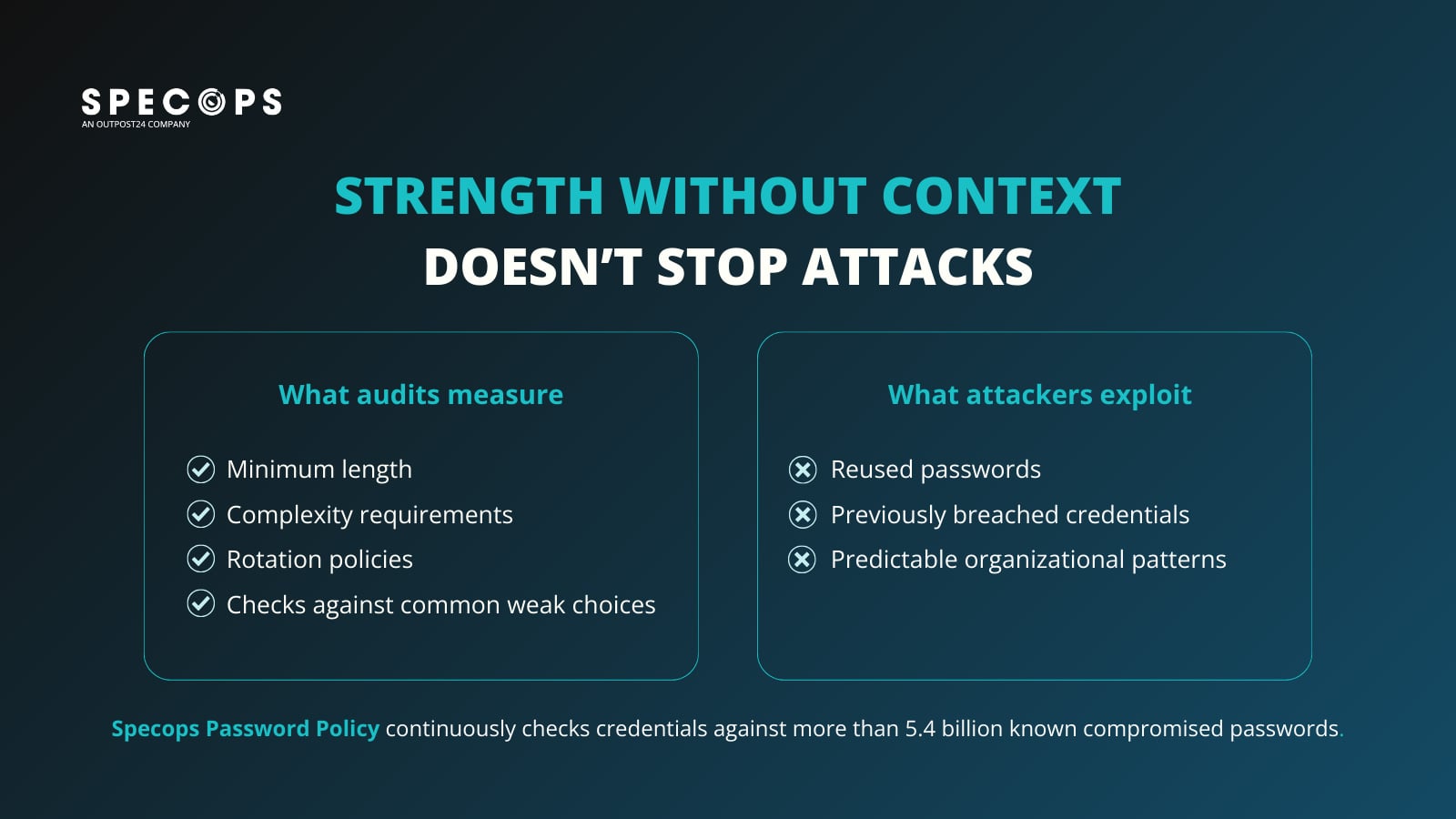
Password audits often start with strength rules: minimum length, complexity requirements, rotation policies, and checks against common weak choices. But if that’s where they end, those audits miss critical vulnerabilities that attackers look for:
- Reused passwords
- Credentials exposed in previous breaches
- Predictable patterns tied to the organization or industry
A password can meet every compliance requirement and still be easily guessable in context. For example, an employee at a hospital using something like Healthcare123! may technically satisfy complexity rules, but attackers can easily crack it using a targeted wordlist.
Even worse, a password can appear “strong” while already being compromised. If it’s been leaked in a breach elsewhere, attackers can simply log in with it. One study highlights this risk, where 83% of 800 million known compromised passwords otherwise satisfied regulatory requirements.
Without breached password screening, audits create a gap where accounts look secure on paper but remain easy to compromise. This is especially true for high-value accounts, where one successful login can open the door to far wider access.
What to do instead: Modern audits should include breached-password screening and risk-based prioritization, so the focus stays on the accounts attackers are most likely to target. Tools like Specops Password Policy help by continuously checking credentials against a database of more than 5.4 billion compromised passwords.
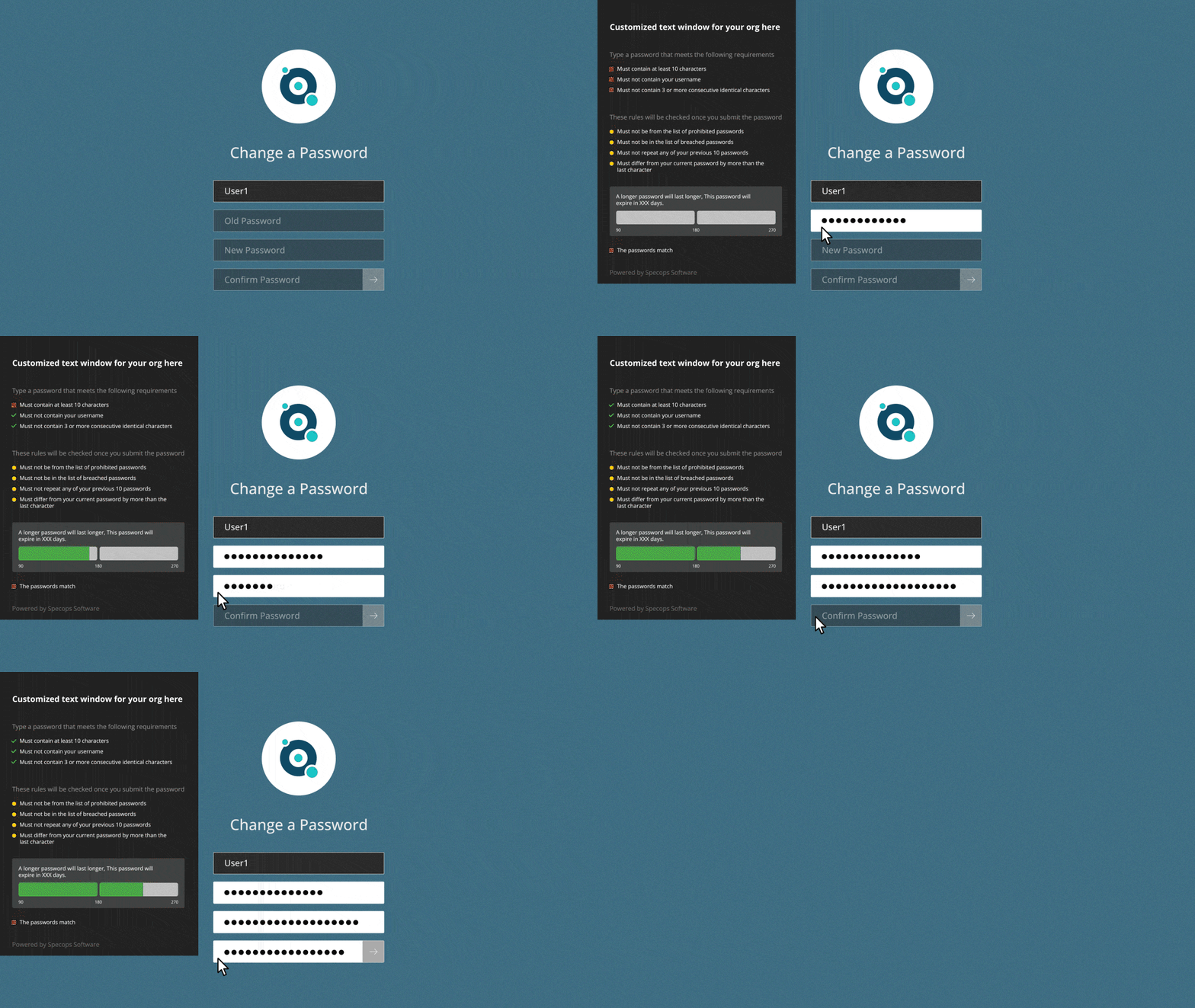
Alongside allowing organizations to create unlimited custom block lists of terms unique to their environment, Specops Password Policy reduces the likelihood of attackers successfully using exposed or predictable credentials.
Orphaned accounts aren’t audited
Typically, password audits assume that the accounts that matter are those on the current employee list. However, in many environments, not every active account belongs to an active employee.
Attackers know this, which is why “orphaned” accounts are such an attractive target. Accounts belonging to former employees, contractors, test accounts or shadow IT accounts operating outside normal identity processes are all-too common in enterprise environments.
Orphaned accounts can sit quietly for months or years without anyone paying attention. They also tend to have weaker controls, such as outdated passwords or missing multi-factor authentication (MFA) enforcement.
If an attacker finds valid credentials for an old contractor account, they may gain access without triggering the same alerts that a privileged login would.
What to do instead: Password audits should extend beyond “active users” and include dormant, external, and non-HR-linked accounts. Pairing password checks with regular access reviews and automated deprovisioning helps close one of the most overlooked gaps in account security.
Verizon’s Data Breach Investigation Report found stolen credentials are involved in 44.7% of breaches.
Effortlessly secure Active Directory with compliant password policies, blocking 4+ billion compromised passwords, boosting security, and slashing support hassles!
Try it for free
Audits miss high-value service accounts
Service accounts are frequently overlooked in user-focused password audits, which is an issue as these accounts often have excessive permissions alongside passwords that never expire. From an attacker’s point of view, compromising a service account can provide long-term access without the visibility or scrutiny that comes with a privileged user login.
The result is that organizations may pass a password audit while some of riskiest accounts remain effectively unmanaged.
What to do instead: Password audits should explicitly include service accounts, especially those with elevated permissions. Moving credentials into a vault, enforcing rotation, and applying least-privilege access can significantly reduce the risk of service accounts becoming an attacker’s easiest route into critical infrastructure.
Point-in-time audits can’t keep up with continuous threats
An audit delivers a snapshot of password hygiene at the moment the audit ran. But credential-based attacks are continuous, and the risk can change overnight.
One of the most common examples is credential stuffing. Attackers take usernames and passwords exposed in one breach and try them across other services, betting on password reuse. That means an account can be perfectly compliant today and compromised tomorrow, simply because the same credentials were leaked elsewhere.
This is especially relevant for larger organizations or those with external-facing login portals. Attackers don’t need to break password rules if they can just reuse credentials that already exist in criminal marketplaces.
What to do instead: Strong password auditing needs an element of continuous monitoring. That includes regularly checking credentials against updated breach data, watching for suspicious login patterns, and treating password security as an ongoing control.
How to carry out secure password audits
If the goal is to reduce the likelihood of compromise, not just pass an assessment, audits need to reflect how attackers actually operate. At a minimum, password audits should:
- Check passwords against known breach data, not just complexity rules
- Prioritize highvalue and privileged accounts, rather than treating all users equally
- Include orphaned and dormant accounts, not just active employees
- Explicitly cover service accounts, especially those with elevated permissions
- Incorporate continuous monitoring, rather than relying on periodic snapshots
- Consider MFA resilience, particularly for sensitive systems
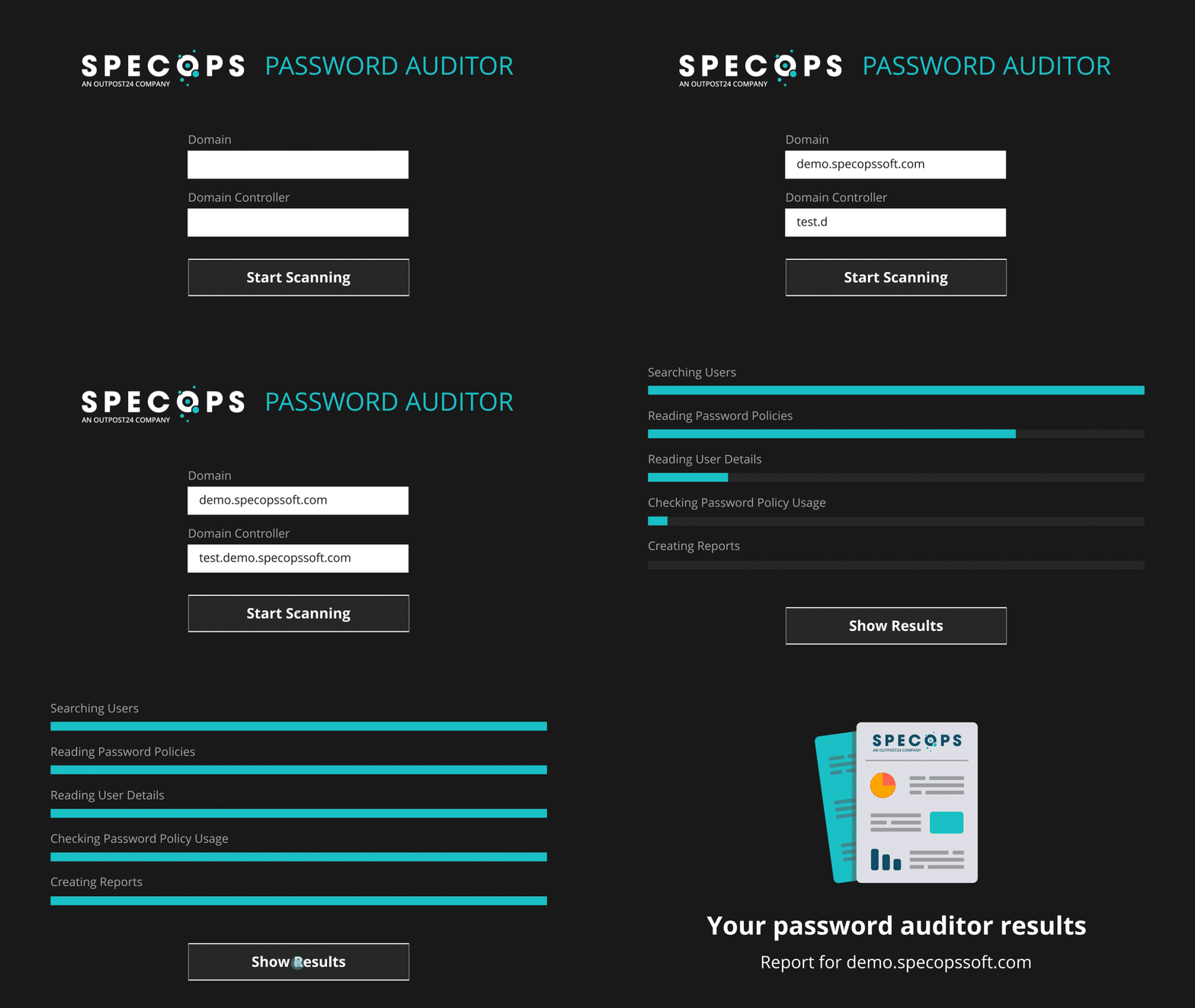
Solutions like Specops Password Auditor help organizations assess their password health by running a read-only scan of their Active Directory and flagging vulnerabilities like inactive privileged admin accounts or compromised passwords.
To understand more about how these controls can work in your organization, speak to a Specops expert or request a live demonstration.
Sponsored and written by Specops Software.