I just realized Claude Tag might be the AGI moment I’ve been talking about since 2023.
No, that doesn’t mean Claude generally is pure, technical “AGI”. It’s hard to even know what that means. Everyone disagrees.
My definition of AGI, which is what I think we actually care about, is just:
An AI system that can replace an average knowledge worker.
The whole point of all this stuff is the impact it has on us humans, which is why I think this is the best definition.
The “G” in AGI stands for generality, and nobody agrees on how to measure that. But one thing we know requires generality is doing a chaotic knowledge work job, because it demands competence across dozens of different skills. If something has general enough intelligence to be an average knowledge worker, that’s a solid standard for generality.
In November 2023 I wrote Why We’ll Have AGI by 2025-2028:k
My prediction is a 60% chance of AGI in 2025 and a 90% of AGI in 2028.November 2023
That post also had the definition I still use:
An AI system capable of replacing a knowledge worker making the average salary in the United States.
The argument for how we’d get there was systems, not components. We wouldn’t need one magic model to be AGI by itself. A system of AIs working together toward a shared goal would get there first.
Then in March I wrote We Are Confusing Two Types of AGI, which split AGI into Hard AGI (the academic, Computer Science version) and Soft AGI:
An AI system implemented as a Product/OSS Project that emulates learning generality well enough to replace knowledge workers.
And that post made another specific call:
I believe we’ll see one or more commercial products in 2026 or 2027 that do this.March 2026
I even described how that product would behave. It onboards like a regular human. It does orientation. It takes instruction from the manager. It interacts with the team. It works. It ships results.
That’s the shape Claude Tag just showed up in. You install it into Slack, where knowledge work already lives, and you treat it like a coworker.
What it actually does
Here’s how Anthropic’s docs describe it:
Anyone in a channel can tag Claude into a problem and hand it work: reproduce a bug and open a pull request, turn a decision thread into a doc, assemble the state of a project.Claude Tag documentation
That’s a job description.
Here it is picking up a Sentry alert, reproducing the bug, opening the PR, and asking the code owner for review:
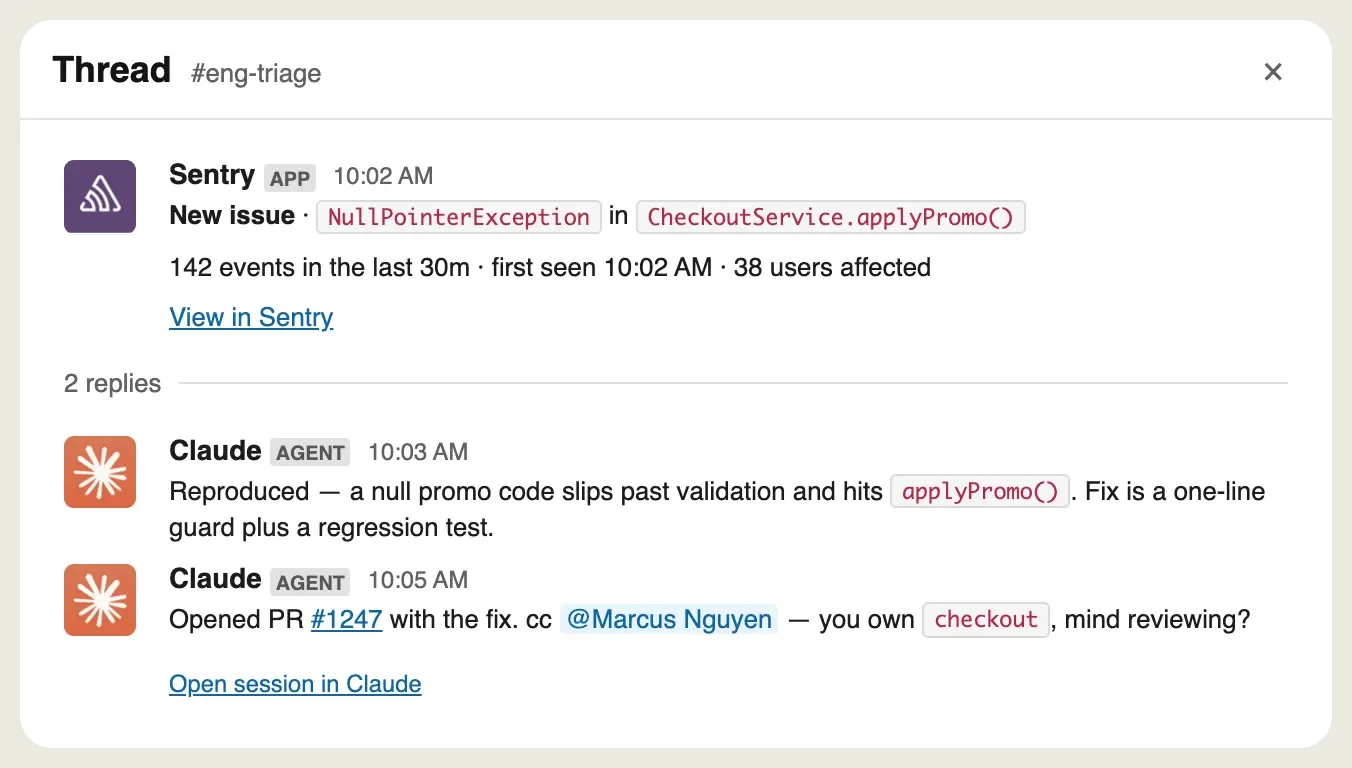
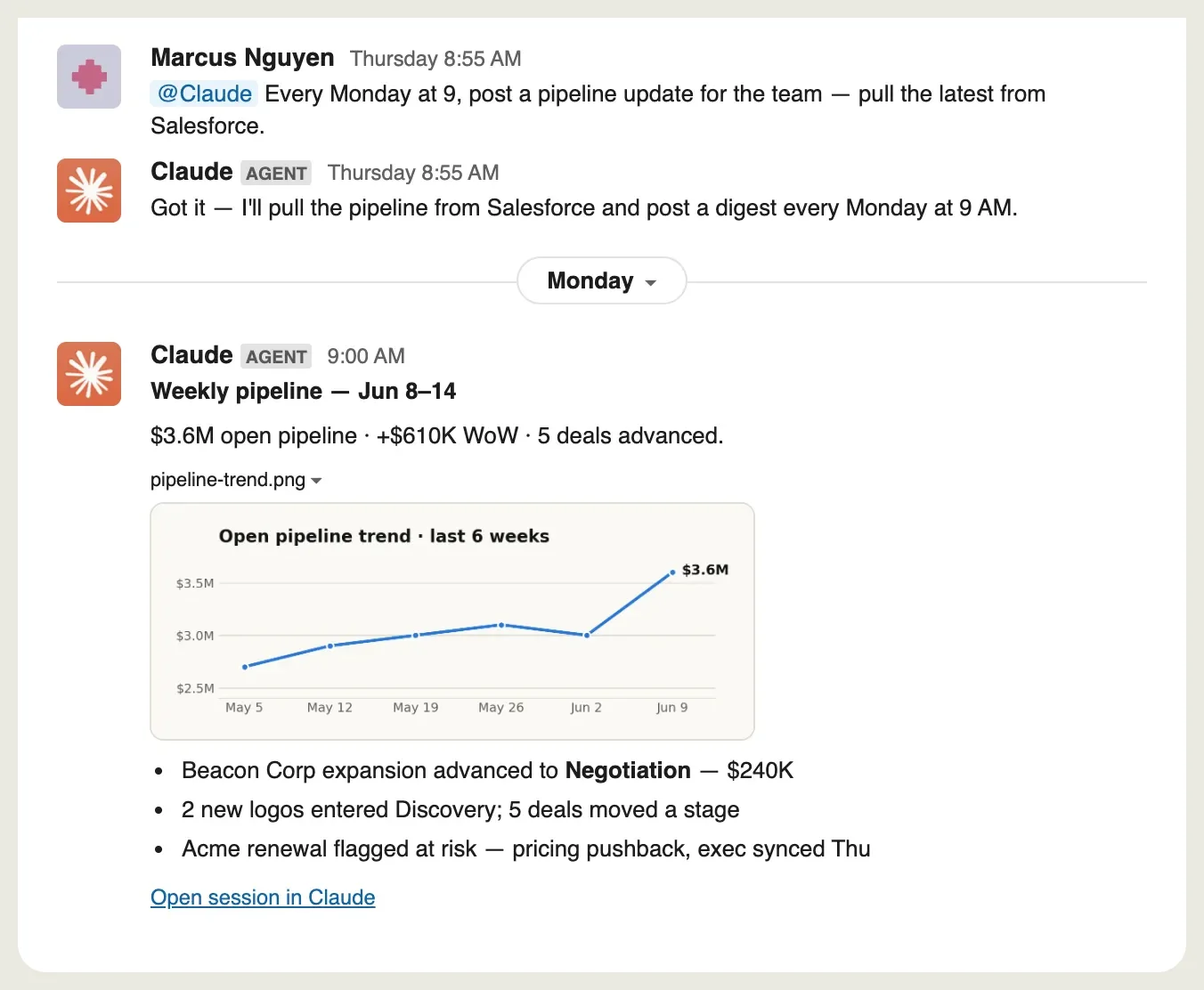
Here it is doing the boring recurring work, a Monday pipeline digest pulled from Salesforce on a schedule:
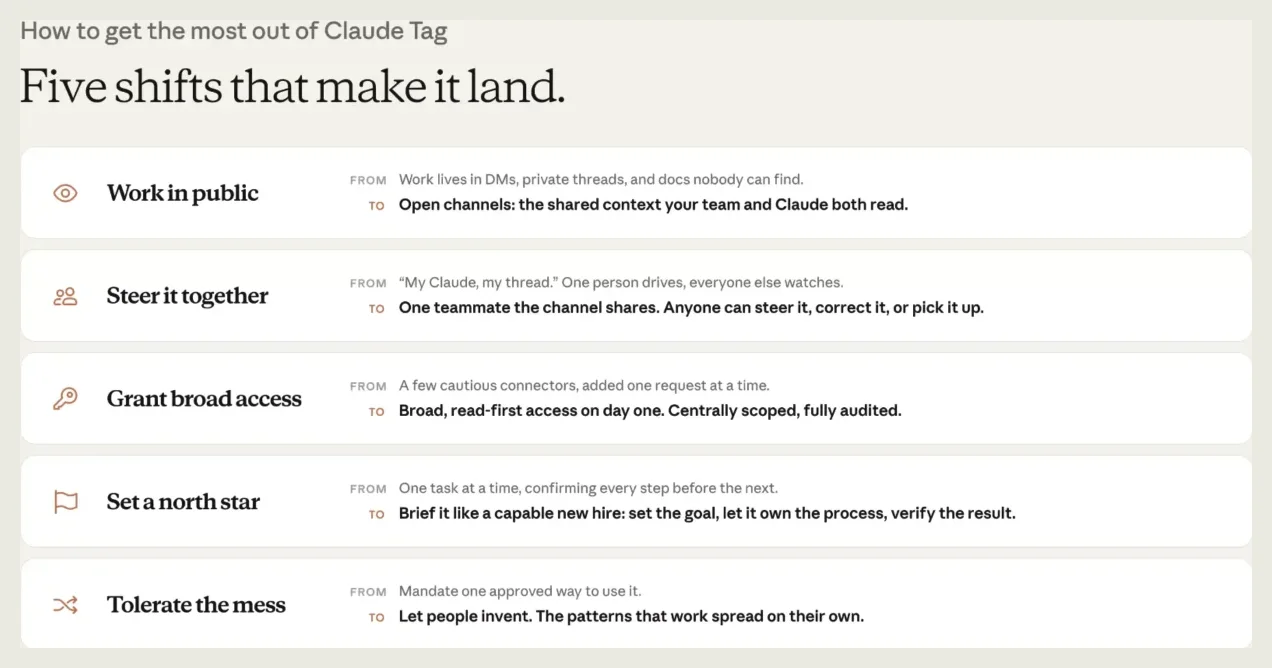
And in the webinar, Anthropic literally tells you to manage it like a person. Their words: “Brief it like a capable new hire: set the goal, let it own the process, verify the result.”
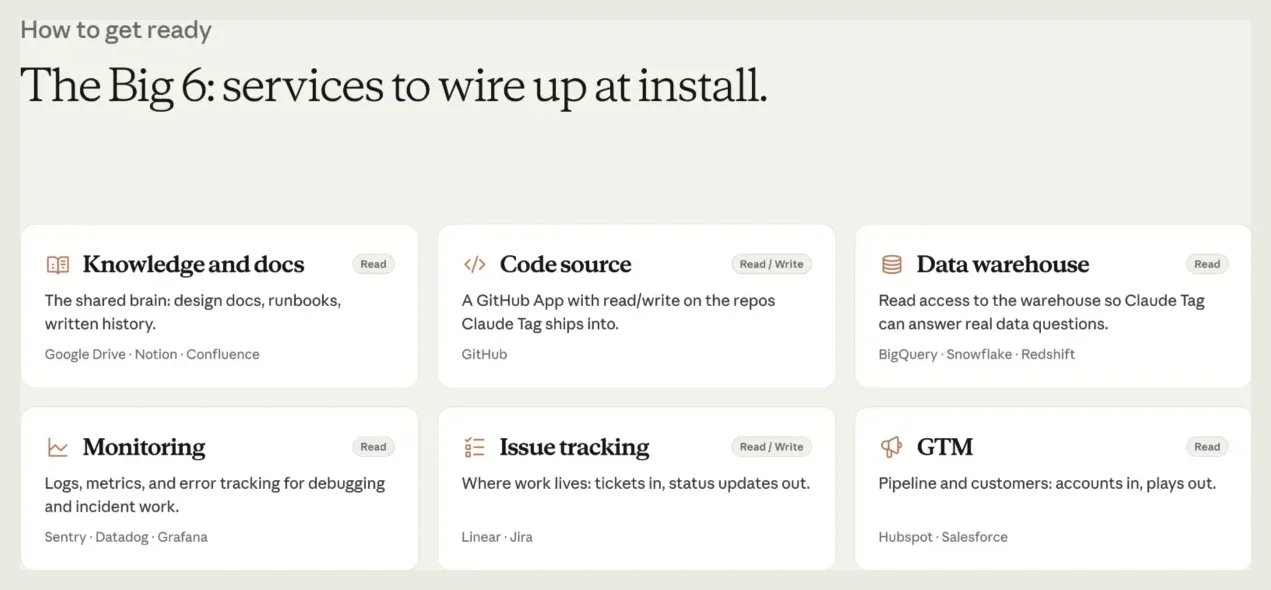
At install you wire it into your repos, your docs, your data warehouse, your monitoring, and your ticketing. It runs in a sandbox hosted by Anthropic, and it works out of the channels your team already uses.
That’s onboarding. That’s what you do with an employee.
A GPT-4 moment for worker replacement
I think this is like a GPT-4 moment, but for worker replacement.
Think of it this way. All these companies have been trying to “replace” workers with AI, but they have no idea how to do that. They don’t know what the work is. They can’t give specific instructions to AI. AI doesn’t have enough tools. The whole thing is not scaffolded well enough and integrated well enough with their work to actually be able to do it.
I think this is the first moment via this product where it’s so deeply integrated, and all you have to do is have regular conversations with it like a co-worker.
It’s actually doing all the Claude Code stuff that we’re all so impressed with. It’s doing that all on the backend by itself, so it’s literally like you’re talking to a co-worker.
That’s the part that is actually going to make laying off like half the workforce possible.
Basically, up until now, what replacing people with AI meant was giving that work to somebody else who was really good with AI.
Now you’re not giving it to another person who has Claude Code, who’s like one of us and a total ninja with AI. Now you’re actually just handing it to a co-worker, in this case Claude.
Anyway.
After reading all the Claude Tag docs, and watching a full Anthropic webinar on the project, I think this might be it.
The tangible thing I was waiting for was an actual PRODUCT being dropped that can replace a human worker.
Not like general tech. Most people can’t use Claude Code. But something that you literally install and you can then treat it like a knowledge worker.
I think Claude Tag might be it.
I’m like 85% sure.
Meaning, I’m 85% sure we just hit what I believe to be the best definition of AGI.
I guess the reason I’m tripping out about this is because I think everyone, including myself, was waiting for a technology upgrade to get AGI.
When in fact it might just be in the form of an integration.
I always knew this was going to come from a product, not a model change. I just thought it would be some startup — a cool name, a cool logo, and the whole basis of the company is a drop-in knowledge worker replacement. Turns out it’s a sub-product inside the Anthropic platform.
And you can damn sure bet OpenAI will be there soon. Microsoft can do this too. Google can’t, because their product management is paralyzed — they’re out of this game until they fix that. That’s what sets Anthropic apart: they are so good at being connected to what people need and rolling out product fast. Listen, ship, iterate. Listen, ship, iterate.
Think about what Claude will say about you
Here’s the part everyone needs to sit with.
Once Claude is inside your company, you can literally ask it to figure out what Sarah or Raj or Chris actually does. Find every Slack message they sent. Every meeting they sat in — read the transcripts. Every email in and out.
And not just the volume of work. The impact. What tasks are they actually doing? How many new ideas have they had? Have they come up with new product ideas? Do they encourage others? Are they a nurturing type who helps out across the team? Do they support the culture or quietly undermine it?
AIs understand all of these things. The only thing they need is inputs.
Yes, the quality of the prompts and the criteria will matter, and some companies will get that wrong and it’ll be bad. But in general I think this locks in fairly quickly, because it’s in companies’ interest to keep the best possible people and get rid of the worst.
Companies will literally be able to say: this is what a model employee looks like for us. They produce this type of value. They have this type of attitude, this type of energy. They come up with new ideas. They help customers. They add signal to the organization — to our procedures, to how we do things. They’re not simply executing tasks.
Because that’s the question now: what can you do that Claude cannot?
In pretty much all cases, that domain is encouraging others, collaborating with creativity, coming up with new ideas for products and features, producing delight for customers. AI will get really good at delight in the SLA sense — fast response times, high-accuracy emails, great reports. But coming up with its own ideas based on a deep understanding of what a customer or a coworker needs? That requires internal fire. Internal vibration.
Humans have that. It comes from their experiences and passions and curiosity — from seeing bad products and unhappy customers and wishing the world were different than it is today. Wishing a product existed that doesn’t exist yet. We could probably prompt something like that into an AI, but it’s going to be unnatural. It’s not going to be the same as from a human. At least not anytime soon.
The universal employee
It gets even simpler than that, because you no longer need to be an expert in Claude Code or AI harnesses. Even that is being abstracted away now. The only thing that matters is your ideas that don’t exist yet in the world. New things to build. New products, new features.
So you hire for energy. You hire for positivity. You hire for creativity. You hire for culture fit. And 1 plus 1 equals 7 — except each of those ones has hundreds or thousands of Claudes backing them, building designs, building prototypes, creating reports, doing testing.
Product merges with engineering. Engineering merges with design. Everyone is a vision person. Everyone’s an idea person. Everyone’s a PM. Everyone’s an engineer. There will obviously still be hardcore engineers and hardcore designers, but everyone at the company becomes one of these universal employees. Super well-rounded. Super AI-native.
The people in danger
The people in the most danger are the people who have been trained not to have ideas. The people who have been trained to execute other people’s ideas their whole life. That’s what they were taught in school. That’s what they were trained for. And that’s what they’re doing.
This is the whole point of my Human 3.0 thing — to encourage them to light up their inner self, their younger self that was curious and interesting and asking questions, before it got beaten out of them by peers and school and work.
The type of person who’s going to thrive in this world is somebody who up until now has only been able to execute on a tiny, minuscule fraction of their ideas. They want to make movies. They want to write novels. They want to make music. They have ideas for new ways of doing healthcare for elderly people, for robots that help people with declining mental faculties.
The vast majority — 99.999% — of people’s ideas have never been attempted. Never encouraged, never possible, because of the giant stack of requirements between the idea and reality: money, connections, networking, timing, programming skills, design skills, a million different things needed to produce something end to end.
That is just no longer the case.
Inside a company, that manifests as the people with ideas for how to grow the thing — sales campaigns, marketing campaigns, new features, new products altogether. All those ideas now become possible.
If you’ve heard me talk about the K-shaped recovery before — where the people in a good position shoot up into orbit and the people in a bad position fall to the ground — well, that just got massively magnified.
Which is exactly what we knew was going to happen with AGI.
And it’s now upon us.
Everyone reading this needs to be thinking very carefully about what Claude will say inside your company when it reads every single email and every single Slack message, and asks how aligned you are with the culture, how many new ideas you’re putting out, and what you’re actually doing that provides value AI can’t.
This isn’t a prediction. I’m describing a reality that’s already happening.
We need to transition ourselves, as quickly as possible, from executors of other people’s ideas to creators of ideas of our own.