Executive Summary
Vulnerability exploitation now happens at a speed that manual, ticket-based remediation can’t match. Qualys’s Enterprise TruRisk Management Platform closes that gap with autonomous remediation: exposures are prioritized by threat, business, and environmental context, then validated by TruConfirm and Agent Val before any resource is committed, eliminating over 90% of remediation noise across 1,600+ CVEs. Confirmed risks move to TruRisk Eliminate, which scores patch reliability and deploys in waves within human-set guardrails—cutting remediation time on CISA KEV vulnerabilities to 14 days versus a 1-month-19-day industry average. As boards shift from activity metrics to outcome metrics, this continuous detection-to-remediation architecture provides security teams with an evidence-based answer on whether they’re more or less exposed than 90 days ago.
Somewhere in every enterprise, there is a person who approves remediation actions that a machine has already determined are necessary, already validated as safe, and already queued to execute. That role was designed for a threat environment that no longer exists, and the people in it are usually the first to say so, because they were handed a queue that grows faster every quarter, severity ratings that tell them almost nothing about their own estate, and an approval gate that makes them personally accountable for outcomes they have no evidence to predict. Nothing about the role failed, but the conditions around it changed, and the tooling never caught up.
How much they changed is now measurable. Gartner reports that the time from disclosure to active exploitation has compressed from more than two years in 2018 to less than two days, and that 76% of exploited CVEs are now weaponized before or on the day of disclosure. Verizon’s 2026 DBIR ranks exploitation of vulnerabilities as the number one initial access vector, ahead of credential abuse and phishing for the first time. Meanwhile, the latency between a vulnerability being discovered and a patch being published is tracking at over two weeks, which means the approval queue is often waiting on a fix that attackers have already outpaced.
The organizations closing that gap are not doing it with larger teams or bigger budgets, but by removing human latency from the critical path, which is a question of architecture rather than of tooling.
It is tempting to treat autonomous remediation as something a patching tool does on its own, and that reading misses most of what the term covers. Autonomous remediation is a concept that Qualys operationalizes across the Enterprise TruRisk Management platform, where:
- Detection feeds prioritization,
- Prioritization feeds validated exploitability,
- Validated exploitability feeds remediation, and
- Remediation feeds confirmed risk reduction back into the next cycle.
Each stage hands the next a smaller and better-qualified problem, and the sequence runs continuously rather than pausing while a person moves work between tools.
Read More
Most vulnerability programs break at the same point, which is the moment a scanner returns thousands of findings that all carry a high severity rating, and none of which indicate what matters here. Hyper-prioritization resolves that by supplying the context severity scores leave out, since threat context establishes whether an exposure is being weaponized right now, business context establishes what the affected asset actually supports, and environmental context establishes whether conditions in your estate make exploitation viable at all. Layered together, they narrow a list of everything that looks urgent into a queue of what is genuinely exploitable on assets the business depends on, and TruRisk and TruLens are where that capability lives in the platform.
Ranking exposures well still leaves the expensive question unanswered, because a finding at the top of a prioritized queue is a strong hypothesis about risk and remains a hypothesis until someone tests it against the controls and configurations actually in place. Confirmation is the step that determines whether autonomy is defensible at all.
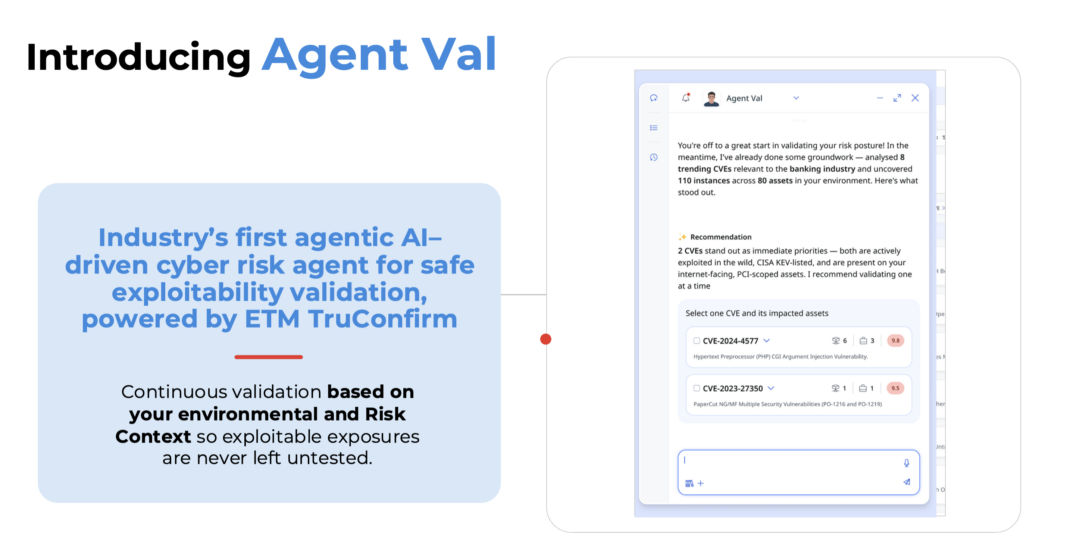
TruConfirm, powered by Agent Val, closes that gap. Agent Val decides what to validate next, autonomously selecting the highest-priority exposures without waiting for manual triage, while TruConfirm safely replicates an attacker’s technique against live production assets to prove whether the exploit path is genuinely open. Each validation returns one of three answers backed by evidence, which is that the exposure is exploitable, blocked by a compensating control, or unreachable, so that EternalBlue is flagged exploitable only where SMBv1 is actually enabled and Log4Shell only where the JNDI path is live. Across more than 1,600 CVEs, this removes over 90% of remediation noise, filtering out everything theoretical before a single remediation resource is committed.
What Autonomous Actually Means
The word autonomous makes security leaders uncomfortable, and for understandable reasons, since automation that acts without appropriate guardrails in a production environment is a liability and the failure modes are familiar: patches that break systems, containment actions that take out business-critical services, and automated changes in fragile environments where nobody can predict the second-order effects.
What autonomous describes here is where human judgment gets applied, rather than whether it does. Humans stay in the loop and move to the point where their judgment carries the most leverage, defining the rules, setting the thresholds, and reviewing exceptions, while the system executes within those boundaries at a pace that manual ticket approval was never going to sustain.
Once Agent Val has confirmed exploitable risk and moved it to the top of the queue, TruRisk Eliminate is where the sequence acts, functioning as the remediation intelligence layer and doing considerably more than applying a patch on command. It scores the reliability of a patch before deployment, offers mitigation paths where patching is not viable, and, with operational resiliency complementing the score later this year, extends that intelligence to how deployments hold up over time, which together make the trust architecture the substance of the product rather than a wrapper around it.
Patch reliability is the probability that a patch will deploy successfully in production without causing system failures, rollbacks, or unintended side effects, and Qualys measures it by analyzing real-world deployment telemetry aggregated from real-world deployments. A patch with high reliability deploys cleanly at scale, while a patch with low reliability fails frequently in production and requires rollback or an alternative remediation path. That global evidence lets teams automate high-confidence patches immediately while validating riskier ones through staged ring deployment before they reach production, so the outcome is understood in advance rather than discovered during the rollout. Wave-based deployment then moves from least critical to most critical assets, containing the blast radius of any unexpected behavior before it reaches the systems that matter most, and those controls are what make autonomous remediation a conversation a CISO can have with the board without flinching.
TruRisk Eliminate also matters because not every confirmed exposure can be patched, and it operates across the full remediation spectrum accordingly, patching where a reliable patch exists and the reliability score supports deployment, fixing misconfigurations where those are the root cause, applying virtual patching or WAF rules where operational constraints make immediate patching impractical, uninstalling software where the asset no longer requires it and the risk of keeping it outweighs the cost of removal, and isolating assets where no other path is viable in the available window.
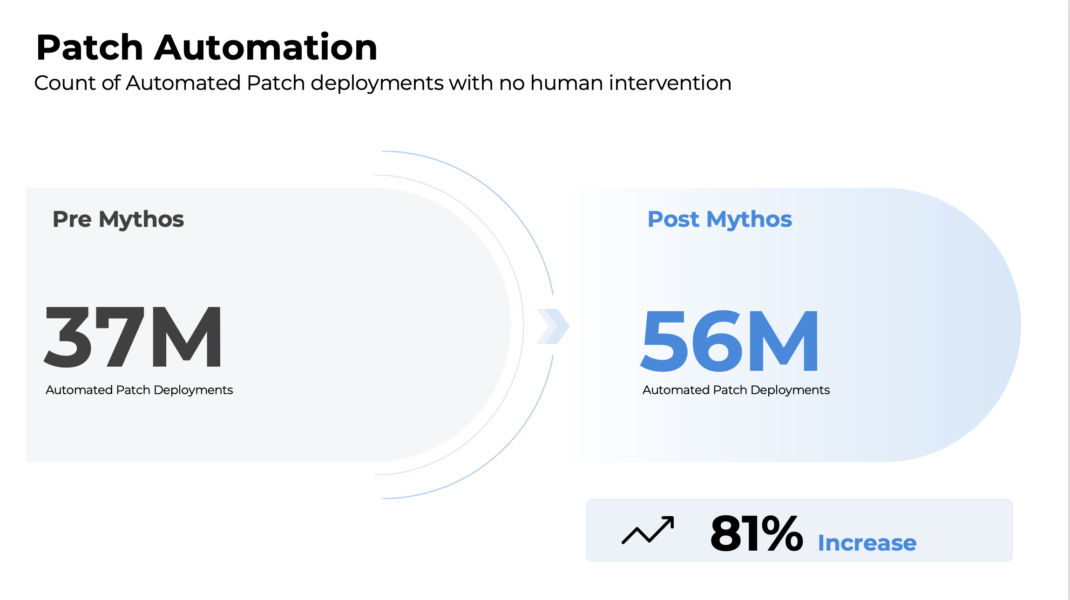
The effect of that architecture shows up in remediation speed rather than in activity counts, and on internet-facing assets carrying CISA KEV vulnerabilities, TruRisk Eliminate customers are remediating in 14 days against 1 month and 19 days for everyone else, while on overall risky exposure at QVSS 9 or above, they are closing in 24 days against 1 month and 22 days. Automation carries most of that load, and in the two quarters following the Mythos announcement, automated patch deployments requiring no human intervention rose 81%, from 37 million to 56 million, which indicates what organizations do once they can predict deployment outcomes rather than discover them.
Specific customer outcomes follow the same pattern, with 92,000 instances of Zoom uninstalled and securely migrated in response to a security risk, 27,000 WinVerifyTrust vulnerabilities remediated in three days, 40,000 .NET end-of-life vulnerabilities removed in 16 days, and 10,000 birthday attack vulnerabilities resolved in six days, each of them a case where the operational risk was managed, and the result was a demonstrable reduction in confirmed exposure.
The Board Conversation That Is Coming
Boards are starting to ask better questions about vulnerability risk, and Frontier AI will accelerate that change, because how many vulnerabilities were found, how many patches were deployed, and what the current severity distribution looks like are all questions about activity that describe work being done while saying nothing about how much risk was actually reduced. The questions arriving now are different, and they run along the lines of:
- Whether the organization is more or less exposed than it was 90 days ago
- How long confirmed risk remained open against the systems that matter most to the business
- What the Average Window of Exposure looks like this quarter, compared with last, and against the peer group
None of that can be answered with patch counts, whereas Average Window of Exposure measures how long an organization sits exposed cumulatively rather than how quickly it closed any individual ticket, which is the measurement that survives contact with a threat environment where 76% of exploited vulnerabilities are weaponized on or before disclosure day. Gartner’s guidance points in the same direction, recommending that generic patch deployment targets be replaced with outcome-based ones such as exploited vulnerabilities listed in the KEV catalog on internet-facing systems remediated within 72 hours, supported by measures that are similarly concrete: mean time to patch overall and by exposure group, the exploit-to-patch gap, automated patch success and rollback rates, and the share of patching an organization is able to automate at all. Alongside AWE, dollarized exposure burned down on validated risks and remediation resiliency, meaning the percentage of remediations applied on the first pass with no rollbacks completes the picture.
Because validation happens before remediation is triggered, closure rests on confirmed evidence that the exploit path no longer works, and after mitigation, Agent Val runs validation again to verify that the path is closed and the controls are holding, which is a fundamentally different kind of assurance from assuming that applying a patch resolved the risk.
The Model, Running End to End
An AI-Native Risk Operations Center is neither a dashboard nor a team name, but a cyber risk operations model where three capabilities run as one continuous chain:
- AI-speed detection that surfaces exposures as the environment changes
- Hyper-prioritization that ranks them by real business-weighted risk, with agentic confirmation that separates exploitable risk from theoretical exposure before any resource is committed
- Autonomous remediation that acts across the full spectrum at the speed the threat environment demands, with the guardrails that make production-safe automation real
Eliminate on its own removes real risk, and what the wider platform adds is the certainty that the risk it removes was the right one to remove first.
Sign up for a trial of TruRisk Eliminate today and get started on your own autonomous remediation journey.
The threat has gone autonomous because the discovery and exploitation of vulnerabilities now runs at machine speed, and a defense built on human-speed ticketing closes that gap by matching the architecture of the threat rather than by working harder inside the old one, with detection, prioritization, validation, and remediation running as a single autonomous sequence.
This series has built that case across four articles, from the broken operating model through the hidden exposure across the window and the confirmation gap that leaves most remediation cycles spent on risk that was never reachable, to the autonomous engine that closes it, and the organizations building a defense to match the threat are eliminating a risk rather than taking one.