- 1. Same-day exposure neutralization becomes possible
- 2. Patch deployments become reliable
- 3. Remediation becomes contextual
- 4. Compliance deadlines stop being emergencies
- 5. That 43-day median remediation time gets shorter
- The Operational Reality
- See How This Works At Scale
- Frequently Asked Questions (FAQs)
- What is patchless remediation?
- Does patchless remediation replace patching?
- How does this help with CISA KEV deadlines?
- Will this increase operational risk?

Executive Summary
Most IT teams still operate under a false binary: patch or accept risk. That assumption creates unnecessary operational pressure. Patchless remediation is real and production-proven. Mitigate, Uninstall, Run Custom Scripts, Isolate; close exposure when no reliable patch exists. Same-day exposure neutralization becomes possible for CISA KEV items without emergency change control or restart risk. AI-driven patch reliability scoring and contextual routing reduce friction between Security and IT, improving MTTR and response times. Expanding remediation beyond patching turns a monthly fire drill into a controlled, operational capability.
The call comes on a Thursday afternoon. Security flagged a CISA KEV item. High severity. 2,000 systems affected. You pull the details. End-of-life software. No vendor patches are available. Too critical to risk aggressive change control.
The email chain that follows is familiar. Security escalates. Compliance gets copied. Your director asks when it’ll be resolved. The honest answer: 48 to 72 hours minimum, high risk, emergency change control. This isn’t what your management wants to hear.
This scenario plays out monthly in most IT organizations. Not because the team is slow. Because the assumption everyone operates under is wrong: patch or accept risk. Those are the only options. Except they’re not.
Most organizations treat vulnerability management like a binary: if there’s no patch, there’s no solution. That gap is where much of the operational pressure lives.
Configuration hardening that neutralizes exposure without requiring a system restart. EOL software removal workflows tested against real production environments. Targeted mitigations that buy time for permanent fixes to happen in scheduled maintenance windows. These aren’t theoretical. Patchless remediation is real. It’s not a workaround. It’s an intentional set of remediation strategies validated by security teams and deployed at scale across production estates.
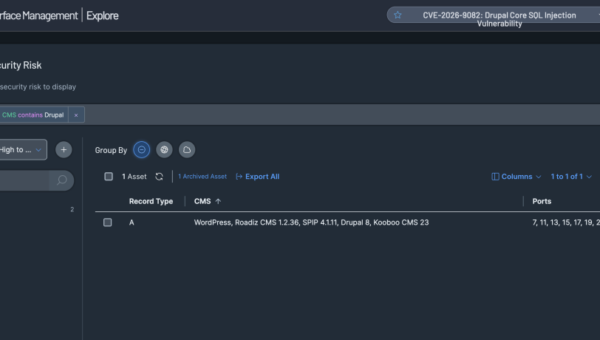
Examples of customer deployment:
The vulnerabilities your team thought were unsolvable actually had solutions. You just weren’t operating with that information.
Not all vulnerabilities follow the same path to resolution. Here are the five remediation strategies that close exposure when patches aren’t available, safe, or timely.
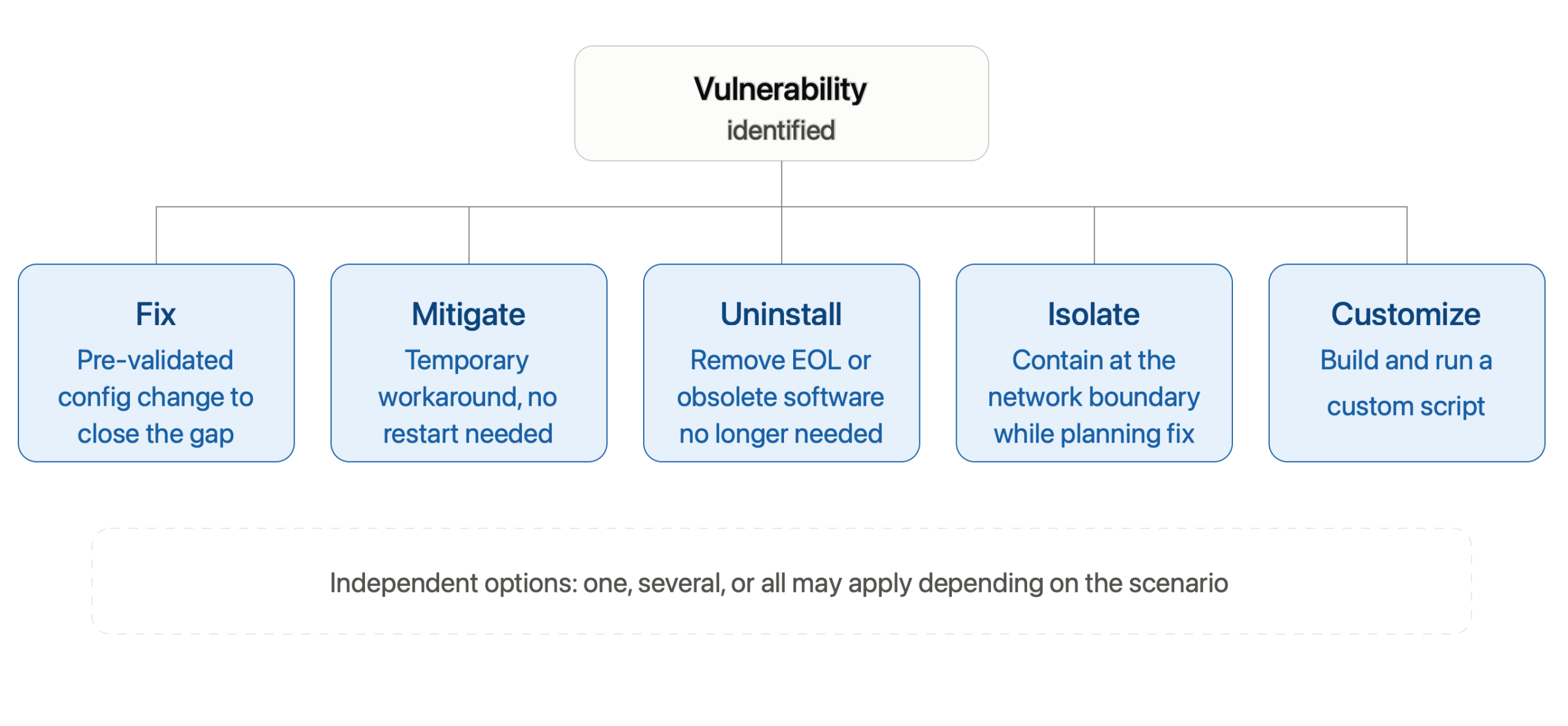
Most IT teams operate with only the first path visible. Patch or accept risk. That’s the choice when remediation means one thing. Expanding to five means every known vulnerability has a viable path forward, and IT isn’t trapped waiting for vendors or negotiating deployment windows with production teams.
The moment you expand the meaning of “remediation” beyond patching, the operational calculus shifts.
1. Same-day exposure neutralization becomes possible
Security needs immediate action on KEV items. Patchless mitigations neutralize exposure the same day, without emergency change control, without restart risk. The permanent patch can be applied during your next scheduled maintenance window.
Result: No calendar disruption. No Friday night deployments.
2. Patch deployments become reliable
A failed patch creates more disruption than the vulnerability it fixes. AI-driven patch reliability scoring routes low-risk updates for immediate deployment and stages higher-risk patches through existing testing and pilot rings.
Result: 250,000 workstations patched in 14 days with rollback rates below 0.1% across 150M patches deployed.
3. Remediation becomes contextual
Most IT-Security friction starts with an incomplete asset context. Tickets arrive without ownership data. Your team validates whether an action is warranted and then reassigns tickets.
Result: When asset context and risk intelligence route tasks before ticket creation, MTTR drops 30%. Response times improve 40%.
4. Compliance deadlines stop being emergencies
CISA KEV mandates require speed, not emergency deployment risk. Automated prioritization keeps zero-day items covered within SLA windows. Audit logging happens automatically. Production resiliency checks confirm stability. Near-complete KEV coverage becomes achievable without operational disruption.
5. That 43-day median remediation time gets shorter
The industry-wide figure isn’t due to IT teams being inefficient. It’s because traditional workflows assume patching is the only path forward. When you have configuration-based remediation, isolation strategies, and pre-validated fixes for common scenarios, the median improves significantly.
The Operational Reality
Your organization currently has vulnerabilities for which no patches are available. They’re sitting on your estate. Known exposures. End-of-life systems. Critical production environments are too fragile to risk aggressive change control. Those vulnerabilities don’t have to stay there.
Patchless remediation isn’t a security team concern that IT needs to support. It’s an operational capability that changes how vulnerability response actually works. It removes the false choice between “patch aggressively and risk production” or “accept the risk.”
See How This Works At Scale

Read More
Frequently Asked Questions (FAQs)
What is patchless remediation?
Patchless remediation is a set of intentional strategies: configuration hardening, software removal, isolation, mitigation, and custom scripts that close or reduce exposure when no reliable vendor patch is available, safe, or timely.
Does patchless remediation replace patching?
No. It expands the options available to IT teams. When a high-reliability patch exists, it is still the preferred path. When it does not, or when change-control risk is too high, the other four paths keep exposure under control.
How does this help with CISA KEV deadlines?
Patchless mitigations and isolation strategies can neutralize exposure the same day without emergency change control. This allows teams to meet aggressive SLAs while scheduling permanent fixes in normal maintenance windows.
Will this increase operational risk?
The opposite. AI-driven reliability scoring, staged deployment, and built-in rollback keep production stable. Large-scale deployments using these methods have shown rollback rates below 0.1%.