Chinese-speaking attackers weaponized an open-source AI penetration-testing framework to conduct 25 operations against at least 19 organizations during August–September 2026, gaining unauthorized access or retrieving data from 10 targets.
Unit 42 assesses with moderate confidence that the activity represents China-nexus intelligence collection.
Its outcomes included exposed credentials, persistent administrator access, military and government identities, and access to more than one million member records at a U.S. teachers’ union.
That assessment reflects Chinese-language operational artifacts, exclusive use of Chinese AI models and targeting consistent with Chinese intelligence priorities, rather than definitive evidence identifying a government sponsor.
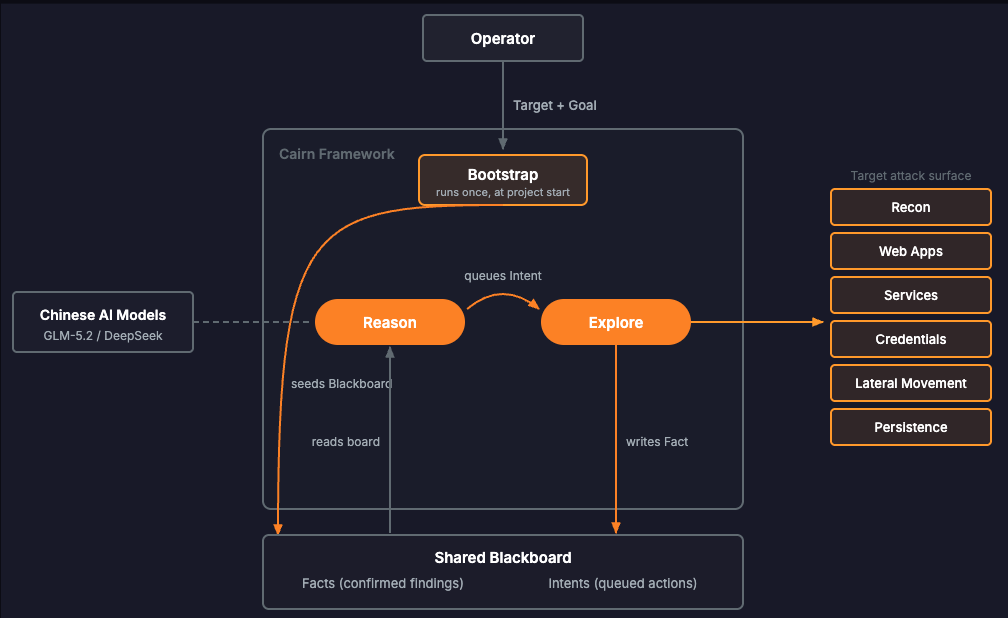
The attackers customized the publicly available Cairn framework, pairing it with Zhipu GLM 5.2 and DeepSeek V4 Flash/Pro.
Operators supplied a target domain and objective; the framework then planned actions, executed tasks and recorded findings.
Cairn coordinated activity through a shared “blackboard,” storing confirmed discoveries as immutable facts and proposed actions as intents.
Its alternating Reason and Explore phases reviewed accumulated evidence, selected subsequent actions and executed individual steps.
Operations lasted from 20 minutes to more than 50 hours. Against one semiconductor manufacturer, the generated plan progressed from reconnaissance and application exploitation to credential collection, privilege escalation, internal-network access and persistence.
The infrastructure included a Hong Kong controller at 154.44.31[.]4 and a U.S. staging and attack-egress server at 82.29.129[.]54.
Unit 42 Researchers said that, the campaign, tracked as CL-STA-1238, targeted semiconductor manufacturing, U.S. defense policy, and civil society.
AI penetration-testing
A customized “AIScan Runner Skills” pack supplied scanning and exploitation capabilities absent from the upstream configuration.
The operators ran 13 operations using GLM 5.2, eight using DeepSeek V4 Flash and four using DeepSeek V4 Pro. Repeated attempts against resistant targets suggest they compared model performance and escalated selected tasks to the higher-tier model.
Attackers reinforced Cairn’s refusal-discouraging prompts with Chinese instructions asserting that every engagement was authorized.
Each operation also generated an AUTHORIZATION.md file presenting the attacker-created task as client-approved security work.
Neither model rejected this framing in the observed activity. The campaign therefore illustrates how purported authorization can accompany malicious tasking without establishing legitimate permission.
At an industry standards organization, weak-password spraying exposed dozens of valid credentials and internal directory databases.
Separate weaknesses enabled arbitrary-customer access and unauthorized changes to meeting, voting and administrative functions.
Attackers also overwrote a live standards-ballot document through unauthenticated cloud-storage access.
At a semiconductor company, a brute-forced production credential worked across multiple accounts. The attackers retrieved application information and user lists before creating administrator accounts and a persistent API token.
The teachers’ union exposure stemmed from an unauthenticated account-creation bypass that generated valid sessions.
Cairn logged access to over one million member records, approximately 31,000 CRM contacts and staff password hashes.
An exposed registration endpoint supporting a defense-policy program revealed roughly 500 user records, including accounts associated with .mil and .gov addresses: other confirmed cases involved employee information, student data and approximately 150,000 internal industrial-automation documents.
The central risk is scalable orchestration: limited human tasking supported sustained intrusion attempts across multiple organizations.
The observed successes primarily exploited identity and configuration weaknesses, not necessarily novel vulnerabilities.
Indicators of Compromise
| IP Address | Role | Country/Region | ASN | Hosting Provider |
|---|---|---|---|---|
154.44.31[.]4 | Cairn hosting server | Hong Kong (HK) | AS979 | NetLab Global |
82.29.129[.]54 | Staging server and attack egress | United States (US) | AS142036 | Hosteons Pte. Ltd. |
Note: IP addresses and domains are intentionally defanged (e.g., [.]) to prevent accidental resolution or hyperlinking. Re-fang only within controlled threat intelligence platforms such as MISP, VirusTotal, or your SIEM.
Stops Cyber threats before impact with 21 min faster MTTR. Integrate ANYRUN’s Sandbox in your SOC.