Fake Word phishing attacks are abusing trusted remote access tools to bypass detection, exposing a growing security gap for enterprises.
A fake Word Online phishing page has exposed a growing enterprise blind spot: attackers using trusted tools to gain remote access without raising immediate alarms. The attack chain observed by ANY.RUN moved from an Outlook email to an MSI installer, silent execution, ScreenConnect remote access, and HideUL-based concealment. For CISOs, this is a warning that phishing investigations must focus on full behavior, not just malicious files.
The Business Risk: Delayed Detection During an Active Intrusion
The biggest risk in this type of phishing attack is not only the fake Word Online page but also the delay between the first suspicious action and a confident response.
When attackers use legitimate installers, remote access tools, and concealment utilities, the SOC may see separate pieces of activity without enough context to understand the full business risk.
For CISOs, this creates several problems at once:
- Trusted tools become part of the intrusion path
- Tier 1 teams need more time to validate the threat
- Escalations may reach Tier 2 or IR without enough context
- Leadership may lack a clear view of severity and business impact
- Remote access may be established before the incident is prioritized
This is why the key question is not only whether the phishing page was detected. It is whether the organization can quickly understand what happened after the click, what tools were deployed, and how much risk the incident creates.
The Attack Chain: From Fake Document to Remote Access
The attack begins with an Outlook email that leads the victim to what appears to be a Word Online or OneDrive document preview. At this stage, the lure looks like a routine business workflow: open a document, preview a file, continue working. But after the click, the chain shifts from phishing to remote access deployment.
Observed attack chain: Outlook email → fake Word Online page → MSI installer → Ninite silent execution → ScreenConnect remote access → HideUL concealment.
This is where the risk becomes harder to detect. The attack does not rely only on a suspicious file or a traditional malware loader. Instead, it moves through tools and actions that may appear normal in enterprise environments, including software installation and remote access activity.
| Help your SOC move faster from suspicious phishing alerts to clear evidence and response.Claim bonus seats and special pricing before May 31. Get special offer now |
For security leaders, this makes the case especially important. When each stage is reviewed separately, the incident may not look urgent enough. But when the full chain is connected, it shows a clear path from a phishing email to potential hands-on remote access inside the organization.
How to Reveal the Full Attack Path Before It Turns into Business Risk
Traditional detection tools may catch separate parts of this activity, but they can miss the bigger picture. The full risk becomes clear only when the sequence is connected.
Inside ANY.RUN’s Interactive Sandbox, the attack chain was visible from the initial phishing email to remote access deployment and concealment behavior. This gives security teams the timeline and behavioral context needed to understand whether a phishing alert has become an active intrusion path.
This context is especially important for SOC workflows because the value is not only in seeing the technical chain, but in turning it into a clear decision: how severe is the incident, who needs to act, and how fast.
With Tier 1 Reports and AI Summary built into the sandbox, teams can move from raw investigation data to leadership-ready context faster. Instead of waiting for manual interpretation, SOC teams get a structured explanation of what happened, why the activity is risky, and what evidence supports escalation.
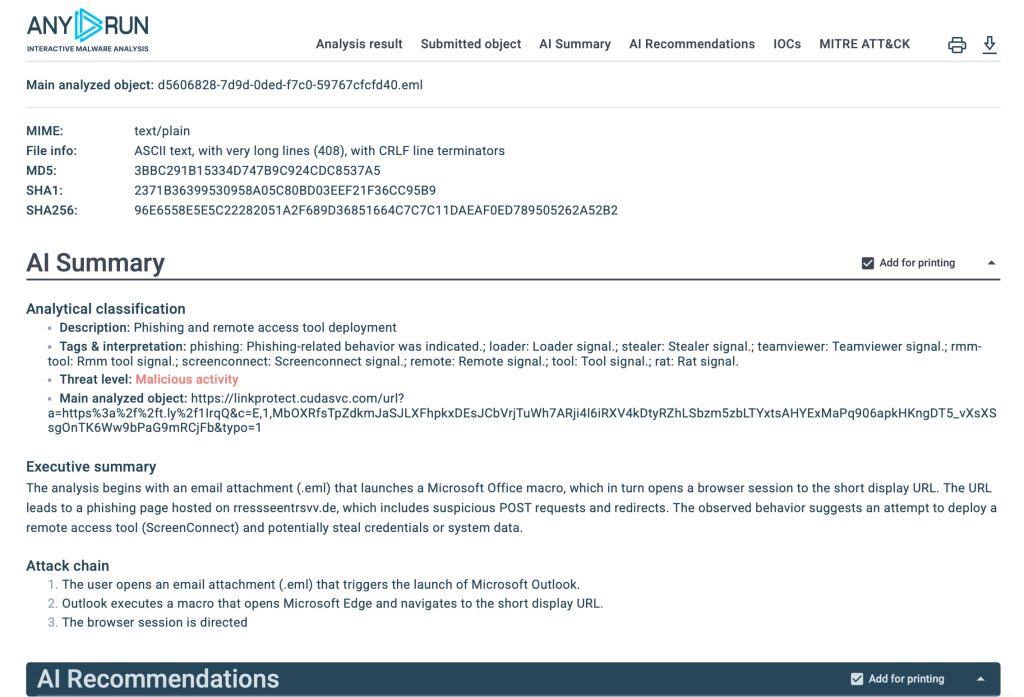
For CISOs and SOC managers, this creates several practical outcomes:
- More consistent escalation quality across the SOC
- Less context loss between Tier 1, Tier 2, and IR teams
- Better visibility into business exposure before the incident grows
- Faster prioritization when phishing may have led to remote access
- Clearer severity assessment without digging through raw telemetry
In cases like this, clarity matters. The faster the organization understands that a fake document flow has turned into a remote access deployment, the faster leaders can support containment, resource allocation, and internal communication.
Get Special ANY.RUN Offers Before May 31
To mark its 10th anniversary, ANY.RUN is offering special conditions for teams that want to strengthen phishing analysis, threat intelligence, and SOC workflows.
Until May 31, teams can access anniversary offers across key ANY.RUN solutions, including:
- Interactive Sandbox for deeper malware and phishing analysis, with bonus seats and exclusive pricing available for teams.
- Threat Intelligence solutions with extra months to support detection, investigation, and response with fresh threat context.
For SOCs, MSSPs, and enterprise security teams, this is a good moment to expand visibility into phishing-driven attacks, improve response readiness, and reduce the delay between detection and action.
Get a special offer now to help your SOC detect threats earlier, respond faster, and limit business exposure before it spreads.
Turn Trusted-Tool Abuse into Measurable SOC Impact
Phishing-to-remote-access attacks create risk because they delay certainty. When a fake document flow leads to installers, remote access software, and concealment tools, every extra minute can mean more investigation friction, slower escalation, and a longer window for business exposure.
ANY.RUN helps security teams close the gap between the first phishing signal and confident action. Teams can safely observe the full attack chain, confirm whether remote access behavior was triggered, enrich findings with threat context, and turn the investigation into clear evidence for response and leadership review.
Teams using ANY.RUN report:
- 21 minutes faster MTTR per case to reduce the time between detection and containment.
- 94% faster triage reported by users to cut uncertainty during suspicious file, URL, and phishing investigations.
- 30% fewer Tier 1 to Tier 2 escalations to protect senior team capacity.
- Up to 20% lower Tier 1 workload to reduce manual investigation effort.
- Up to 3x stronger SOC efficiency across validation, escalation, enrichment, and response workflows.
Close the blind spot between phishing detection and remote access exposure. Get bonus seats and special pricing to expand SOC visibility while the anniversary offer is available.