Remus Stealer’s operators are advertising a way to open a victim’s Gmail inbox directly from a stolen-device record. They claim access survives password changes and session revocation.
The evidence points to a mailbox-access workflow built into an infostealer service. It does not show a Gmail zero-day.
The version 1.3.9 announcement promotes email-code interception without collecting browser cookie files. It also advertises shareable mailbox links.
The feature is limited to the Enterprise tier, which the main sales thread lists at $1,000 per month.
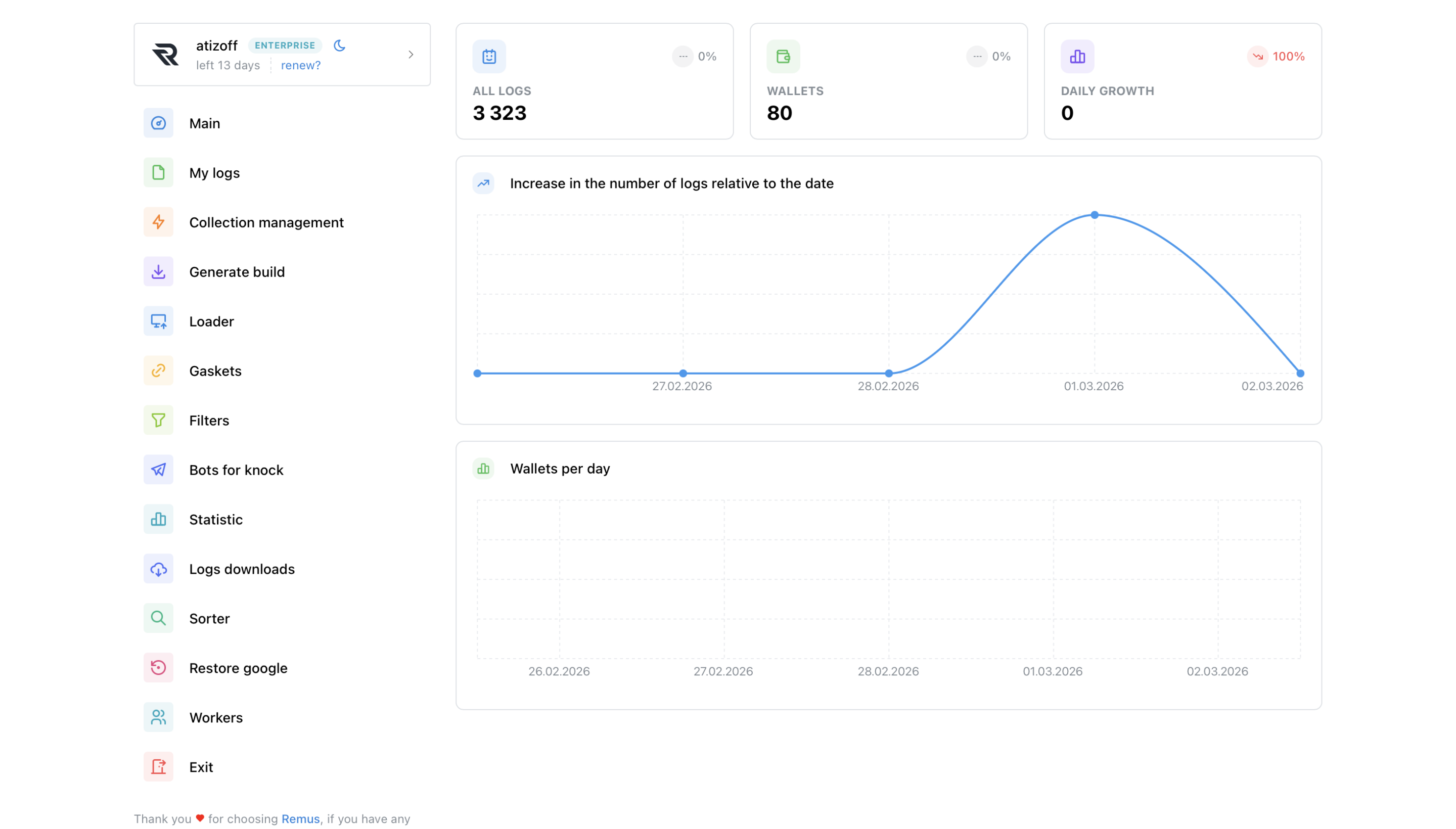
Screenshots show a webmail-style viewer with senders, subjects, timestamps, search, and individual messages. A Mail action sits beside each compromised-device record.
The panel therefore exposes general mailbox contents, not only one-time codes. Those contents can include recovery links and verification messages for cryptocurrency, YouTube, workplace and other sensitive accounts.
The developer told Hudson Rock the feature works through browser-memory interaction and that the software executes and exits.
The developer also claimed the service avoids Google’s anti-fraud checks, but gave no further technical detail.
A person who publicly vouched for the service said mail stayed visible after a session reset and browser closure. He said it also stayed visible after a Google password change.
He reported seeing codes from several services and messages dating from the initial “injection.” When asked whether Remus must rerun at startup, he leaned toward a single execution being enough, but he was tentative.
He supplied no account settings, timing or revocation records. He is also a commercially interested party.
If these accounts are accurate, Remus probably obtains reusable authorization while it has access to a signed-in browser.
A remote component could then request mail after the local executable exits, for as long as the service accepts that authorization.
This is an inference. The material identifies no specific cookie, token, API or injection method. Avoiding cookie files does not rule out cookies held in memory.
Hudson Rock examined that, the version 1.3.9 announcement and questioned the developer and a customer who vouched for the feature.
Secret Gmail Access
Access after the process exits is a different claim from access after full recovery. Google documents that a password change invalidates both access and refresh tokens for mail scopes.
The exceptions are Apps Script applications and OAuth-authenticated IMAP sessions. Those IMAP sessions last only as long as the access token, usually about one hour.
Google also lists exceptions to being signed out everywhere after a password change. Nothing shows Remus uses any of these paths.
Other explanations remain open. These include an additional account-access or mail-routing path, incomplete revocation, a component still running on the endpoint, or a panel showing mail collected earlier.
No controlled test shows a message delivered after password, session and application-access revocation appearing in Remus.
A valid test would use an authorized mailbox and an instrumented endpoint, with recovery performed from a separate clean device.
It would then need to show that a newly delivered message appeared in the panel. The reporting contains no malware analysis or network telemetry that identifies the method.
Hudson Rock therefore does not classify the feature as a demonstrated Gmail zero-day.
Stolen authentication material enabling later access is an established threat, as Google’s discussion of session theft explains. What is notable here is the packaging.
Remus bundles mailbox reading and sharing into a commercial stealer panel and makes a strong claim about surviving recovery.
Earlier SpyCloud analysis covered Remus’s broader credential and browser-data theft. That work predates this announcement.
If continued retrieval of fresh mail is confirmed, operators could collect new recovery links and verification codes after the initial infection.
That could support further account takeovers, depending on each service’s controls. The screenshots do not show a universal MFA bypass, the ability to send mail, or control of every connected account.
Treat any infected device as fully compromised. Clean the endpoint first, then change passwords from a clean device.
Sign out of all sessions and review third-party app access, forwarding rules, filters and recovery settings. Turn on passkeys or hardware security keys, and rotate credentials for accounts whose recovery emails reached the mailbox.
Stops Cyber threats before impact with 21 min faster MTTR. Integrate ANYRUN’s Sandbox in your SOC.