A new variant of the Cling botnet has infected about 5,600 devices. It hides its command-and-control (C&C) traffic inside ordinary STUN exchanges, which makes it hard to spot.
China’s CNCERT reported the spread in November 2026. The botnet mainly targets Linux servers and IoT devices.
STUN helps devices behind a NAT discover their public address and port. Every STUN message header carries a 96-bit Transaction ID. RFC 8489 says this value is randomly selected.
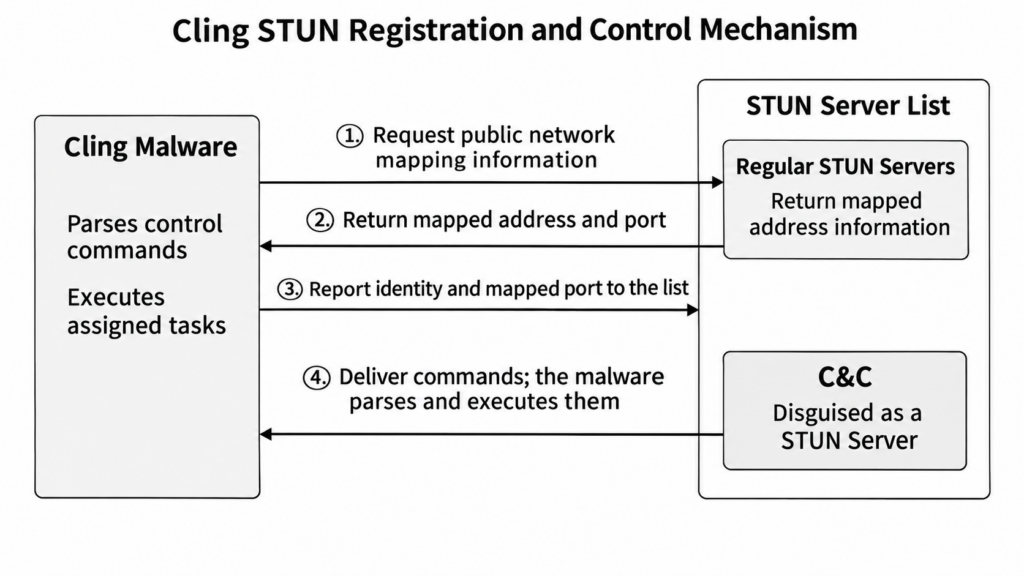
The malware holds 13 ChaCha20-encrypted server addresses. Twelve belong to public STUN servers, and one belongs to the attacker.
It sends standard Binding Requests to all 13 to learn its NAT-mapped port. It then sends custom registration messages carrying the mapped port and an infection tag.
Legitimate servers discard these malformed packets, but the rogue server records them.
The C&C server then sends commands to the mapped port. The first 2 bytes of the Transaction ID act as a marker, and the remaining 10 bytes hold encrypted task parameters.
The server also spoofs its source address as a Google STUN server. Defenders therefore see traffic that looks like it comes from a well-known service.
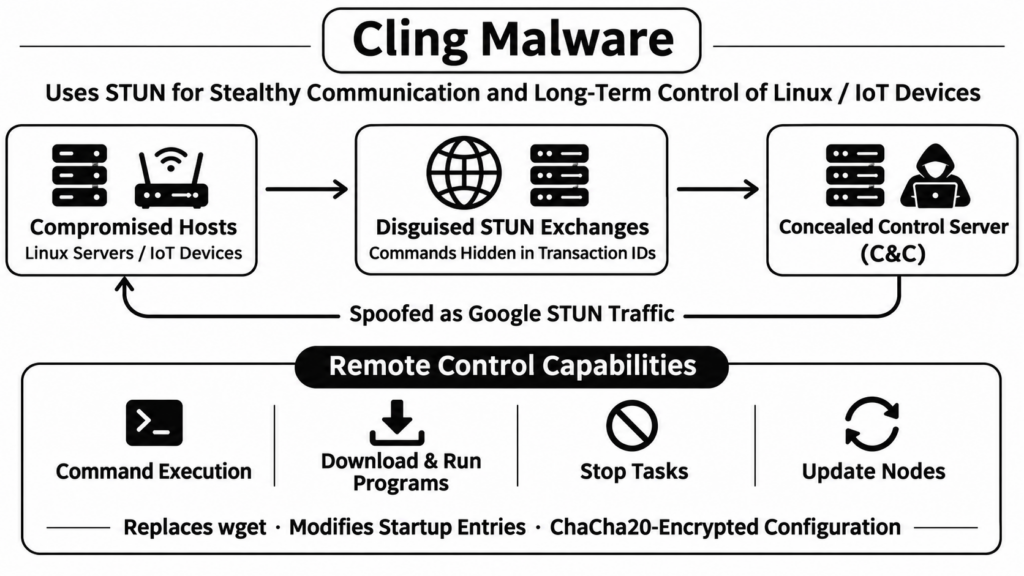
This variant is leaner than earlier ones. The authors removed the vulnerability-propagation, proxy, and DDoS modules.
What remains is command execution and program download-and-execute, plus task termination and node updates. Together these suit a loader that keeps long-term access and delivers other malware.
CNCERT observed the botnet, from November 9 to November 20, 2026. Daily active bots peaked at 2,730, and the cumulative infection count reached 5,600 devices. The figures cover mainland China.
Stealthy Malware Campaign
The authors also fixed a flaw in earlier builds, where the real C&C server returned Transaction IDs that differed from those of genuine STUN servers. Sample configurations are now ChaCha20-encrypted, and the C&C moved to a new IP address.
The malware replaces the wget utility and appends startup entries to /etc/inittab, /etc/init.d/rcS and /etc/rc.d/rc.boot. It listens on port 58346 so only one instance runs, a technique common in Mirai-style families.
It also writes -1000 to /proc/self/oom_score_adj, which makes it less likely to be killed when memory runs low.
Spread relies mainly on one CVE, which CNCERT’s text gives as CVE-2021-3539 4. That looks like a typo, so verify the identifier before relying on it.
Earlier versions exploited flaws including CVE-2016-10372 (Eir D1000), CVE-2023-41011 (FiberHome), CVE-2014-8361 (Realtek SDK), CVE-2023-26801 (LB-LINK), CVE-2024-3721 (TBK DVR), CVE-2025-34037 (Linksys) and CVE-2016-20016 (MVPower DVR).
This variant follows earlier reporting. In October, Nozomi Networks documented Cling. It found the malware contacting 13 hardcoded STUN servers about every five seconds, using all-zero Transaction IDs in its Binding Requests.
Attackers delivered it through attempts to exploit the Realtek Jungle SDK flaw. Nozomi traced command packets to 74.125.250[.]129, an address that stun.l.google.com resolves to.
Fortinet tracks the family as ClingSTUN, a backconnect proxy backdoor that turns infected systems into remotely controlled proxy nodes.
CNCERT advises inspecting periodic registration traffic sent to several STUN nodes over UDP port 3478. It also advises looking for Transaction IDs that are non-random and follow a fixed structure.
The earlier Nozomi research adds frequent STUN requests with all-zero Transaction IDs and non-STUN UDP messages sent to STUN endpoints. The one C&C IP CNCERT lists is 209.99.188[.]119.
Administrators should patch or retire exposed routers and DVRs. They should also restrict outbound UDP from embedded devices to approved destinations.
Finally, they should audit init scripts for unexpected entries and watch for modified system utilities.
Cling’s authors have moved away from noisy DDoS activity. They now prioritize stealth and persistent access, so infected hosts can later carry payloads from other threat actors.
Networks with exposed IoT gear should treat even routine-looking STUN traffic as worth checking.
Indicators of Compromise
| # | Type | Indicator (defanged) | Notes |
|---|---|---|---|
| 1 | MD5 | 84ced85e53bc326f8b11115ae4bc24a7 | Sample hash |
| 2 | MD5 | 65d94c9dddea41ef4690f193fbc54ec3 | Sample hash |
| 3 | MD5 | 92533318fb6f0365eefd25090e7df146 | Sample hash |
| 4 | Download URL | hxxp[:]//202.110.70.60:800/alya.x86 | x86 payload |
| 5 | Download URL | hxxp[:]//202.110.70.60:800/alya.mipsel | MIPS little-endian payload |
| 6 | Download URL | hxxp[:]//202.110.70.60:800/alya.arc | ARC architecture payload |
Note: IP addresses and domains are intentionally defanged (e.g., [.]) to prevent accidental resolution or hyperlinking. Re-fang only within controlled threat intelligence platforms such as MISP, VirusTotal, or your SIEM.
Stops Cyber threats before impact with 21 min faster MTTR. Integrate ANYRUN’s Sandbox in your SOC.