Over the past year, the Huntress API has grown from six read-only endpoints into a full integration and automation platform, along with Webhooks and an MCP server. For partners, that means Huntress data can show up wherever they already work, not just in our portal. It also means software vendors can build their own Huntress integrations on their own schedule, without having to wait on us.
Nine Minds is a great example. Their team built a Huntress integration for AlgaPSA, their professional services automation (PSA) platform, using our public API documentation. No technical support or special access needed. They just read the docs and, a few days later, had a working integration. This post covers what they built, what the experience was like, and what it shows about how you can use the Huntress API.
Meet Nine Minds and AlgaPSA
Nine Minds was founded by Robert Isaacs and Arnie Bellini, who both spent over a decade at ConnectWise. AlgaPSA is their answer to a problem they saw in the industry for years: PSA tools that are too expensive, too complicated, and primarily built for mature organizations.
AlgaPSA brings ticketing, projects, time tracking, billing, and client operations into one platform, and it was designed with the smallest MSPs in mind. As Robert told ChannelE2E, “The small MSP doesn’t want to sign a three-year contract.” But as they’ve progressed, larger MSPs have started taking notice, too.
AlgaPSA gives MSPs control over how they run the software with hosted, self-hosted, and open-source options. Over a hundred MSPs now rely on AlgaPSA for day-to-day operations, with more signing up every week.
Why Build a Huntress Integration?
For Nine Minds, the decision came down to two things. Mutual customers were asking for it, and their team spends a lot of time in the MSP community, including at IT Nation, and Huntress is one of the names they see everywhere.
When your users already rely on Huntress to catch threats, the next question is simple: how do those incidents get to the technicians who need to act on them? The AlgaPSA <> Huntress integration provides an answer.
How the Integration Works
The integration is built around the premise that a security incident should never go without a ticket. When the Huntress SOC publishes an incident report, it appears in AlgaPSA as a ticket on a dedicated security board, with the incident summary and a priority based on its severity.
Technicians work it like any other ticket, and the time they log flows into AlgaPSA’s billing and invoicing. That means security responses get tracked and billed like the rest of their work, instead of living in a separate console. When the SOC closes the incident, the ticket can close automatically, too. And if an incident comes from a client that hasn’t been mapped yet, it still lands on a triage board, so nothing slips through.
Setup takes a few steps:
Connect your Huntress API credentials
Map Huntress organizations to AlgaPSA clients
Choose where tickets land and how severities translate to priorities.
Nine Minds walks through each step in the AlgaPSA Huntress integration docs.
A few things to know before you start:
Use a dedicated API key. Huntress API keys are tied to a user and mirror that user’s permissions, so it’s a good idea to create a separate key just for this integration.
You need AlgaPSA’s paid tier. The Huntress integration is part of AlgaPSA’s Enterprise Edition (also offered as AlgaPSA Pro). It isn’t included in the open-source Community Edition.
Finish routing first. AlgaPSA won’t start pulling incidents until the security board, the fallback client and board, and priorities for all three Huntress severities (Critical, High, and Low) are set.
Expect tickets on a schedule, not instantly. AlgaPSA checks Huntress for new incident reports at an interval you choose between one and 60 minutes, so tickets show up at the next check.
What Was It Like to Build on the Huntress API?
This is the part we’re most excited about. Nine Minds went from idea to a shipped integration in just a few days.
They built it using our public documentation, without reaching out to us first. After a short period working out which data they needed, Robert said things went smoothly: no confusing fields, no missing endpoints, no documentation gaps that slowed them down. Their team also uses AI coding tools, and pointing those tools at the Huntress API docs was enough to get the job done.
“Integrating Huntress into AlgaPSA was easy enough that we almost felt as if we had missed something… [Then] our customers started thanking us for the integration. Working with Huntress could not have been easier.”
– Robert Isaacs
Founder / CEO, Nine Minds
Nine Minds also built a Huntress emulator so they could test the integration without depending on live incidents. They told us a dedicated sandbox environment would make that easier, and we’ve shared that feedback with our team.
What Else Can You Build?
AlgaPSA’s integration shows one common pattern: pull incidents from Huntress and turn them into tickets. But the API supports a lot more.
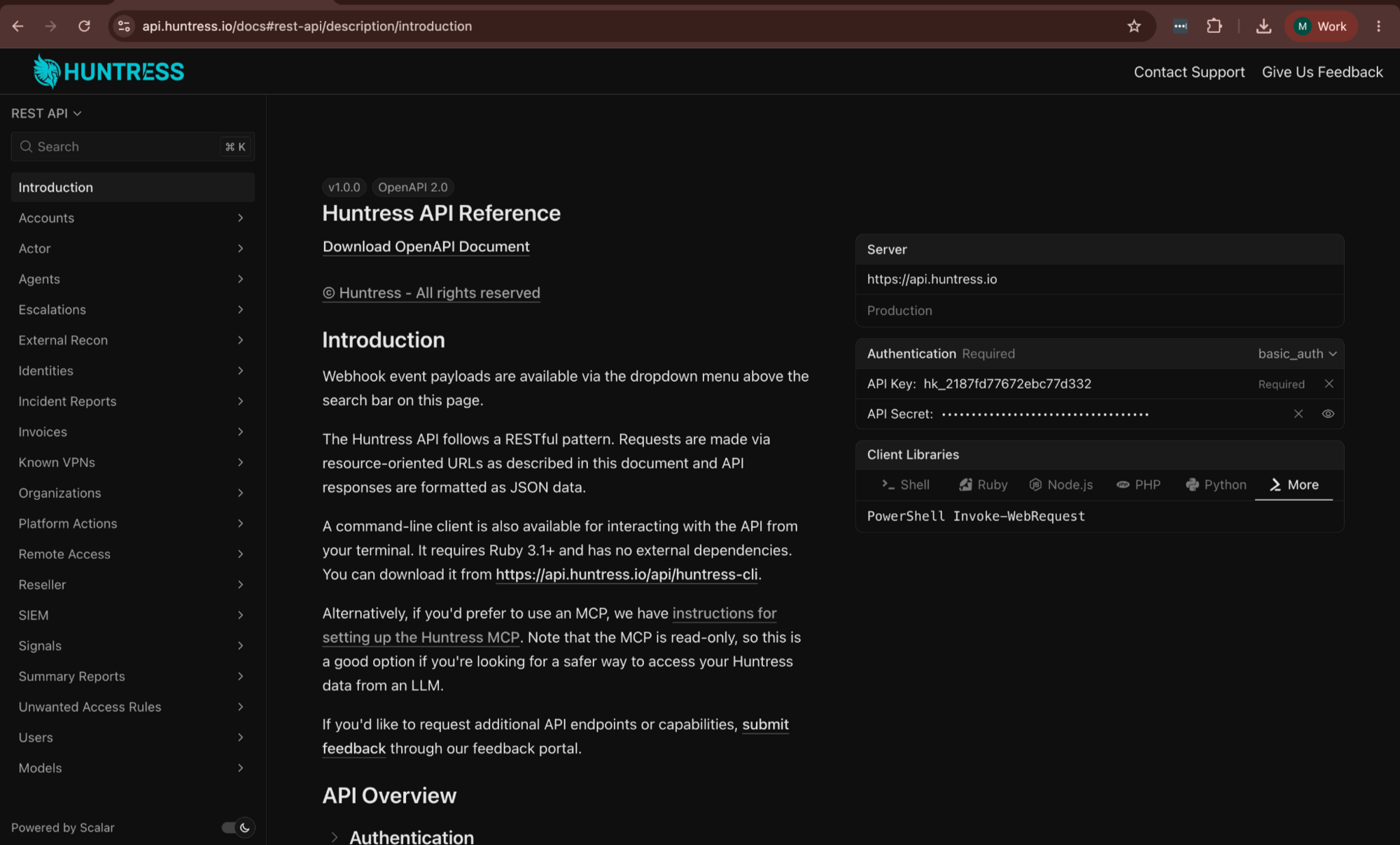
A few examples:
Get incidents in real time. Instead of polling, Huntress Webhooks push incidents and escalations to your PSA, Slack, or SIEM as they happen.
Act on incidents. Approve or reject remediations through the Incident Report response API, and isolate or release hosts through the Agents API.
Automate onboarding. Create, update, and delete organizations programmatically. For example, when a new client is added in your RMM, automation can create the matching Huntress organization and start EDR deployment.
Reconcile billing and build reports. Pull billing reports and per-product organization stats, like agent counts, SIEM storage, and ITDR identity counts, into your dashboards, QBRs, or PSA contracts.
Bring Huntress into AI workflows. The Huntress MCP server connects your AI assistant to your incidents, agents, billing data, and more.
Prefer to see how this works? Watch our video below to see inside the Huntress API, Webooks, and MCP server:
Ready to Learn More?
AlgaPSA’s integration started with a customer request and ended with a shipped feature just a few days later. That’s the kind of experience we want every developer to have with the Huntress API. If you’ve been thinking about connecting Huntress to your own tools, the docs are a good place to start.