The security tools SecOps teams rely on have gotten exceptionally good at detecting infrastructure-level events: subprocess spawns, outbound network connections, and system calls. However, what has historically been missing is visibility into the application layer sitting directly above those events: which specific function executed the call, how code execution reached that point, and whether the observed runtime behavior represents expected application logic or an active exploit in progress.
This visibility gap is becoming increasingly critical to address. AI-assisted attacks have dramatically compressed the time from vulnerability disclosure to active exploitation–meaning attackers routinely reach execution faster than engineering teams can patch. At the same time, modern threats like compromised dependencies and prompt-injected AI agents execute entirely inside legitimate application processes without a CVE at all. When every minute counts, deep application context lets SecOps teams immediately separate real attacks from benign app behavior, pinpoint how execution happened, and respond without delay.
Today, we are excited to announce Wiz ADR (Application Detection and Response). Built directly into the Wiz Runtime Sensor, Wiz ADR brings application-layer visibility into threat detection–pairing application call stacks with OS and process telemetry, with no extra agents or code changes required. Rather than only alerting on suspicious events at the system layer, Wiz ADR reveals the exact functions that triggered them–helping SecOps cut false positives by seeing the application’s true intent, and simplifying the handoff to engineering by pinpointing the exact line of code to fix.
Wiz ADR: Turning Runtime Alerts into Clear Intent and Fast Fixes
Whenever a runtime detection fires across your workloads, the Wiz Runtime Sensor doesn’t stop at the OS process–it reaches into the application layer to capture what your code was doing at the exact moment the event occurred.
Wiz ADR reconstructs the application call stack both inside the process that triggered the alert and across parent-to-child spawns–so even when a web service launches a child shell command, analysts see the exact application function that kicked it off. Along the way, it flags meaningful execution patterns with application context tags (such as Request Handler, Dynamic Code Execution, or Unsafe Deserialization), translating raw function calls into plain-English security signals so SecOps can spot the root cause immediately, even without knowing the underlying codebase. When those context tags appear on a runtime event, the Sensor also uses them directly to trigger high-fidelity application detections and elevate the severity of existing alerts.
Paired with the broader Wiz Platform, that application context turns ambiguous alerts into confirmed verdicts and code-level fixes across two everyday scenarios.
Confirming a Real Exploit with Wiz Blue Agent
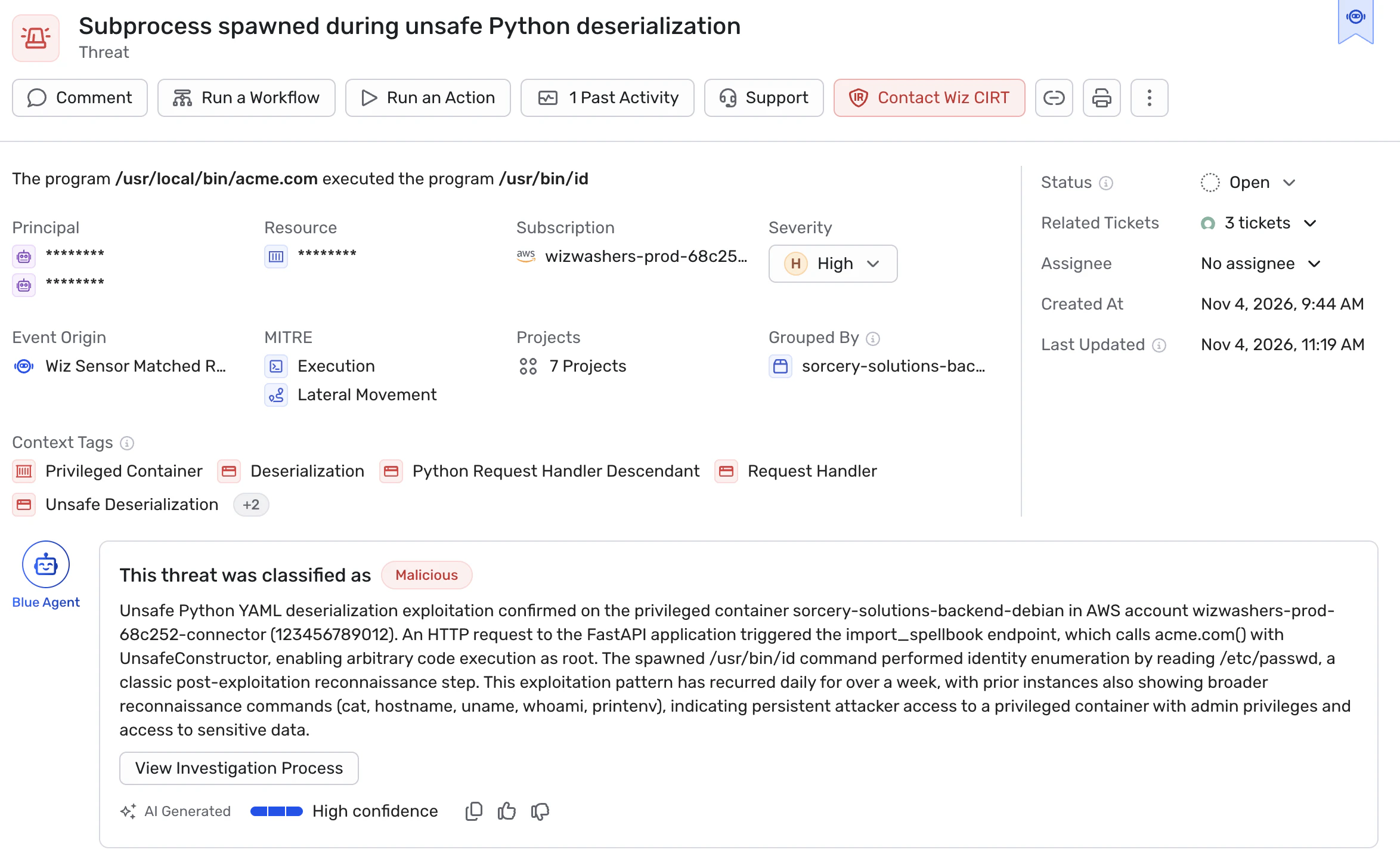
Consider a containerized Python FastAPI service that unexpectedly spawns /usr/bin/id as root. On its own, /user/bin/id is too common across Linux workloads for standard OS-level rules to alert on without flooding the SOC–meaning early post-exploitation reconnaissance routinely slips by unnoticed.
With Wiz ADR, the Sensor sees where execution started. It reconstructs the call stack across the process spawn–tracing /user/bin/id back to the import_spellbook HTTP endpoint and into PyYAML’s UnsafeConstructor, attaches context tags like Request Handler, Python Request Handler Descendant, and Unsafe Deserialization, and fires a High-severity alert immediately.
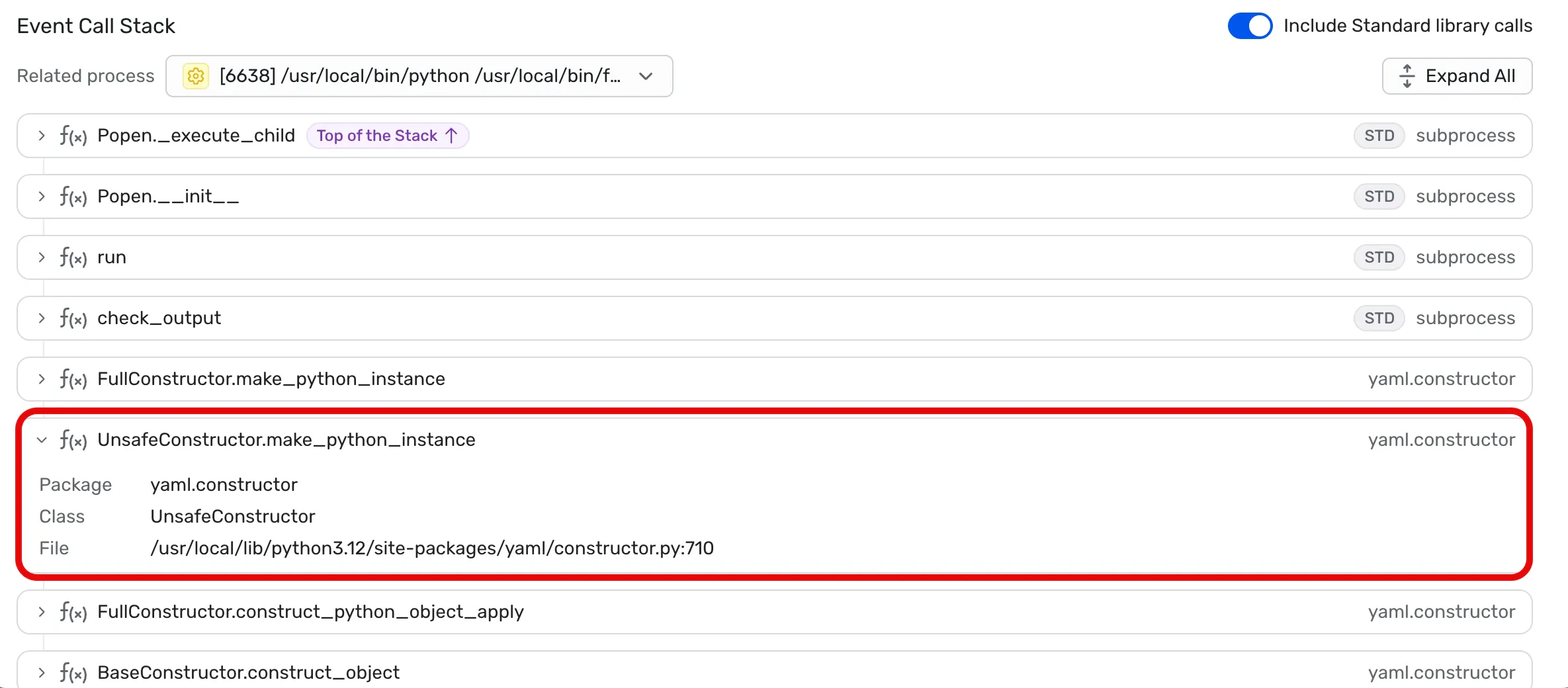
Bringing that stack-trace analysis together with process ancestry and cloud risk gives the Wiz Blue Agent the context to classify the alert as Malicious with high confidence, connecting the application context to root execution inside a privileged production container and pointing teams directly to the import_spellbook endpoint. From there, Wiz Workflows can notify the right teams with full context and trigger response actions to contain the threat immediately.
Eliminating False Positives and Tracing Threats Straight to Code
Now consider the flip side: internal services whose legitimate code triggers scary OS alerts. When repohygiene–a containerized Go service on CI runners–runs find /data -name .git-credentials -type f during post-build audits, OS-level rules flag it as potential credential harvesting.
Pairing Wiz ADR with Wiz Code unlocks Threat to Code correlation, tracing the Go call stack (Scanner.findGitCredentials) straight back to the exact repository, file (scanner.go, line 55) and code owner in GitHub, surfacing the developer’s own code and comments right inside the alert inside of handing engineering a bare container ID and PID.

And with Blue Agent, no human has to triage it manually. Wiz Blue Agent synthesizes the stack trace, clean process ancestry (systemd -> containerd -> runc -> repohygine -> find), and sensor forensics to confirm the activity matches intended application logic, automatically classifying the alert as Not Malicious and deprioritizing it before it burns SecOps hours.
Start Defending Your Environment with Application Context
Wiz ADR is available now through the Wiz Runtime Sensor–giving SecOps and Engineering teams deep application context on runtime detections with no code changes or extra agents required.
Existing Wiz customers can learn more about Wiz ADR in our documentation, and if you are not a customer and want to see it in action please request a demo.